

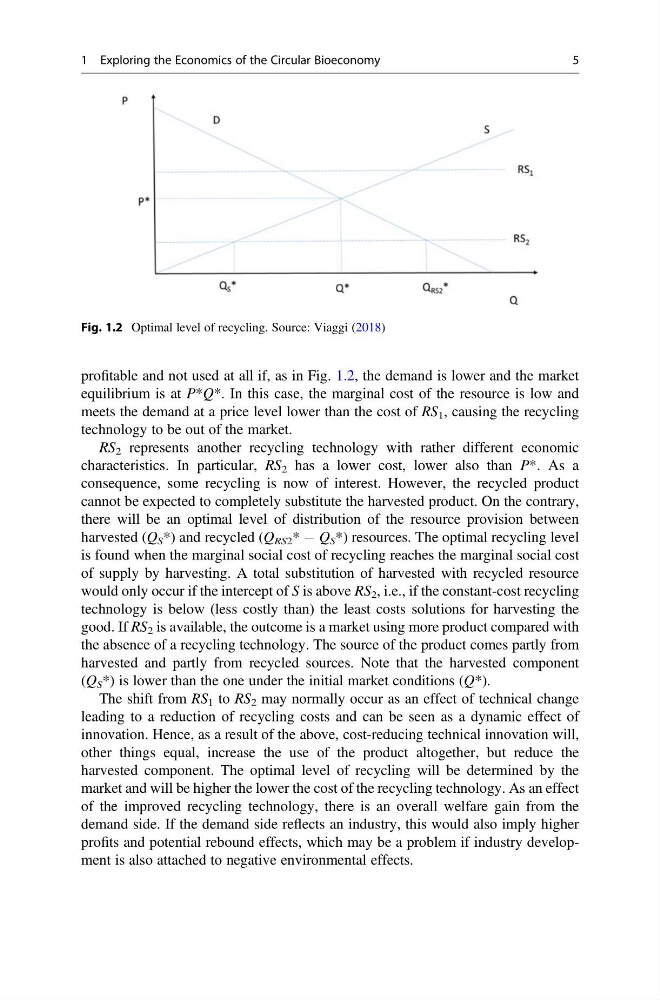
profitable and not used at all if, as in Fig. 1.2, the demand is lower and the market
equilibrium is at P*Q*. In this case, the marginal cost of the resource is low and
meets the demand at a price level lower than the cost of RS 1 , causing the recycling
technology to be out of the market.
RS 2 represents another recycling technology with rather different economic
characteristics. In particular, RS 2 has a lower cost, lower also than P*. As a
consequence, some recycling is now of interest. However, the recycled product
cannot be expected to completely substitute the harvested product. On the contrary,
there will be an optimal level of distribution of the resource provision between
harvested (Q S *) and recycled (Q RS2 * À Q S *) resources. The optimal recycling level
is found when the marginal social cost of recycling reaches the marginal social cost
of supply by harvesting. A total substitution of harvested with recycled resource
would only occur if the intercept of S is above RS 2 , i.e., if the constant-cost recycling
technology is below (less costly than) the least costs solutions for harvesting the
good. If RS 2 is available, the outcome is a market using more product compared with
the absence of a recycling technology. The source of the product comes partly from
harvested and partly from recycled sources. Note that the harvested component
(Q S *) is lower than the one under the initial market conditions (Q*).
The shift from RS 1 to RS 2 may normally occur as an effect of technical change
leading to a reduction of recycling costs and can be seen as a dynamic effect of
innovation. Hence, as a result of the above, cost-reducing technical innovation will,
other things equal, increase the use of the product altogether, but reduce the
harvested component. The optimal level of recycling will be determined by the
market and will be higher the lower the cost of the recycling technology. As an effect
of the improved recycling technology, there is an overall welfare gain from the
demand side. If the demand side reflects an industry, this would also imply higher
profits and potential rebound effects, which may be a problem if industry development is also attached to negative environmental effects.
Fig. 1.2 Optimal level of recycling. Source: Viaggi (2018)
1 Exploring the Economics of the Circular Bioeconomy
5
equilibrium is at P*Q*. In this case, the marginal cost of the resource is low and
meets the demand at a price level lower than the cost of RS 1 , causing the recycling
technology to be out of the market.
RS 2 represents another recycling technology with rather different economic
characteristics. In particular, RS 2 has a lower cost, lower also than P*. As a
consequence, some recycling is now of interest. However, the recycled product
cannot be expected to completely substitute the harvested product. On the contrary,
there will be an optimal level of distribution of the resource provision between
harvested (Q S *) and recycled (Q RS2 * À Q S *) resources. The optimal recycling level
is found when the marginal social cost of recycling reaches the marginal social cost
of supply by harvesting. A total substitution of harvested with recycled resource
would only occur if the intercept of S is above RS 2 , i.e., if the constant-cost recycling
technology is below (less costly than) the least costs solutions for harvesting the
good. If RS 2 is available, the outcome is a market using more product compared with
the absence of a recycling technology. The source of the product comes partly from
harvested and partly from recycled sources. Note that the harvested component
(Q S *) is lower than the one under the initial market conditions (Q*).
The shift from RS 1 to RS 2 may normally occur as an effect of technical change
leading to a reduction of recycling costs and can be seen as a dynamic effect of
innovation. Hence, as a result of the above, cost-reducing technical innovation will,
other things equal, increase the use of the product altogether, but reduce the
harvested component. The optimal level of recycling will be determined by the
market and will be higher the lower the cost of the recycling technology. As an effect
of the improved recycling technology, there is an overall welfare gain from the
demand side. If the demand side reflects an industry, this would also imply higher
profits and potential rebound effects, which may be a problem if industry development is also attached to negative environmental effects.
Fig. 1.2 Optimal level of recycling. Source: Viaggi (2018)
1 Exploring the Economics of the Circular Bioeconomy
5