

holding capacity of soil. Composting also has several limitations such as release of
odour, NH 3 , GHG, and leachate. While AD works well for biomass, waste water,
sludge, industrial by-products, food waste to methane has several shortcomings. Due
to high nutrient load in food waste, the methane yield gets reduced. Further,
increased production of free fatty acids which are volatile in nature results in
formation of foams. In some countries the digestate can be of excellent fertilizer to
soil; however, it increases the nutrient content in soil. Hence, the demand for
sustainable methods of valorization of food wastes are increasing from the past
decade (Mirabella et al. 2014).
5.2.2.2 Fuels from Food Wastes
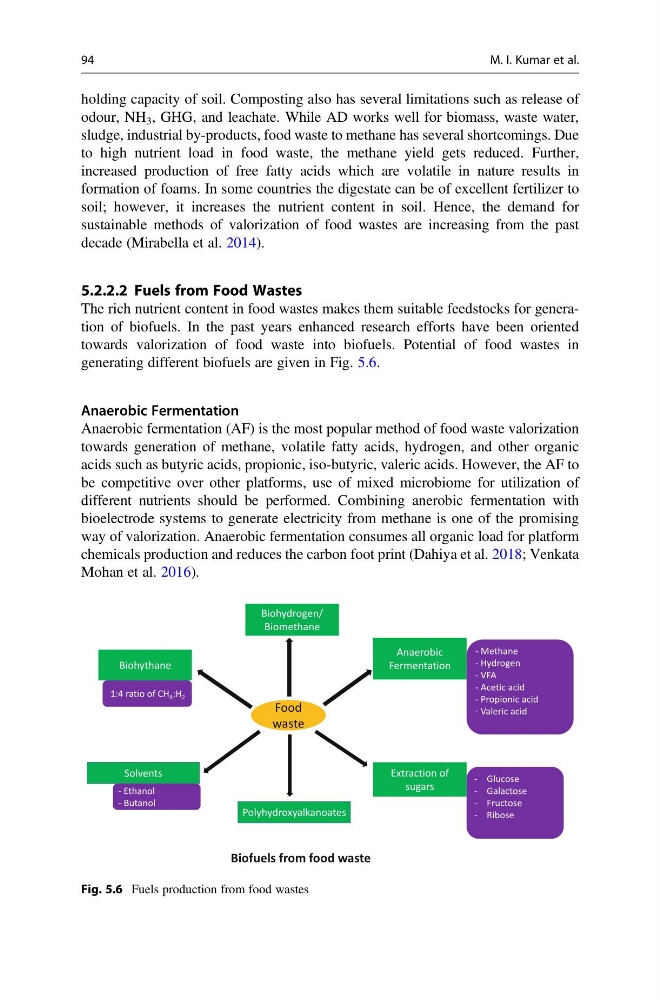
The rich nutrient content in food wastes makes them suitable feedstocks for generation of biofuels. In the past years enhanced research efforts have been oriented
towards valorization of food waste into biofuels. Potential of food wastes in
generating different biofuels are given in Fig. 5.6.
Anaerobic Fermentation
Anaerobic fermentation (AF) is the most popular method of food waste valorization
towards generation of methane, volatile fatty acids, hydrogen, and other organic
acids such as butyric acids, propionic, iso-butyric, valeric acids. However, the AF to
be competitive over other platforms, use of mixed microbiome for utilization of
different nutrients should be performed. Combining anerobic fermentation with
bioelectrode systems to generate electricity from methane is one of the promising
way of valorization. Anaerobic fermentation consumes all organic load for platform
chemicals production and reduces the carbon foot print (Dahiya et al. 2018; Venkata
Mohan et al. 2016).
Food
waste
Biohythane
1:4 ratio of CH 4 :H 2
Biohydrogen/
Biomethane
Anaerobic
Fermentation
- Methane
- Hydrogen
- VFA
- Acetic acid
- Propionic acid
- Valeric acid
Extraction of
sugars
- Glucose
- Galactose
- Fructose
- Ribose
Biofuels from food waste
Polyhydroxyalkanoates
Solvents
- Ethanol
- Butanol
Fig. 5.6 Fuels production from food wastes
94
M. I. Kumar et al.
odour, NH 3 , GHG, and leachate. While AD works well for biomass, waste water,
sludge, industrial by-products, food waste to methane has several shortcomings. Due
to high nutrient load in food waste, the methane yield gets reduced. Further,
increased production of free fatty acids which are volatile in nature results in
formation of foams. In some countries the digestate can be of excellent fertilizer to
soil; however, it increases the nutrient content in soil. Hence, the demand for
sustainable methods of valorization of food wastes are increasing from the past
decade (Mirabella et al. 2014).
5.2.2.2 Fuels from Food Wastes
The rich nutrient content in food wastes makes them suitable feedstocks for generation of biofuels. In the past years enhanced research efforts have been oriented
towards valorization of food waste into biofuels. Potential of food wastes in
generating different biofuels are given in Fig. 5.6.
Anaerobic Fermentation
Anaerobic fermentation (AF) is the most popular method of food waste valorization
towards generation of methane, volatile fatty acids, hydrogen, and other organic
acids such as butyric acids, propionic, iso-butyric, valeric acids. However, the AF to
be competitive over other platforms, use of mixed microbiome for utilization of
different nutrients should be performed. Combining anerobic fermentation with
bioelectrode systems to generate electricity from methane is one of the promising
way of valorization. Anaerobic fermentation consumes all organic load for platform
chemicals production and reduces the carbon foot print (Dahiya et al. 2018; Venkata
Mohan et al. 2016).
Food
waste
Biohythane
1:4 ratio of CH 4 :H 2
Biohydrogen/
Biomethane
Anaerobic
Fermentation
- Methane
- Hydrogen
- VFA
- Acetic acid
- Propionic acid
- Valeric acid
Extraction of
sugars
- Glucose
- Galactose
- Fructose
- Ribose
Biofuels from food waste
Polyhydroxyalkanoates
Solvents
- Ethanol
- Butanol
Fig. 5.6 Fuels production from food wastes
94
M. I. Kumar et al.