

(Rosales-Calderon and Arantes 2019; Shahbazali 2013; Singhvi and Gokhale 2019)
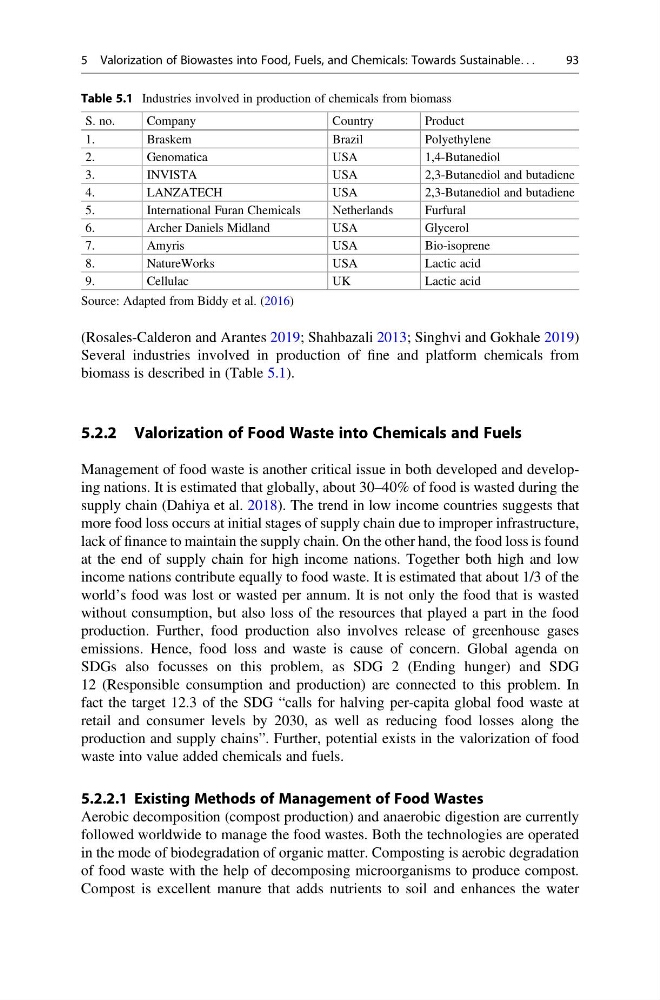
Several industries involved in production of fine and platform chemicals from
biomass is described in (Table 5.1).
5.2.2 Valorization of Food Waste into Chemicals and Fuels
Management of food waste is another critical issue in both developed and developing nations. It is estimated that globally, about 30–40% of food is wasted during the
supply chain (Dahiya et al. 2018). The trend in low income countries suggests that
more food loss occurs at initial stages of supply chain due to improper infrastructure,
lack of finance to maintain the supply chain. On the other hand, the food loss is found
at the end of supply chain for high income nations. Together both high and low
income nations contribute equally to food waste. It is estimated that about 1/3 of the
world’s food was lost or wasted per annum. It is not only the food that is wasted
without consumption, but also loss of the resources that played a part in the food
production. Further, food production also involves release of greenhouse gases
emissions. Hence, food loss and waste is cause of concern. Global agenda on
SDGs also focusses on this problem, as SDG 2 (Ending hunger) and SDG
12 (Responsible consumption and production) are connected to this problem. In
fact the target 12.3 of the SDG “calls for halving per-capita global food waste at
retail and consumer levels by 2030, as well as reducing food losses along the
production and supply chains”. Further, potential exists in the valorization of food
waste into value added chemicals and fuels.
5.2.2.1 Existing Methods of Management of Food Wastes
Aerobic decomposition (compost production) and anaerobic digestion are currently
followed worldwide to manage the food wastes. Both the technologies are operated
in the mode of biodegradation of organic matter. Composting is aerobic degradation
of food waste with the help of decomposing microorganisms to produce compost.
Compost is excellent manure that adds nutrients to soil and enhances the water
Table 5.1 Industries involved in production of chemicals from biomass
S. no.
Company
Country
Product
1.
Braskem
Brazil
Polyethylene
2.
Genomatica
USA
1,4-Butanediol
3.
INVISTA
USA
2,3-Butanediol and butadiene
4.
LANZATECH
USA
2,3-Butanediol and butadiene
5.
International Furan Chemicals
Netherlands
Furfural
6.
Archer Daniels Midland
USA
Glycerol
7.
Amyris
USA
Bio-isoprene
8.
NatureWorks
USA
Lactic acid
9.
Cellulac
UK
Lactic acid
Source: Adapted from Biddy et al. (2016)
5 Valorization of Biowastes into Food, Fuels, and Chemicals: Towards Sustainable. . .
93
Several industries involved in production of fine and platform chemicals from
biomass is described in (Table 5.1).
5.2.2 Valorization of Food Waste into Chemicals and Fuels
Management of food waste is another critical issue in both developed and developing nations. It is estimated that globally, about 30–40% of food is wasted during the
supply chain (Dahiya et al. 2018). The trend in low income countries suggests that
more food loss occurs at initial stages of supply chain due to improper infrastructure,
lack of finance to maintain the supply chain. On the other hand, the food loss is found
at the end of supply chain for high income nations. Together both high and low
income nations contribute equally to food waste. It is estimated that about 1/3 of the
world’s food was lost or wasted per annum. It is not only the food that is wasted
without consumption, but also loss of the resources that played a part in the food
production. Further, food production also involves release of greenhouse gases
emissions. Hence, food loss and waste is cause of concern. Global agenda on
SDGs also focusses on this problem, as SDG 2 (Ending hunger) and SDG
12 (Responsible consumption and production) are connected to this problem. In
fact the target 12.3 of the SDG “calls for halving per-capita global food waste at
retail and consumer levels by 2030, as well as reducing food losses along the
production and supply chains”. Further, potential exists in the valorization of food
waste into value added chemicals and fuels.
5.2.2.1 Existing Methods of Management of Food Wastes
Aerobic decomposition (compost production) and anaerobic digestion are currently
followed worldwide to manage the food wastes. Both the technologies are operated
in the mode of biodegradation of organic matter. Composting is aerobic degradation
of food waste with the help of decomposing microorganisms to produce compost.
Compost is excellent manure that adds nutrients to soil and enhances the water
Table 5.1 Industries involved in production of chemicals from biomass
S. no.
Company
Country
Product
1.
Braskem
Brazil
Polyethylene
2.
Genomatica
USA
1,4-Butanediol
3.
INVISTA
USA
2,3-Butanediol and butadiene
4.
LANZATECH
USA
2,3-Butanediol and butadiene
5.
International Furan Chemicals
Netherlands
Furfural
6.
Archer Daniels Midland
USA
Glycerol
7.
Amyris
USA
Bio-isoprene
8.
NatureWorks
USA
Lactic acid
9.
Cellulac
UK
Lactic acid
Source: Adapted from Biddy et al. (2016)
5 Valorization of Biowastes into Food, Fuels, and Chemicals: Towards Sustainable. . .
93