

192
J. L. Braga and M. Dionísio
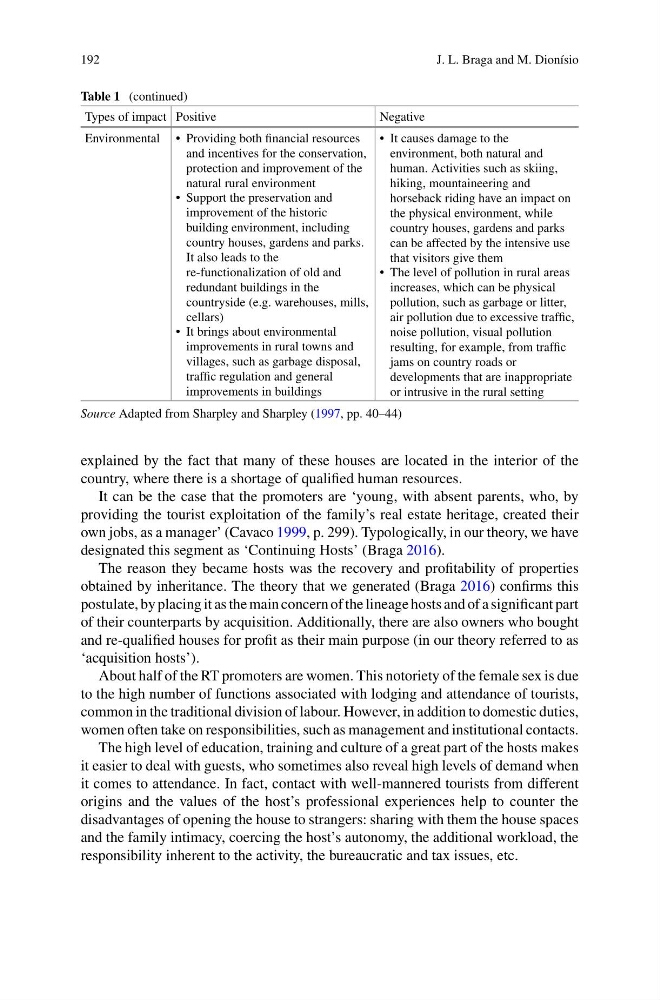
Table 1 (continued)
Types of impact Positive
Negative
Environmental • Providing both financial resources
and incentives for the conservation,
protection and improvement of the
natural rural environment
• Support the preservation and
improvement of the historic
building environment, including
country houses, gardens and parks.
It also leads to the
re-functionalization of old and
redundant buildings in the
countryside (e.g. warehouses, mills,
cellars)
• It brings about environmental
improvements in rural towns and
villages, such as garbage disposal,
traffic regulation and general
improvements in buildings
• It causes damage to the
environment, both natural and
human. Activities such as skiing,
hiking, mountaineering and
horseback riding have an impact on
the physical environment, while
country houses, gardens and parks
can be affected by the intensive use
that visitors give them
• The level of pollution in rural areas
increases, which can be physical
pollution, such as garbage or litter,
air pollution due to excessive traffic,
noise pollution, visual pollution
resulting, for example, from traffic
jams on country roads or
developments that are inappropriate
or intrusive in the rural setting
Source Adapted from Sharpley and Sharpley (1997, pp. 40–44)
explained by the fact that many of these houses are located in the interior of the
country, where there is a shortage of qualified human resources.
It can be the case that the promoters are ‘young, with absent parents, who, by
providing the tourist exploitation of the family’s real estate heritage, created their
own jobs, as a manager’ (Cavaco 1999, p. 299). Typologically, in our theory, we have
designated this segment as ‘Continuing Hosts’ (Braga 2016).
The reason they became hosts was the recovery and profitability of properties
obtained by inheritance. The theory that we generated (Braga 2016) confirms this
postulate, by placing it as the main concern of the lineage hosts and of a significant part
of their counterparts by acquisition. Additionally, there are also owners who bought
and re-qualified houses for profit as their main purpose (in our theory referred to as
‘acquisition hosts’).
About half of the RT promoters are women. This notoriety of the female sex is due
to the high number of functions associated with lodging and attendance of tourists,
common in the traditional division of labour. However, in addition to domestic duties,
women often take on responsibilities, such as management and institutional contacts.
The high level of education, training and culture of a great part of the hosts makes
it easier to deal with guests, who sometimes also reveal high levels of demand when
it comes to attendance. In fact, contact with well-mannered tourists from different
origins and the values of the host’s professional experiences help to counter the
disadvantages of opening the house to strangers: sharing with them the house spaces
and the family intimacy, coercing the host’s autonomy, the additional workload, the
responsibility inherent to the activity, the bureaucratic and tax issues, etc.
J. L. Braga and M. Dionísio
Table 1 (continued)
Types of impact Positive
Negative
Environmental • Providing both financial resources
and incentives for the conservation,
protection and improvement of the
natural rural environment
• Support the preservation and
improvement of the historic
building environment, including
country houses, gardens and parks.
It also leads to the
re-functionalization of old and
redundant buildings in the
countryside (e.g. warehouses, mills,
cellars)
• It brings about environmental
improvements in rural towns and
villages, such as garbage disposal,
traffic regulation and general
improvements in buildings
• It causes damage to the
environment, both natural and
human. Activities such as skiing,
hiking, mountaineering and
horseback riding have an impact on
the physical environment, while
country houses, gardens and parks
can be affected by the intensive use
that visitors give them
• The level of pollution in rural areas
increases, which can be physical
pollution, such as garbage or litter,
air pollution due to excessive traffic,
noise pollution, visual pollution
resulting, for example, from traffic
jams on country roads or
developments that are inappropriate
or intrusive in the rural setting
Source Adapted from Sharpley and Sharpley (1997, pp. 40–44)
explained by the fact that many of these houses are located in the interior of the
country, where there is a shortage of qualified human resources.
It can be the case that the promoters are ‘young, with absent parents, who, by
providing the tourist exploitation of the family’s real estate heritage, created their
own jobs, as a manager’ (Cavaco 1999, p. 299). Typologically, in our theory, we have
designated this segment as ‘Continuing Hosts’ (Braga 2016).
The reason they became hosts was the recovery and profitability of properties
obtained by inheritance. The theory that we generated (Braga 2016) confirms this
postulate, by placing it as the main concern of the lineage hosts and of a significant part
of their counterparts by acquisition. Additionally, there are also owners who bought
and re-qualified houses for profit as their main purpose (in our theory referred to as
‘acquisition hosts’).
About half of the RT promoters are women. This notoriety of the female sex is due
to the high number of functions associated with lodging and attendance of tourists,
common in the traditional division of labour. However, in addition to domestic duties,
women often take on responsibilities, such as management and institutional contacts.
The high level of education, training and culture of a great part of the hosts makes
it easier to deal with guests, who sometimes also reveal high levels of demand when
it comes to attendance. In fact, contact with well-mannered tourists from different
origins and the values of the host’s professional experiences help to counter the
disadvantages of opening the house to strangers: sharing with them the house spaces
and the family intimacy, coercing the host’s autonomy, the additional workload, the
responsibility inherent to the activity, the bureaucratic and tax issues, etc.