

direct and indirect. Direct application of geothermal energy involves such needs as
agriculture, aquaculture, space heating of buildings, crop drying, milk pasteurisation,
and balneology. The indirect use of geothermal resources involves district heating
and cooling, power generation, and numerous industrial applications (Yadav and
Sircar 2019).
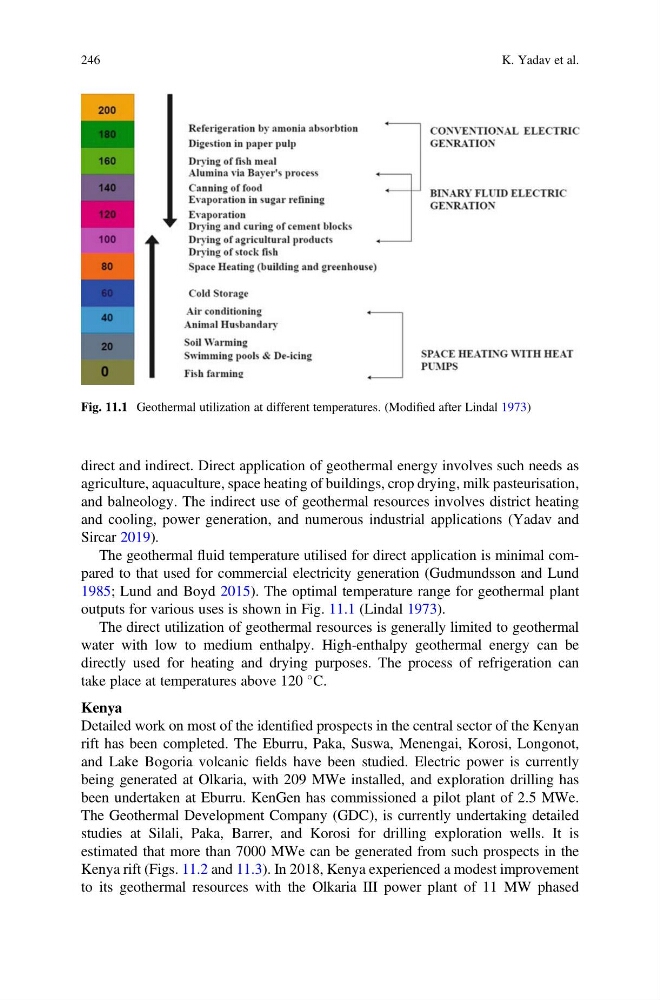
The geothermal fluid temperature utilised for direct application is minimal compared to that used for commercial electricity generation (Gudmundsson and Lund
1985; Lund and Boyd 2015). The optimal temperature range for geothermal plant
outputs for various uses is shown in Fig. 11.1 (Lindal 1973).
The direct utilization of geothermal resources is generally limited to geothermal
water with low to medium enthalpy. High-enthalpy geothermal energy can be
directly used for heating and drying purposes. The process of refrigeration can
take place at temperatures above 120
C.
Kenya
Detailed work on most of the identified prospects in the central sector of the Kenyan
rift has been completed. The Eburru, Paka, Suswa, Menengai, Korosi, Longonot,
and Lake Bogoria volcanic fields have been studied. Electric power is currently
being generated at Olkaria, with 209 MWe installed, and exploration drilling has
been undertaken at Eburru. KenGen has commissioned a pilot plant of 2.5 MWe.
The Geothermal Development Company (GDC), is currently undertaking detailed
studies at Silali, Paka, Barrer, and Korosi for drilling exploration wells. It is
estimated that more than 7000 MWe can be generated from such prospects in the
Kenya rift (Figs. 11.2 and 11.3). In 2018, Kenya experienced a modest improvement
to its geothermal resources with the Olkaria III power plant of 11 MW phased
Fig. 11.1 Geothermal utilization at different temperatures. (Modified after Lindal 1973)
246
K. Yadav et al.
agriculture, aquaculture, space heating of buildings, crop drying, milk pasteurisation,
and balneology. The indirect use of geothermal resources involves district heating
and cooling, power generation, and numerous industrial applications (Yadav and
Sircar 2019).
The geothermal fluid temperature utilised for direct application is minimal compared to that used for commercial electricity generation (Gudmundsson and Lund
1985; Lund and Boyd 2015). The optimal temperature range for geothermal plant
outputs for various uses is shown in Fig. 11.1 (Lindal 1973).
The direct utilization of geothermal resources is generally limited to geothermal
water with low to medium enthalpy. High-enthalpy geothermal energy can be
directly used for heating and drying purposes. The process of refrigeration can
take place at temperatures above 120
C.
Kenya
Detailed work on most of the identified prospects in the central sector of the Kenyan
rift has been completed. The Eburru, Paka, Suswa, Menengai, Korosi, Longonot,
and Lake Bogoria volcanic fields have been studied. Electric power is currently
being generated at Olkaria, with 209 MWe installed, and exploration drilling has
been undertaken at Eburru. KenGen has commissioned a pilot plant of 2.5 MWe.
The Geothermal Development Company (GDC), is currently undertaking detailed
studies at Silali, Paka, Barrer, and Korosi for drilling exploration wells. It is
estimated that more than 7000 MWe can be generated from such prospects in the
Kenya rift (Figs. 11.2 and 11.3). In 2018, Kenya experienced a modest improvement
to its geothermal resources with the Olkaria III power plant of 11 MW phased
Fig. 11.1 Geothermal utilization at different temperatures. (Modified after Lindal 1973)
246
K. Yadav et al.