

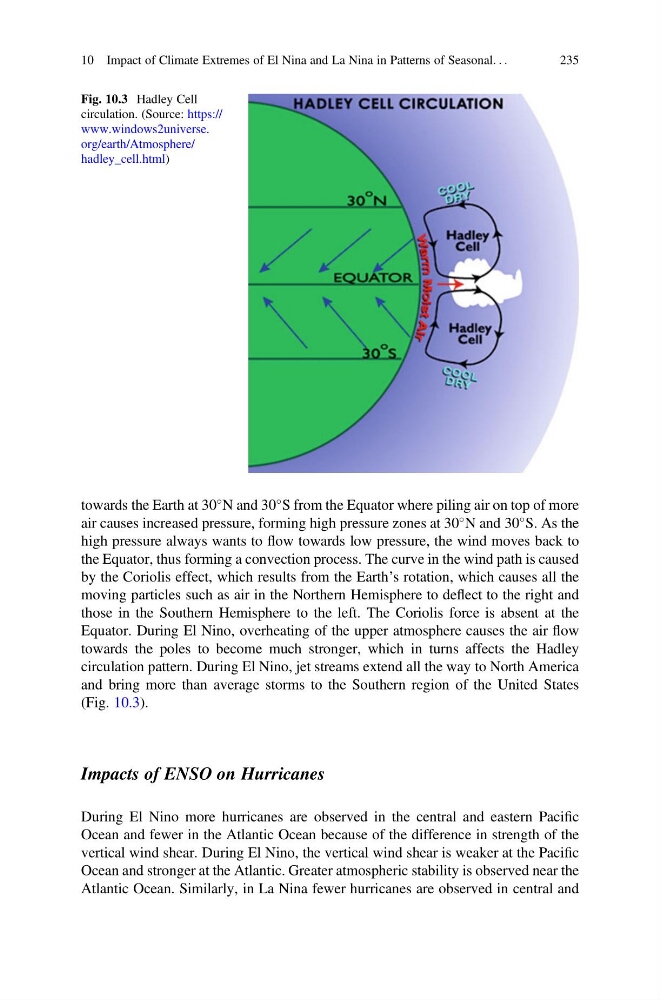
towards the Earth at 30
N and 30
S from the Equator where piling air on top of more
air causes increased pressure, forming high pressure zones at 30
N and 30
S. As the
high pressure always wants to flow towards low pressure, the wind moves back to
the Equator, thus forming a convection process. The curve in the wind path is caused
by the Coriolis effect, which results from the Earth’s rotation, which causes all the
moving particles such as air in the Northern Hemisphere to deflect to the right and
those in the Southern Hemisphere to the left. The Coriolis force is absent at the
Equator. During El Nino, overheating of the upper atmosphere causes the air flow
towards the poles to become much stronger, which in turns affects the Hadley
circulation pattern. During El Nino, jet streams extend all the way to North America
and bring more than average storms to the Southern region of the United States
(Fig. 10.3).
Impacts of ENSO on Hurricanes
During El Nino more hurricanes are observed in the central and eastern Pacific
Ocean and fewer in the Atlantic Ocean because of the difference in strength of the
vertical wind shear. During El Nino, the vertical wind shear is weaker at the Pacific
Ocean and stronger at the Atlantic. Greater atmospheric stability is observed near the
Atlantic Ocean. Similarly, in La Nina fewer hurricanes are observed in central and
Fig. 10.3 Hadley Cell
circulation. (Source: https://
www.windows2universe.
org/earth/Atmosphere/
hadley_cell.html)
10 Impact of Climate Extremes of El Nina and La Nina in Patterns of Seasonal. . .
235
N and 30
S from the Equator where piling air on top of more
air causes increased pressure, forming high pressure zones at 30
N and 30
S. As the
high pressure always wants to flow towards low pressure, the wind moves back to
the Equator, thus forming a convection process. The curve in the wind path is caused
by the Coriolis effect, which results from the Earth’s rotation, which causes all the
moving particles such as air in the Northern Hemisphere to deflect to the right and
those in the Southern Hemisphere to the left. The Coriolis force is absent at the
Equator. During El Nino, overheating of the upper atmosphere causes the air flow
towards the poles to become much stronger, which in turns affects the Hadley
circulation pattern. During El Nino, jet streams extend all the way to North America
and bring more than average storms to the Southern region of the United States
(Fig. 10.3).
Impacts of ENSO on Hurricanes
During El Nino more hurricanes are observed in the central and eastern Pacific
Ocean and fewer in the Atlantic Ocean because of the difference in strength of the
vertical wind shear. During El Nino, the vertical wind shear is weaker at the Pacific
Ocean and stronger at the Atlantic. Greater atmospheric stability is observed near the
Atlantic Ocean. Similarly, in La Nina fewer hurricanes are observed in central and
Fig. 10.3 Hadley Cell
circulation. (Source: https://
www.windows2universe.
org/earth/Atmosphere/
hadley_cell.html)
10 Impact of Climate Extremes of El Nina and La Nina in Patterns of Seasonal. . .
235