

II. Changes in microclimate
The microclimate around plants can be modified to minimize stress by heat and
cold. Some irrigation methods should be followed to modify the microclimate, such
as an overhead sprinkler system, a mid-canopy sprinkler, shade net, canopy management, and water channels.
III. Water management
In drought-prone areas, most orchards depend on rainfed cultivation, which
should be followed by drip irrigation to increase water use efficiency. More favorable soil moisture coupled with increased CO 2 may increase biomass and soil
carbon. Surface water harvesting in suitable structures and preventing evaporation
loss are important adaptations against drought conditions.
IV. Soil moisture conservation
Conservation of soil moisture in all fruit crops increases soil microbial activity
and soil microclimate and also reduces the incidence of abiotic as well as biotic
stresses. The use of plastic mulch is effective on a long-term basis compared to
organic mulches. The use of plastic mulch in fruit crops increases yield 45.23% in
mango, 14.63% in pineapple, and 12.61% in litchi compared to non-mulched plants
(Patil et al. 2013).
V. Protected cultivation
In protected cultivation, the initial expenditure is greater, but for long-term
production the cultivation cost has to be covered. In fruit crops, generally less
production takes place under protected cultivation, but now several high-density
plantings using dwarf rootstock are possible to cultivate. Protected cultivation has an
advantage in terms of modified microclimate and is free from abiotic stresses such as
hail storms, frost, drought, and excess precipitation, with reduced attacks by insects
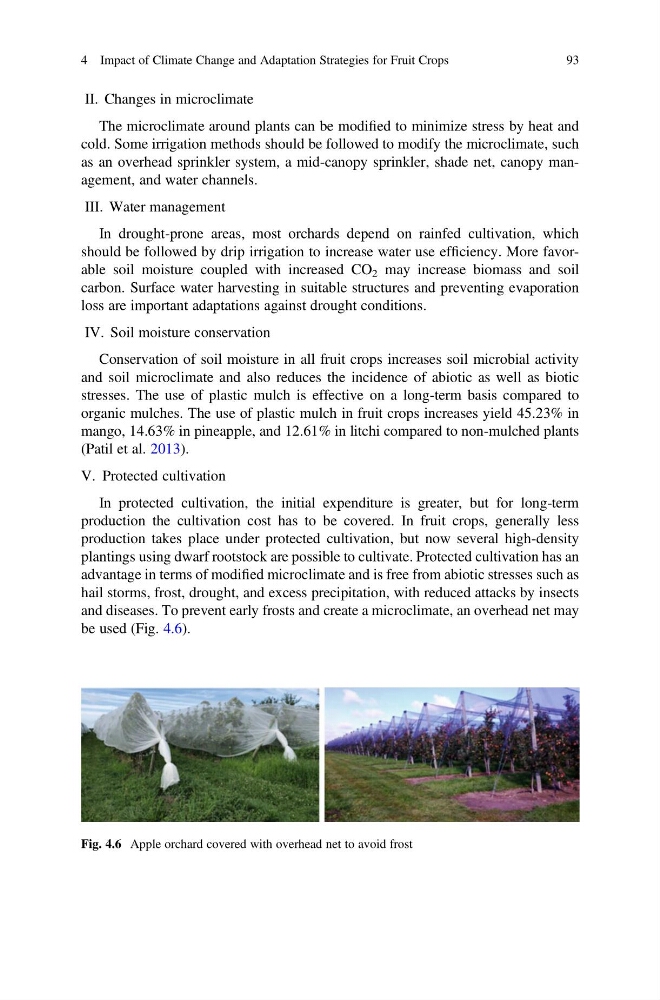
and diseases. To prevent early frosts and create a microclimate, an overhead net may
be used (Fig. 4.6).
Fig. 4.6 Apple orchard covered with overhead net to avoid frost
4 Impact of Climate Change and Adaptation Strategies for Fruit Crops
93
The microclimate around plants can be modified to minimize stress by heat and
cold. Some irrigation methods should be followed to modify the microclimate, such
as an overhead sprinkler system, a mid-canopy sprinkler, shade net, canopy management, and water channels.
III. Water management
In drought-prone areas, most orchards depend on rainfed cultivation, which
should be followed by drip irrigation to increase water use efficiency. More favorable soil moisture coupled with increased CO 2 may increase biomass and soil
carbon. Surface water harvesting in suitable structures and preventing evaporation
loss are important adaptations against drought conditions.
IV. Soil moisture conservation
Conservation of soil moisture in all fruit crops increases soil microbial activity
and soil microclimate and also reduces the incidence of abiotic as well as biotic
stresses. The use of plastic mulch is effective on a long-term basis compared to
organic mulches. The use of plastic mulch in fruit crops increases yield 45.23% in
mango, 14.63% in pineapple, and 12.61% in litchi compared to non-mulched plants
(Patil et al. 2013).
V. Protected cultivation
In protected cultivation, the initial expenditure is greater, but for long-term
production the cultivation cost has to be covered. In fruit crops, generally less
production takes place under protected cultivation, but now several high-density
plantings using dwarf rootstock are possible to cultivate. Protected cultivation has an
advantage in terms of modified microclimate and is free from abiotic stresses such as
hail storms, frost, drought, and excess precipitation, with reduced attacks by insects
and diseases. To prevent early frosts and create a microclimate, an overhead net may
be used (Fig. 4.6).
Fig. 4.6 Apple orchard covered with overhead net to avoid frost
4 Impact of Climate Change and Adaptation Strategies for Fruit Crops
93