

70
3 Vibrational Up-Pumping: Predicting Impact Sensitivity of Some …
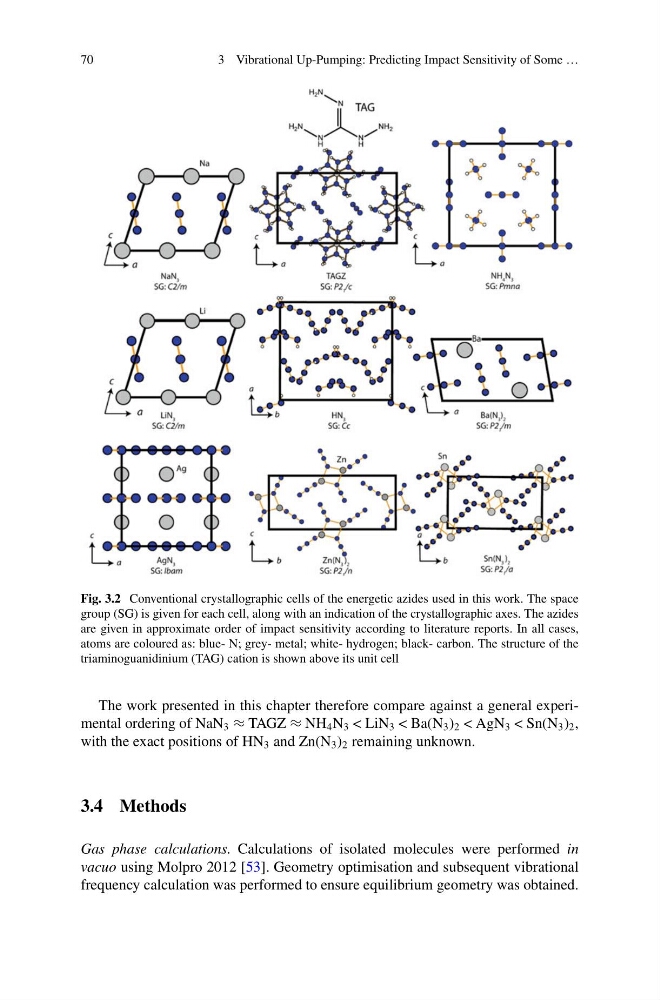
Fig. 3.2 Conventional crystallographic cells of the energetic azides used in this work. The space
group (SG) is given for each cell, along with an indication of the crystallographic axes. The azides
are given in approximate order of impact sensitivity according to literature reports. In all cases,
atoms are coloured as: blue- N; grey- metal; white- hydrogen; black- carbon. The structure of the
triaminoguanidinium (TAG) cation is shown above its unit cell
The work presented in this chapter therefore compare against a general experimental ordering of NaN 3 ≈ TAGZ ≈ NH 4 N 3 < LiN 3 < Ba(N 3 ) 2 < AgN 3 < Sn(N 3 ) 2 ,
with the exact positions of HN 3 and Zn(N 3 ) 2 remaining unknown.
3.4 Methods
Gas phase calculations. Calculations of isolated molecules were performed in
vacuo using Molpro 2012 [53]. Geometry optimisation and subsequent vibrational
frequency calculation was performed to ensure equilibrium geometry was obtained.
3 Vibrational Up-Pumping: Predicting Impact Sensitivity of Some …
Fig. 3.2 Conventional crystallographic cells of the energetic azides used in this work. The space
group (SG) is given for each cell, along with an indication of the crystallographic axes. The azides
are given in approximate order of impact sensitivity according to literature reports. In all cases,
atoms are coloured as: blue- N; grey- metal; white- hydrogen; black- carbon. The structure of the
triaminoguanidinium (TAG) cation is shown above its unit cell
The work presented in this chapter therefore compare against a general experimental ordering of NaN 3 ≈ TAGZ ≈ NH 4 N 3 < LiN 3 < Ba(N 3 ) 2 < AgN 3 < Sn(N 3 ) 2 ,
with the exact positions of HN 3 and Zn(N 3 ) 2 remaining unknown.
3.4 Methods
Gas phase calculations. Calculations of isolated molecules were performed in
vacuo using Molpro 2012 [53]. Geometry optimisation and subsequent vibrational
frequency calculation was performed to ensure equilibrium geometry was obtained.