

3.3 Test Set of Energetic Azides
69
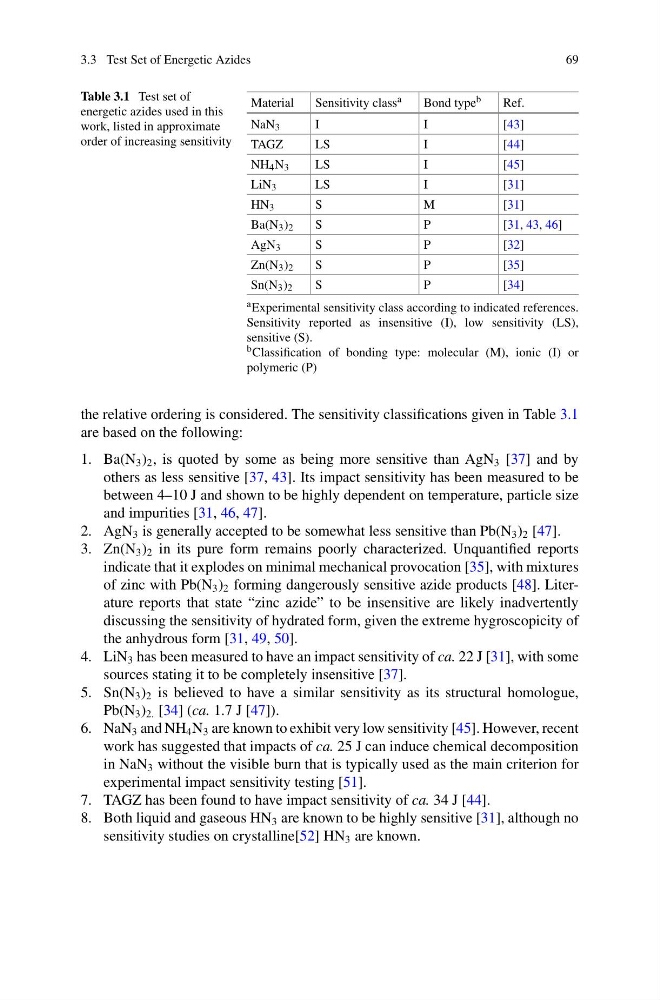
Table 3.1 Test set of
energetic azides used in this
work, listed in approximate
order of increasing sensitivity
Material
Sensitivity class a
Bond type b
Ref.
NaN 3
I
I
[43]
TAGZ
LS
I
[44]
NH 4 N 3
LS
I
[45]
LiN 3
LS
I
[31]
HN 3
S
M
[31]
Ba(N 3 ) 2
S
P
[31, 43, 46]
AgN 3
S
P
[32]
Zn(N 3 ) 2
S
P
[35]
Sn(N 3 ) 2
S
P
[34]
a Experimental sensitivity class according to indicated references.
Sensitivity reported as insensitive (I), low sensitivity (LS),
sensitive (S).
b Classification of bonding type: molecular (M), ionic (I) or
polymeric (P)
the relative ordering is considered. The sensitivity classifications given in Table 3.1
are based on the following:
1. Ba(N 3 ) 2 , is quoted by some as being more sensitive than AgN 3 [37] and by
others as less sensitive [37, 43]. Its impact sensitivity has been measured to be
between 4–10 J and shown to be highly dependent on temperature, particle size
and impurities [31, 46, 47].
2. AgN 3 is generally accepted to be somewhat less sensitive than Pb(N 3 ) 2 [47].
3. Zn(N 3 ) 2 in its pure form remains poorly characterized. Unquantified reports
indicate that it explodes on minimal mechanical provocation [35], with mixtures
of zinc with Pb(N 3 ) 2 forming dangerously sensitive azide products [48]. Literature reports that state “zinc azide” to be insensitive are likely inadvertently
discussing the sensitivity of hydrated form, given the extreme hygroscopicity of
the anhydrous form [31, 49, 50].
4. LiN 3 has been measured to have an impact sensitivity of ca. 22 J [31], with some
sources stating it to be completely insensitive [37].
5. Sn(N 3 ) 2 is believed to have a similar sensitivity as its structural homologue,
Pb(N 3 ) 2. [34] (ca. 1.7 J [47]).
6. NaN 3 and NH 4 N 3 are known to exhibit very low sensitivity [45]. However, recent
work has suggested that impacts of ca. 25 J can induce chemical decomposition
in NaN 3 without the visible burn that is typically used as the main criterion for
experimental impact sensitivity testing [51].
7. TAGZ has been found to have impact sensitivity of ca. 34 J [44].
8. Both liquid and gaseous HN 3 are known to be highly sensitive [31], although no
sensitivity studies on crystalline[52] HN 3 are known.
69
Table 3.1 Test set of
energetic azides used in this
work, listed in approximate
order of increasing sensitivity
Material
Sensitivity class a
Bond type b
Ref.
NaN 3
I
I
[43]
TAGZ
LS
I
[44]
NH 4 N 3
LS
I
[45]
LiN 3
LS
I
[31]
HN 3
S
M
[31]
Ba(N 3 ) 2
S
P
[31, 43, 46]
AgN 3
S
P
[32]
Zn(N 3 ) 2
S
P
[35]
Sn(N 3 ) 2
S
P
[34]
a Experimental sensitivity class according to indicated references.
Sensitivity reported as insensitive (I), low sensitivity (LS),
sensitive (S).
b Classification of bonding type: molecular (M), ionic (I) or
polymeric (P)
the relative ordering is considered. The sensitivity classifications given in Table 3.1
are based on the following:
1. Ba(N 3 ) 2 , is quoted by some as being more sensitive than AgN 3 [37] and by
others as less sensitive [37, 43]. Its impact sensitivity has been measured to be
between 4–10 J and shown to be highly dependent on temperature, particle size
and impurities [31, 46, 47].
2. AgN 3 is generally accepted to be somewhat less sensitive than Pb(N 3 ) 2 [47].
3. Zn(N 3 ) 2 in its pure form remains poorly characterized. Unquantified reports
indicate that it explodes on minimal mechanical provocation [35], with mixtures
of zinc with Pb(N 3 ) 2 forming dangerously sensitive azide products [48]. Literature reports that state “zinc azide” to be insensitive are likely inadvertently
discussing the sensitivity of hydrated form, given the extreme hygroscopicity of
the anhydrous form [31, 49, 50].
4. LiN 3 has been measured to have an impact sensitivity of ca. 22 J [31], with some
sources stating it to be completely insensitive [37].
5. Sn(N 3 ) 2 is believed to have a similar sensitivity as its structural homologue,
Pb(N 3 ) 2. [34] (ca. 1.7 J [47]).
6. NaN 3 and NH 4 N 3 are known to exhibit very low sensitivity [45]. However, recent
work has suggested that impacts of ca. 25 J can induce chemical decomposition
in NaN 3 without the visible burn that is typically used as the main criterion for
experimental impact sensitivity testing [51].
7. TAGZ has been found to have impact sensitivity of ca. 34 J [44].
8. Both liquid and gaseous HN 3 are known to be highly sensitive [31], although no
sensitivity studies on crystalline[52] HN 3 are known.