

52
2 Experimental and Computational Methods
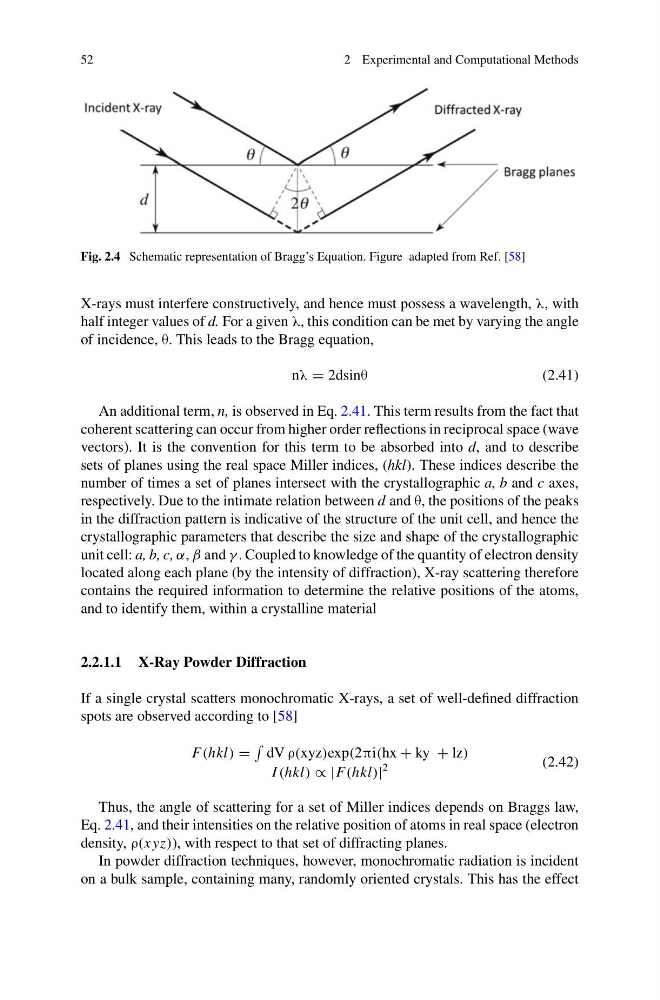
Fig. 2.4 Schematic representation of Bragg’s Equation. Figure adapted from Ref. [58]
X-rays must interfere constructively, and hence must possess a wavelength, λ, with
half integer values of d. For a given λ, this condition can be met by varying the angle
of incidence, θ. This leads to the Bragg equation,
nλ = 2dsinθ
(2.41)
An additional term, n, is observed in Eq. 2.41. This term results from the fact that
coherent scattering can occur from higher order reflections in reciprocal space (wave
vectors). It is the convention for this term to be absorbed into d, and to describe
sets of planes using the real space Miller indices, (hkl). These indices describe the
number of times a set of planes intersect with the crystallographic a, b and c axes,
respectively. Due to the intimate relation between d and θ, the positions of the peaks
in the diffraction pattern is indicative of the structure of the unit cell, and hence the
crystallographic parameters that describe the size and shape of the crystallographic
unit cell: a, b, c, α, β and γ . Coupled to knowledge of the quantity of electron density
located along each plane (by the intensity of diffraction), X-ray scattering therefore
contains the required information to determine the relative positions of the atoms,
and to identify them, within a crystalline material
2.2.1.1 X-Ray Powder Diffraction
If a single crystal scatters monochromatic X-rays, a set of well-defined diffraction
spots are observed according to [58]
F(hkl) =
dV ρ(xyz)exp(2πi(hx + ky + lz)
I (hkl) ∝ |F(hkl)|
2
(2.42)
Thus, the angle of scattering for a set of Miller indices depends on Braggs law,
Eq. 2.41, and their intensities on the relative position of atoms in real space (electron
density, ρ(x yz)), with respect to that set of diffracting planes.
In powder diffraction techniques, however, monochromatic radiation is incident
on a bulk sample, containing many, randomly oriented crystals. This has the effect
2 Experimental and Computational Methods
Fig. 2.4 Schematic representation of Bragg’s Equation. Figure adapted from Ref. [58]
X-rays must interfere constructively, and hence must possess a wavelength, λ, with
half integer values of d. For a given λ, this condition can be met by varying the angle
of incidence, θ. This leads to the Bragg equation,
nλ = 2dsinθ
(2.41)
An additional term, n, is observed in Eq. 2.41. This term results from the fact that
coherent scattering can occur from higher order reflections in reciprocal space (wave
vectors). It is the convention for this term to be absorbed into d, and to describe
sets of planes using the real space Miller indices, (hkl). These indices describe the
number of times a set of planes intersect with the crystallographic a, b and c axes,
respectively. Due to the intimate relation between d and θ, the positions of the peaks
in the diffraction pattern is indicative of the structure of the unit cell, and hence the
crystallographic parameters that describe the size and shape of the crystallographic
unit cell: a, b, c, α, β and γ . Coupled to knowledge of the quantity of electron density
located along each plane (by the intensity of diffraction), X-ray scattering therefore
contains the required information to determine the relative positions of the atoms,
and to identify them, within a crystalline material
2.2.1.1 X-Ray Powder Diffraction
If a single crystal scatters monochromatic X-rays, a set of well-defined diffraction
spots are observed according to [58]
F(hkl) =
dV ρ(xyz)exp(2πi(hx + ky + lz)
I (hkl) ∝ |F(hkl)|
2
(2.42)
Thus, the angle of scattering for a set of Miller indices depends on Braggs law,
Eq. 2.41, and their intensities on the relative position of atoms in real space (electron
density, ρ(x yz)), with respect to that set of diffracting planes.
In powder diffraction techniques, however, monochromatic radiation is incident
on a bulk sample, containing many, randomly oriented crystals. This has the effect