

2.1 Computational Methods
47
along with the screened hybrid DFT functional, HSE06. The major disadvantage is
that there is no systematic and unique approach to enhancing the basis set quality as
there is with plane waves, and hence the basis sets used in this work were obtained
from previous works in which they were successfully employed in similar systems.
2.1.5.3 Pseudopotentials
The Pauli exclusion principle [2] dictates that higher electronic states are orthogonal
with all states of lower energy. It follows that the electronic wavefunction becomes
highly oscillating in the core region. The expansion of the electronic wavefunction
in a plane wave basis set requires very large numbers of plane waves to capture this
feature. Fortunately, the core electrons of an atom are only negligibly affected by the
chemical environment, and can be treated as being frozen. It is therefore possible to
replace the ionic potential with a weaker pseudopotential that mimics the screening
effect of the core electrons, and which yields the same valence electron wavefunction
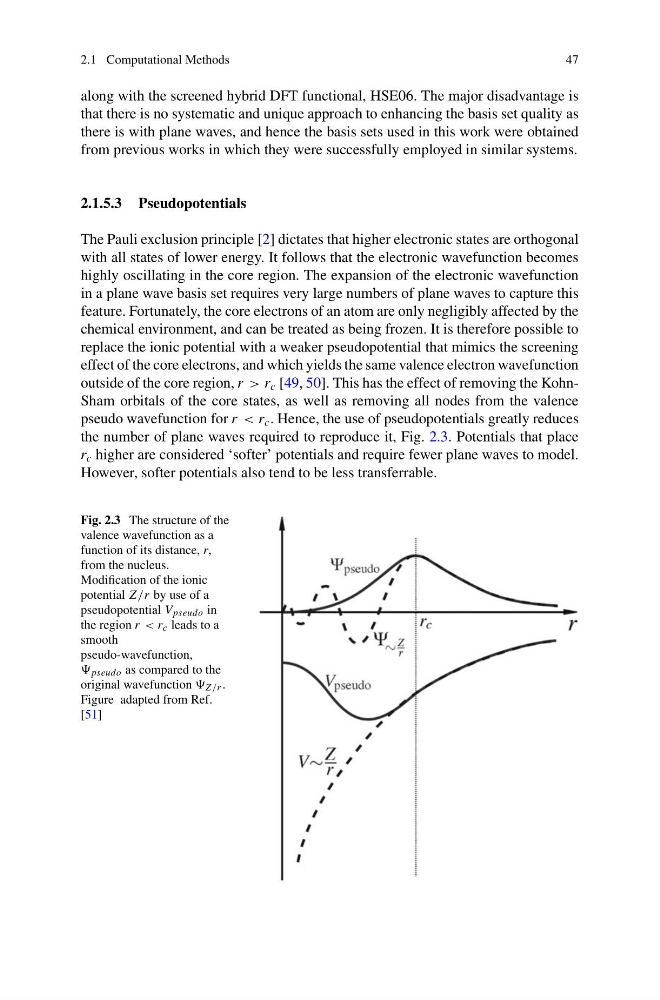
outside of the core region, r > r c [49, 50]. This has the effect of removing the KohnSham orbitals of the core states, as well as removing all nodes from the valence
pseudo wavefunction for r < r c . Hence, the use of pseudopotentials greatly reduces
the number of plane waves required to reproduce it, Fig. 2.3. Potentials that place
r c higher are considered ‘softer’ potentials and require fewer plane waves to model.
However, softer potentials also tend to be less transferrable.
Fig. 2.3 The structure of the
valence wavefunction as a
function of its distance, r,
from the nucleus.
Modification of the ionic
potential Z /r by use of a
pseudopotential V pseudo in
the region r < r c leads to a
smooth
pseudo-wavefunction,
pseudo as compared to the
original wavefunction Z /r .
Figure adapted from Ref.
[51]
47
along with the screened hybrid DFT functional, HSE06. The major disadvantage is
that there is no systematic and unique approach to enhancing the basis set quality as
there is with plane waves, and hence the basis sets used in this work were obtained
from previous works in which they were successfully employed in similar systems.
2.1.5.3 Pseudopotentials
The Pauli exclusion principle [2] dictates that higher electronic states are orthogonal
with all states of lower energy. It follows that the electronic wavefunction becomes
highly oscillating in the core region. The expansion of the electronic wavefunction
in a plane wave basis set requires very large numbers of plane waves to capture this
feature. Fortunately, the core electrons of an atom are only negligibly affected by the
chemical environment, and can be treated as being frozen. It is therefore possible to
replace the ionic potential with a weaker pseudopotential that mimics the screening
effect of the core electrons, and which yields the same valence electron wavefunction
outside of the core region, r > r c [49, 50]. This has the effect of removing the KohnSham orbitals of the core states, as well as removing all nodes from the valence
pseudo wavefunction for r < r c . Hence, the use of pseudopotentials greatly reduces
the number of plane waves required to reproduce it, Fig. 2.3. Potentials that place
r c higher are considered ‘softer’ potentials and require fewer plane waves to model.
However, softer potentials also tend to be less transferrable.
Fig. 2.3 The structure of the
valence wavefunction as a
function of its distance, r,
from the nucleus.
Modification of the ionic
potential Z /r by use of a
pseudopotential V pseudo in
the region r < r c leads to a
smooth
pseudo-wavefunction,
pseudo as compared to the
original wavefunction Z /r .
Figure adapted from Ref.
[51]