

46
2 Experimental and Computational Methods
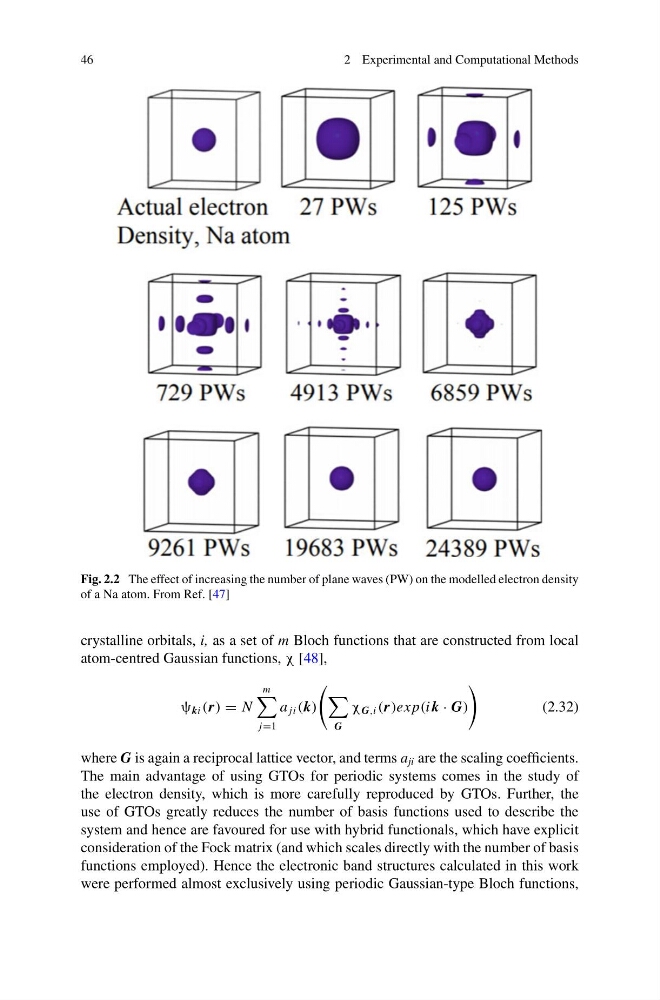
Fig. 2.2 The effect of increasing the number of plane waves (PW) on the modelled electron density
of a Na atom. From Ref. [47]
crystalline orbitals, i, as a set of m Bloch functions that are constructed from local
atom-centred Gaussian functions, χ [48],
ψ ki (r) = N
m
j=1
a ji (k)
G
χ G,i (r)ex p(i k · G)
(2.32)
where G is again a reciprocal lattice vector, and terms a ji are the scaling coefficients.
The main advantage of using GTOs for periodic systems comes in the study of
the electron density, which is more carefully reproduced by GTOs. Further, the
use of GTOs greatly reduces the number of basis functions used to describe the
system and hence are favoured for use with hybrid functionals, which have explicit
consideration of the Fock matrix (and which scales directly with the number of basis
functions employed). Hence the electronic band structures calculated in this work
were performed almost exclusively using periodic Gaussian-type Bloch functions,
2 Experimental and Computational Methods
Fig. 2.2 The effect of increasing the number of plane waves (PW) on the modelled electron density
of a Na atom. From Ref. [47]
crystalline orbitals, i, as a set of m Bloch functions that are constructed from local
atom-centred Gaussian functions, χ [48],
ψ ki (r) = N
m
j=1
a ji (k)
G
χ G,i (r)ex p(i k · G)
(2.32)
where G is again a reciprocal lattice vector, and terms a ji are the scaling coefficients.
The main advantage of using GTOs for periodic systems comes in the study of
the electron density, which is more carefully reproduced by GTOs. Further, the
use of GTOs greatly reduces the number of basis functions used to describe the
system and hence are favoured for use with hybrid functionals, which have explicit
consideration of the Fock matrix (and which scales directly with the number of basis
functions employed). Hence the electronic band structures calculated in this work
were performed almost exclusively using periodic Gaussian-type Bloch functions,