

1.3 Prediction and Rationalisation of Energetic Material Sensitivity
21
become important. This offers an excellent example of the complex interplay of
physical and chemical phenomena in the initiation of EMs.
The dynamic nature of electronic band gaps was recently re-examined by
Bondarchuk [114]. Again, based on the need to induce electronic excitation,
Bondarchuk investigated the propensity of organic materials to ‘metallise’ (i.e. reach
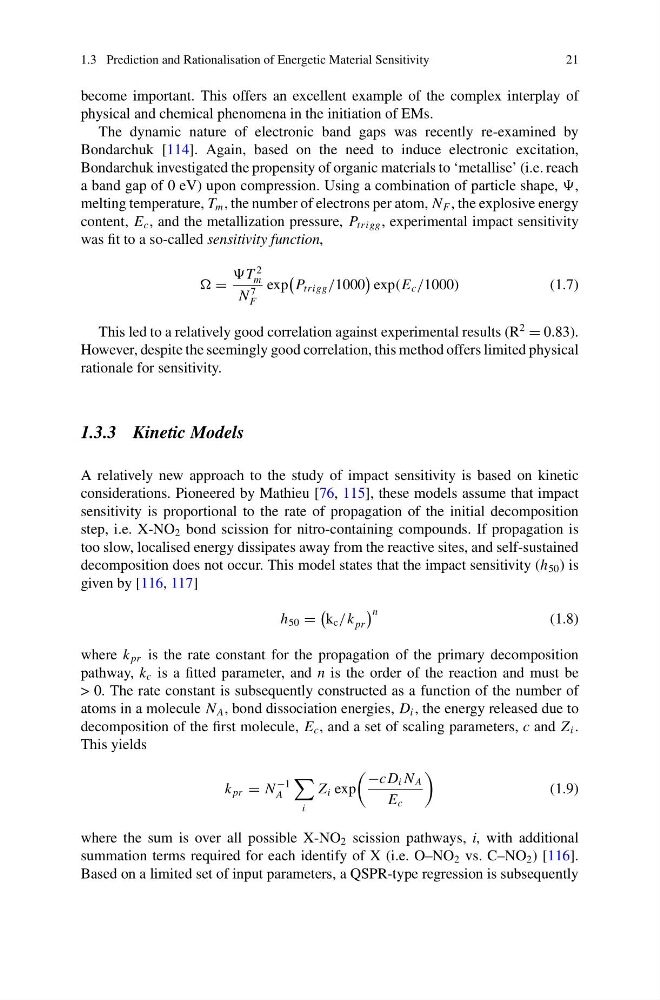
a band gap of 0 eV) upon compression. Using a combination of particle shape, ,
melting temperature, T m , the number of electrons per atom, N F , the explosive energy
content, E c , and the metallization pressure, P trigg , experimental impact sensitivity
was fit to a so-called sensitivity function,
=
T
2
m
N
7
F
exp
P trigg /1000
exp(E c /1000)
(1.7)
This led to a relatively good correlation against experimental results (R
2
= 0.83).
However, despite the seemingly good correlation, this method offers limited physical
rationale for sensitivity.
1.3.3 Kinetic Models
A relatively new approach to the study of impact sensitivity is based on kinetic
considerations. Pioneered by Mathieu [76, 115], these models assume that impact
sensitivity is proportional to the rate of propagation of the initial decomposition
step, i.e. X-NO 2 bond scission for nitro-containing compounds. If propagation is
too slow, localised energy dissipates away from the reactive sites, and self-sustained
decomposition does not occur. This model states that the impact sensitivity (h 50 ) is
given by [116, 117]
h 50 =
k c /k pr
n
(1.8)
where k pr is the rate constant for the propagation of the primary decomposition
pathway, k c is a fitted parameter, and n is the order of the reaction and must be
> 0. The rate constant is subsequently constructed as a function of the number of
atoms in a molecule N A , bond dissociation energies, D i , the energy released due to
decomposition of the first molecule, E c , and a set of scaling parameters, c and Z i .
This yields
k pr = N
−1
A
i
Z i exp
−cD i N A
E c
(1.9)
where the sum is over all possible X-NO 2 scission pathways, i, with additional
summation terms required for each identify of X (i.e. O–NO 2 vs. C–NO 2 ) [116].
Based on a limited set of input parameters, a QSPR-type regression is subsequently
21
become important. This offers an excellent example of the complex interplay of
physical and chemical phenomena in the initiation of EMs.
The dynamic nature of electronic band gaps was recently re-examined by
Bondarchuk [114]. Again, based on the need to induce electronic excitation,
Bondarchuk investigated the propensity of organic materials to ‘metallise’ (i.e. reach
a band gap of 0 eV) upon compression. Using a combination of particle shape, ,
melting temperature, T m , the number of electrons per atom, N F , the explosive energy
content, E c , and the metallization pressure, P trigg , experimental impact sensitivity
was fit to a so-called sensitivity function,
=
T
2
m
N
7
F
exp
P trigg /1000
exp(E c /1000)
(1.7)
This led to a relatively good correlation against experimental results (R
2
= 0.83).
However, despite the seemingly good correlation, this method offers limited physical
rationale for sensitivity.
1.3.3 Kinetic Models
A relatively new approach to the study of impact sensitivity is based on kinetic
considerations. Pioneered by Mathieu [76, 115], these models assume that impact
sensitivity is proportional to the rate of propagation of the initial decomposition
step, i.e. X-NO 2 bond scission for nitro-containing compounds. If propagation is
too slow, localised energy dissipates away from the reactive sites, and self-sustained
decomposition does not occur. This model states that the impact sensitivity (h 50 ) is
given by [116, 117]
h 50 =
k c /k pr
n
(1.8)
where k pr is the rate constant for the propagation of the primary decomposition
pathway, k c is a fitted parameter, and n is the order of the reaction and must be
> 0. The rate constant is subsequently constructed as a function of the number of
atoms in a molecule N A , bond dissociation energies, D i , the energy released due to
decomposition of the first molecule, E c , and a set of scaling parameters, c and Z i .
This yields
k pr = N
−1
A
i
Z i exp
−cD i N A
E c
(1.9)
where the sum is over all possible X-NO 2 scission pathways, i, with additional
summation terms required for each identify of X (i.e. O–NO 2 vs. C–NO 2 ) [116].
Based on a limited set of input parameters, a QSPR-type regression is subsequently