

20
1 Introduction
1.3.2.2 Electronic Band Gap Criterion and Band Gap Dynamics
Amongst the most popular solid state criteria for assessing impact sensitivity is the
‘band-gap criterion’ [106, 107]. Noting that bond dissociation requires population
of anti-bonding states, this simple analysis is based on consideration of the energy
gap between the valence and conduction bands. Within this approach, materials with
larger band gaps (i.e. those whose electronic transitions are less probable) are less
sensitive. While extensive investigation of this band gap criterion is limited, it has
been applied with varying success. Perhaps the largest drawback to this approach is
the unreliable calculation of electronic band gaps within most commonly available
computational methods [108], and the lack of experimental band gap data.
Several authors have expanded this concept to dynamic phenomena. In a similar
spirit to the work of Shreeve and co-workers [92], Kuklja [109–111] investigated the
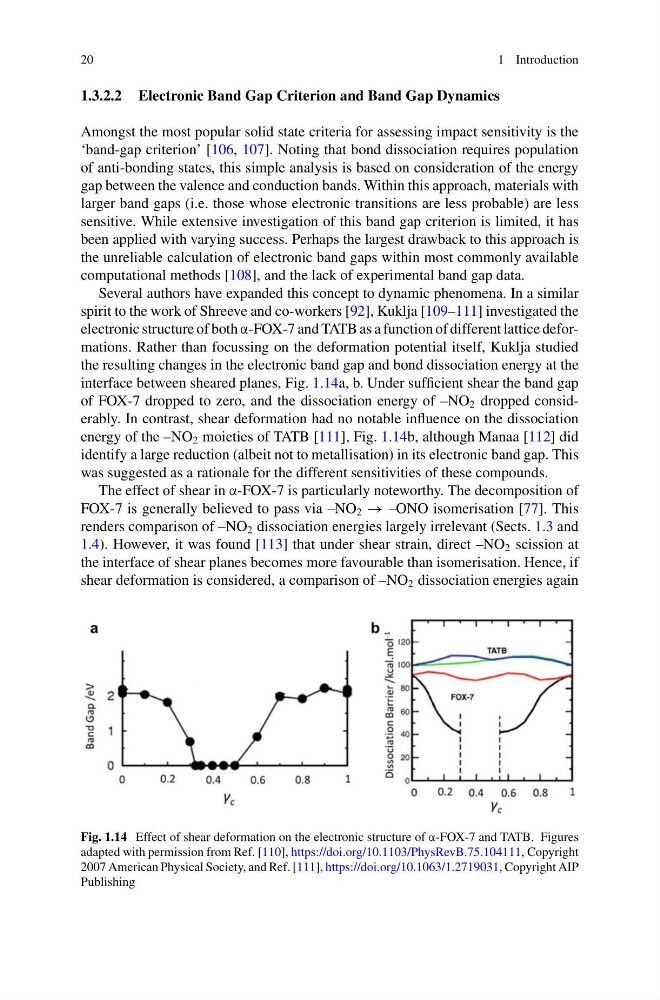
electronic structure of both α-FOX-7 and TATB as a function of different lattice deformations. Rather than focussing on the deformation potential itself, Kuklja studied
the resulting changes in the electronic band gap and bond dissociation energy at the
interface between sheared planes, Fig. 1.14a, b. Under sufficient shear the band gap
of FOX-7 dropped to zero, and the dissociation energy of –NO 2 dropped considerably. In contrast, shear deformation had no notable influence on the dissociation
energy of the –NO 2 moieties of TATB [111], Fig. 1.14b, although Manaa [112] did
identify a large reduction (albeit not to metallisation) in its electronic band gap. This
was suggested as a rationale for the different sensitivities of these compounds.
The effect of shear in α-FOX-7 is particularly noteworthy. The decomposition of
FOX-7 is generally believed to pass via –NO 2 → –ONO isomerisation [77]. This
renders comparison of –NO 2 dissociation energies largely irrelevant (Sects. 1.3 and
1.4). However, it was found [113] that under shear strain, direct –NO 2 scission at
the interface of shear planes becomes more favourable than isomerisation. Hence, if
shear deformation is considered, a comparison of –NO 2 dissociation energies again
Fig. 1.14 Effect of shear deformation on the electronic structure of α-FOX-7 and TATB. Figures
adapted with permission from Ref. [110], https://doi.org/10.1103/PhysRevB.75.104111, Copyright
2007 American Physical Society, and Ref. [111], https://doi.org/10.1063/1.2719031, Copyright AIP
Publishing
1 Introduction
1.3.2.2 Electronic Band Gap Criterion and Band Gap Dynamics
Amongst the most popular solid state criteria for assessing impact sensitivity is the
‘band-gap criterion’ [106, 107]. Noting that bond dissociation requires population
of anti-bonding states, this simple analysis is based on consideration of the energy
gap between the valence and conduction bands. Within this approach, materials with
larger band gaps (i.e. those whose electronic transitions are less probable) are less
sensitive. While extensive investigation of this band gap criterion is limited, it has
been applied with varying success. Perhaps the largest drawback to this approach is
the unreliable calculation of electronic band gaps within most commonly available
computational methods [108], and the lack of experimental band gap data.
Several authors have expanded this concept to dynamic phenomena. In a similar
spirit to the work of Shreeve and co-workers [92], Kuklja [109–111] investigated the
electronic structure of both α-FOX-7 and TATB as a function of different lattice deformations. Rather than focussing on the deformation potential itself, Kuklja studied
the resulting changes in the electronic band gap and bond dissociation energy at the
interface between sheared planes, Fig. 1.14a, b. Under sufficient shear the band gap
of FOX-7 dropped to zero, and the dissociation energy of –NO 2 dropped considerably. In contrast, shear deformation had no notable influence on the dissociation
energy of the –NO 2 moieties of TATB [111], Fig. 1.14b, although Manaa [112] did
identify a large reduction (albeit not to metallisation) in its electronic band gap. This
was suggested as a rationale for the different sensitivities of these compounds.
The effect of shear in α-FOX-7 is particularly noteworthy. The decomposition of
FOX-7 is generally believed to pass via –NO 2 → –ONO isomerisation [77]. This
renders comparison of –NO 2 dissociation energies largely irrelevant (Sects. 1.3 and
1.4). However, it was found [113] that under shear strain, direct –NO 2 scission at
the interface of shear planes becomes more favourable than isomerisation. Hence, if
shear deformation is considered, a comparison of –NO 2 dissociation energies again
Fig. 1.14 Effect of shear deformation on the electronic structure of α-FOX-7 and TATB. Figures
adapted with permission from Ref. [110], https://doi.org/10.1103/PhysRevB.75.104111, Copyright
2007 American Physical Society, and Ref. [111], https://doi.org/10.1063/1.2719031, Copyright AIP
Publishing