

5.1 Introduction
159
To date, no high-pressure forms of HMX have been structurally characterised.
However, some experiments do suggest two potential high-pressure transitions under
quasi-hydrostatic conditions [17, 18]. A conformational transition (i.e. associated
with a small change in the molecular geometry, without a large change in the crystallographic structure) was observed at ca. 12 GPa, with an abrupt phase transition
observed above 27 GPa [18].
FOX-7 is also well known to be polymorphic. Under ambient conditions, FOX-7
is stable as the monoclinic α-phase. Upon heating, two phase transitions occur, first
to β-FOX-7 at 111 °C, and subsequently to γ-FOX-7 at 173 °C [19]. These transitions
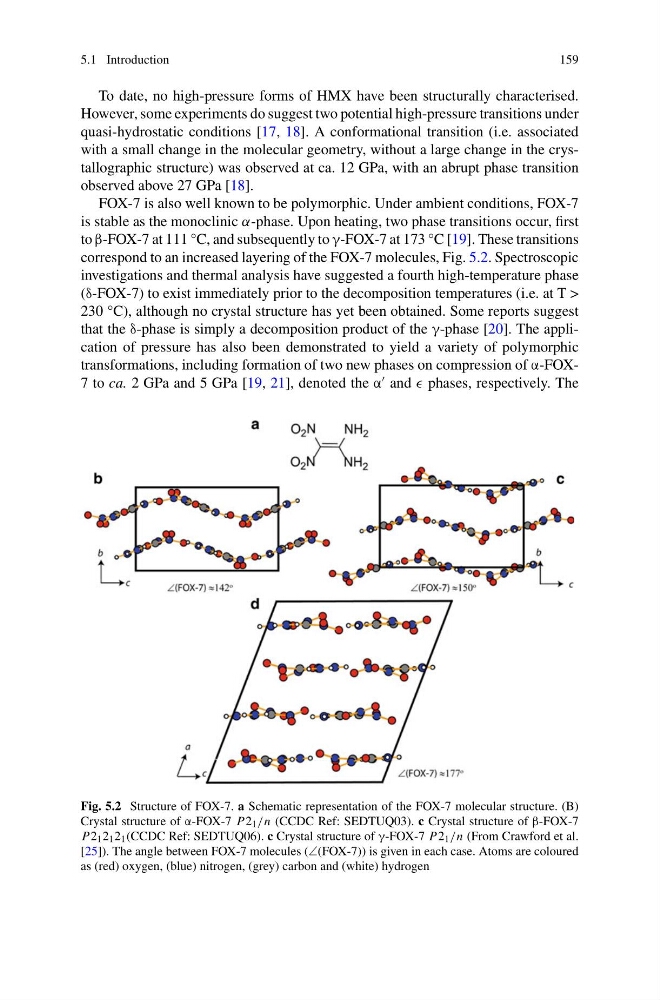
correspond to an increased layering of the FOX-7 molecules, Fig. 5.2. Spectroscopic
investigations and thermal analysis have suggested a fourth high-temperature phase
(δ-FOX-7) to exist immediately prior to the decomposition temperatures (i.e. at T >
230 °C), although no crystal structure has yet been obtained. Some reports suggest
that the δ-phase is simply a decomposition product of the γ-phase [20]. The application of pressure has also been demonstrated to yield a variety of polymorphic
transformations, including formation of two new phases on compression of α-FOX7 to ca. 2 GPa and 5 GPa [19, 21], denoted the α
and phases, respectively. The
Fig. 5.2 Structure of FOX-7. a Schematic representation of the FOX-7 molecular structure. (B)
Crystal structure of α-FOX-7 P2 1 /n (CCDC Ref: SEDTUQ03). c Crystal structure of β-FOX-7
P2 1 2 1 2 1 (CCDC Ref: SEDTUQ06). c Crystal structure of γ-FOX-7 P2 1 /n (From Crawford et al.
[25]). The angle between FOX-7 molecules (∠(FOX-7)) is given in each case. Atoms are coloured
as (red) oxygen, (blue) nitrogen, (grey) carbon and (white) hydrogen
159
To date, no high-pressure forms of HMX have been structurally characterised.
However, some experiments do suggest two potential high-pressure transitions under
quasi-hydrostatic conditions [17, 18]. A conformational transition (i.e. associated
with a small change in the molecular geometry, without a large change in the crystallographic structure) was observed at ca. 12 GPa, with an abrupt phase transition
observed above 27 GPa [18].
FOX-7 is also well known to be polymorphic. Under ambient conditions, FOX-7
is stable as the monoclinic α-phase. Upon heating, two phase transitions occur, first
to β-FOX-7 at 111 °C, and subsequently to γ-FOX-7 at 173 °C [19]. These transitions
correspond to an increased layering of the FOX-7 molecules, Fig. 5.2. Spectroscopic
investigations and thermal analysis have suggested a fourth high-temperature phase
(δ-FOX-7) to exist immediately prior to the decomposition temperatures (i.e. at T >
230 °C), although no crystal structure has yet been obtained. Some reports suggest
that the δ-phase is simply a decomposition product of the γ-phase [20]. The application of pressure has also been demonstrated to yield a variety of polymorphic
transformations, including formation of two new phases on compression of α-FOX7 to ca. 2 GPa and 5 GPa [19, 21], denoted the α
and phases, respectively. The
Fig. 5.2 Structure of FOX-7. a Schematic representation of the FOX-7 molecular structure. (B)
Crystal structure of α-FOX-7 P2 1 /n (CCDC Ref: SEDTUQ03). c Crystal structure of β-FOX-7
P2 1 2 1 2 1 (CCDC Ref: SEDTUQ06). c Crystal structure of γ-FOX-7 P2 1 /n (From Crawford et al.
[25]). The angle between FOX-7 molecules (∠(FOX-7)) is given in each case. Atoms are coloured
as (red) oxygen, (blue) nitrogen, (grey) carbon and (white) hydrogen