

158
5 Vibrational Up-Pumping in Polymorphic Materials
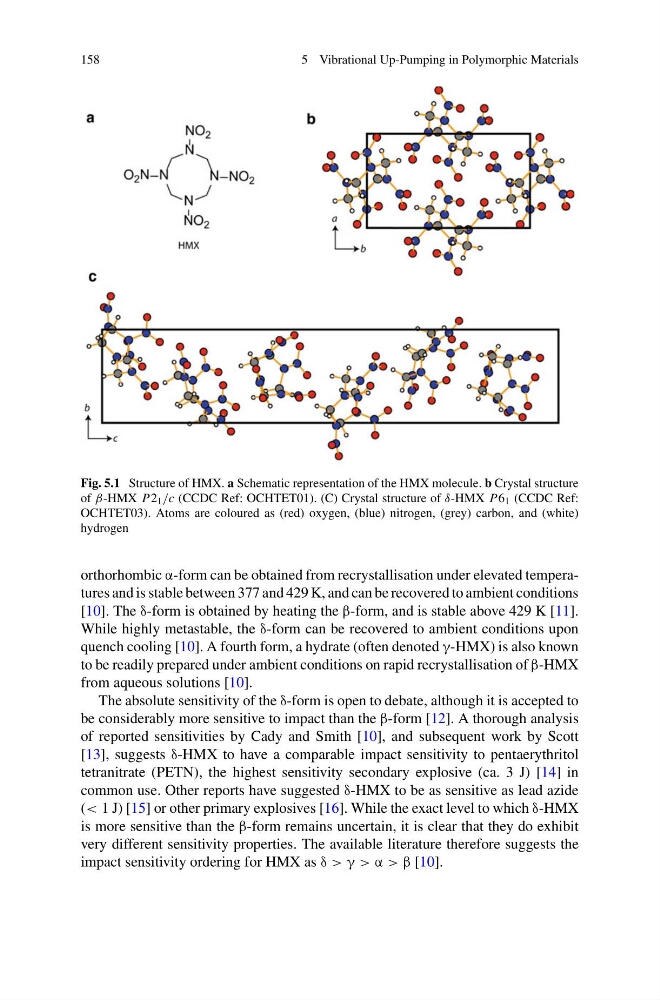
Fig. 5.1 Structure of HMX. a Schematic representation of the HMX molecule. b Crystal structure
of β-HMX P2 1 /c (CCDC Ref: OCHTET01). (C) Crystal structure of δ-HMX P6 1 (CCDC Ref:
OCHTET03). Atoms are coloured as (red) oxygen, (blue) nitrogen, (grey) carbon, and (white)
hydrogen
orthorhombic α-form can be obtained from recrystallisation under elevated temperatures and is stable between 377 and 429 K, and can be recovered to ambient conditions
[10]. The δ-form is obtained by heating the β-form, and is stable above 429 K [11].
While highly metastable, the δ-form can be recovered to ambient conditions upon
quench cooling [10]. A fourth form, a hydrate (often denoted γ-HMX) is also known
to be readily prepared under ambient conditions on rapid recrystallisation of β-HMX
from aqueous solutions [10].
The absolute sensitivity of the δ-form is open to debate, although it is accepted to
be considerably more sensitive to impact than the β-form [12]. A thorough analysis
of reported sensitivities by Cady and Smith [10], and subsequent work by Scott
[13], suggests δ-HMX to have a comparable impact sensitivity to pentaerythritol
tetranitrate (PETN), the highest sensitivity secondary explosive (ca. 3 J) [14] in
common use. Other reports have suggested δ-HMX to be as sensitive as lead azide
(< 1 J) [15] or other primary explosives [16]. While the exact level to which δ-HMX
is more sensitive than the β-form remains uncertain, it is clear that they do exhibit
very different sensitivity properties. The available literature therefore suggests the
impact sensitivity ordering for HMX as δ > γ > α > β [10].
5 Vibrational Up-Pumping in Polymorphic Materials
Fig. 5.1 Structure of HMX. a Schematic representation of the HMX molecule. b Crystal structure
of β-HMX P2 1 /c (CCDC Ref: OCHTET01). (C) Crystal structure of δ-HMX P6 1 (CCDC Ref:
OCHTET03). Atoms are coloured as (red) oxygen, (blue) nitrogen, (grey) carbon, and (white)
hydrogen
orthorhombic α-form can be obtained from recrystallisation under elevated temperatures and is stable between 377 and 429 K, and can be recovered to ambient conditions
[10]. The δ-form is obtained by heating the β-form, and is stable above 429 K [11].
While highly metastable, the δ-form can be recovered to ambient conditions upon
quench cooling [10]. A fourth form, a hydrate (often denoted γ-HMX) is also known
to be readily prepared under ambient conditions on rapid recrystallisation of β-HMX
from aqueous solutions [10].
The absolute sensitivity of the δ-form is open to debate, although it is accepted to
be considerably more sensitive to impact than the β-form [12]. A thorough analysis
of reported sensitivities by Cady and Smith [10], and subsequent work by Scott
[13], suggests δ-HMX to have a comparable impact sensitivity to pentaerythritol
tetranitrate (PETN), the highest sensitivity secondary explosive (ca. 3 J) [14] in
common use. Other reports have suggested δ-HMX to be as sensitive as lead azide
(< 1 J) [15] or other primary explosives [16]. While the exact level to which δ-HMX
is more sensitive than the β-form remains uncertain, it is clear that they do exhibit
very different sensitivity properties. The available literature therefore suggests the
impact sensitivity ordering for HMX as δ > γ > α > β [10].