

3.5 Results and Discussion
103
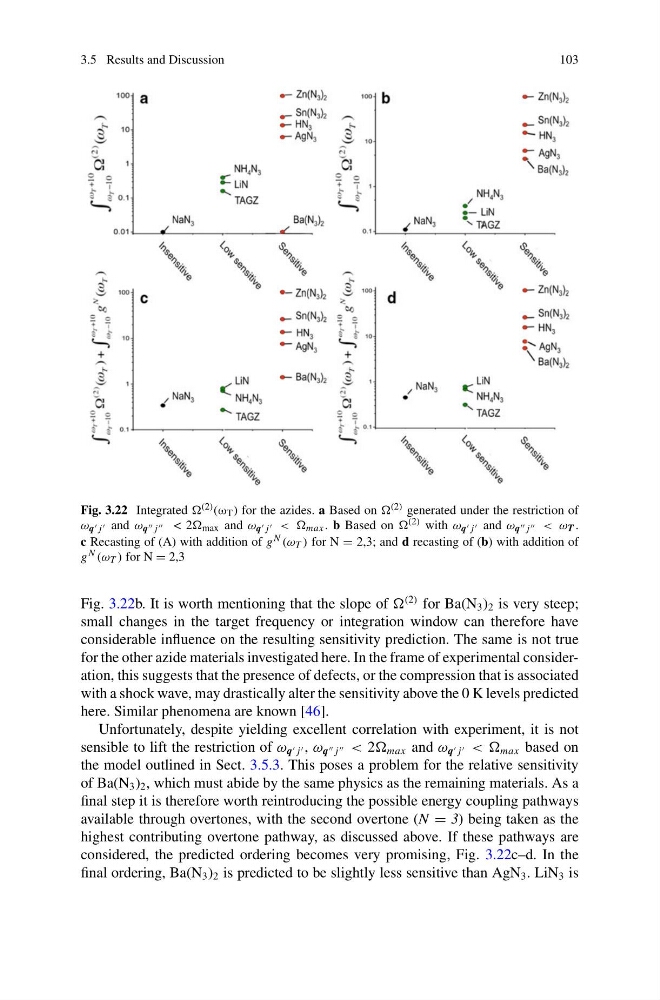
Fig. 3.22 Integrated (2) (ω T ) for the azides. a Based on (2) generated under the restriction of
ω q j and ω q j < 2 max and ω q j < < max . b Based on (2) with ω q j and ω q j < ω T .
c Recasting of (A) with addition of g N (ω T ) for N = 2,3; and d recasting of (b) with addition of
g N (ω T ) for N = 2,3
Fig. 3.22b. It is worth mentioning that the slope of
(2) for Ba(N 3 ) 2 is very steep;
small changes in the target frequency or integration window can therefore have
considerable influence on the resulting sensitivity prediction. The same is not true
for the other azide materials investigated here. In the frame of experimental consideration, this suggests that the presence of defects, or the compression that is associated
with a shock wave, may drastically alter the sensitivity above the 0 K levels predicted
here. Similar phenomena are known [46].
Unfortunately, despite yielding excellent correlation with experiment, it is not
sensible to lift the restriction of ω q j , ω q j < 2 max and ω q j < < max based on
the model outlined in Sect. 3.5.3. This poses a problem for the relative sensitivity
of Ba(N 3 ) 2 , which must abide by the same physics as the remaining materials. As a
final step it is therefore worth reintroducing the possible energy coupling pathways
available through overtones, with the second overtone (N = 3) being taken as the
highest contributing overtone pathway, as discussed above. If these pathways are
considered, the predicted ordering becomes very promising, Fig. 3.22c–d. In the
final ordering, Ba(N 3 ) 2 is predicted to be slightly less sensitive than AgN 3 . LiN 3 is
103
Fig. 3.22 Integrated (2) (ω T ) for the azides. a Based on (2) generated under the restriction of
ω q j and ω q j < 2 max and ω q j < < max . b Based on (2) with ω q j and ω q j < ω T .
c Recasting of (A) with addition of g N (ω T ) for N = 2,3; and d recasting of (b) with addition of
g N (ω T ) for N = 2,3
Fig. 3.22b. It is worth mentioning that the slope of
(2) for Ba(N 3 ) 2 is very steep;
small changes in the target frequency or integration window can therefore have
considerable influence on the resulting sensitivity prediction. The same is not true
for the other azide materials investigated here. In the frame of experimental consideration, this suggests that the presence of defects, or the compression that is associated
with a shock wave, may drastically alter the sensitivity above the 0 K levels predicted
here. Similar phenomena are known [46].
Unfortunately, despite yielding excellent correlation with experiment, it is not
sensible to lift the restriction of ω q j , ω q j < 2 max and ω q j < < max based on
the model outlined in Sect. 3.5.3. This poses a problem for the relative sensitivity
of Ba(N 3 ) 2 , which must abide by the same physics as the remaining materials. As a
final step it is therefore worth reintroducing the possible energy coupling pathways
available through overtones, with the second overtone (N = 3) being taken as the
highest contributing overtone pathway, as discussed above. If these pathways are
considered, the predicted ordering becomes very promising, Fig. 3.22c–d. In the
final ordering, Ba(N 3 ) 2 is predicted to be slightly less sensitive than AgN 3 . LiN 3 is