

3.5 Results and Discussion
93
γ q,j =
π
2 N q
q
, j , j
V
(3)
q j,q
j ,q j
2 ×
1 + n q
j + n q j
δ
ω q j − ω q
j − ω q j
+ 2
n q
j − n q j
δ
ω q j + ω q
j − ω q j
(3.3)
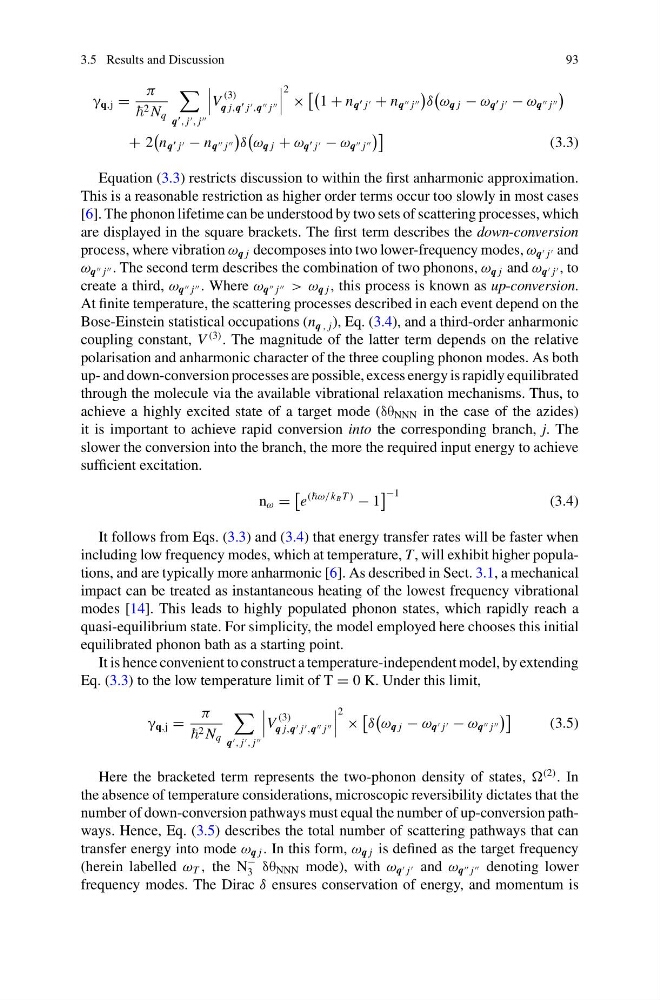
Equation (3.3) restricts discussion to within the first anharmonic approximation.
This is a reasonable restriction as higher order terms occur too slowly in most cases
[6]. The phonon lifetime can be understood by two sets of scattering processes, which
are displayed in the square brackets. The first term describes the down-conversion
process, where vibration ω q j decomposes into two lower-frequency modes, ω q j and
ω q j . The second term describes the combination of two phonons, ω q j and ω q j , to
create a third, ω q j . Where ω q j > ω q j , this process is known as up-conversion.
At finite temperature, the scattering processes described in each event depend on the
Bose-Einstein statistical occupations (n q , j ), Eq. (3.4), and a third-order anharmonic
coupling constant, V
(3) . The magnitude of the latter term depends on the relative
polarisation and anharmonic character of the three coupling phonon modes. As both
up- and down-conversion processes are possible, excess energy is rapidly equilibrated
through the molecule via the available vibrational relaxation mechanisms. Thus, to
achieve a highly excited state of a target mode (δθ NNN in the case of the azides)
it is important to achieve rapid conversion into the corresponding branch, j. The
slower the conversion into the branch, the more the required input energy to achieve
sufficient excitation.
n ω =
e
(ω/kB T )
− 1
−1
(3.4)
It follows from Eqs. (3.3) and (3.4) that energy transfer rates will be faster when
including low frequency modes, which at temperature, T, will exhibit higher populations, and are typically more anharmonic [6]. As described in Sect. 3.1, a mechanical
impact can be treated as instantaneous heating of the lowest frequency vibrational
modes [14]. This leads to highly populated phonon states, which rapidly reach a
quasi-equilibrium state. For simplicity, the model employed here chooses this initial
equilibrated phonon bath as a starting point.
It is hence convenient to construct a temperature-independent model, by extending
Eq. (3.3) to the low temperature limit of T = 0 K. Under this limit,
γ q,j =
π
2 N q
q , j , j
V
(3)
q j,q j ,q j
2 ×
δ
ω q j − ω q j − ω q j
(3.5)
Here the bracketed term represents the two-phonon density of states,
(2) . In
the absence of temperature considerations, microscopic reversibility dictates that the
number of down-conversion pathways must equal the number of up-conversion pathways. Hence, Eq. (3.5) describes the total number of scattering pathways that can
transfer energy into mode ω q j . In this form, ω q j is defined as the target frequency
(herein labelled ω T , the N
−
3 δθ NNN mode), with ω q j and ω q j denoting lower
frequency modes. The Dirac δ ensures conservation of energy, and momentum is
93
γ q,j =
π
2 N q
q
, j , j
V
(3)
q j,q
j ,q j
2 ×
1 + n q
j + n q j
δ
ω q j − ω q
j − ω q j
+ 2
n q
j − n q j
δ
ω q j + ω q
j − ω q j
(3.3)
Equation (3.3) restricts discussion to within the first anharmonic approximation.
This is a reasonable restriction as higher order terms occur too slowly in most cases
[6]. The phonon lifetime can be understood by two sets of scattering processes, which
are displayed in the square brackets. The first term describes the down-conversion
process, where vibration ω q j decomposes into two lower-frequency modes, ω q j and
ω q j . The second term describes the combination of two phonons, ω q j and ω q j , to
create a third, ω q j . Where ω q j > ω q j , this process is known as up-conversion.
At finite temperature, the scattering processes described in each event depend on the
Bose-Einstein statistical occupations (n q , j ), Eq. (3.4), and a third-order anharmonic
coupling constant, V
(3) . The magnitude of the latter term depends on the relative
polarisation and anharmonic character of the three coupling phonon modes. As both
up- and down-conversion processes are possible, excess energy is rapidly equilibrated
through the molecule via the available vibrational relaxation mechanisms. Thus, to
achieve a highly excited state of a target mode (δθ NNN in the case of the azides)
it is important to achieve rapid conversion into the corresponding branch, j. The
slower the conversion into the branch, the more the required input energy to achieve
sufficient excitation.
n ω =
e
(ω/kB T )
− 1
−1
(3.4)
It follows from Eqs. (3.3) and (3.4) that energy transfer rates will be faster when
including low frequency modes, which at temperature, T, will exhibit higher populations, and are typically more anharmonic [6]. As described in Sect. 3.1, a mechanical
impact can be treated as instantaneous heating of the lowest frequency vibrational
modes [14]. This leads to highly populated phonon states, which rapidly reach a
quasi-equilibrium state. For simplicity, the model employed here chooses this initial
equilibrated phonon bath as a starting point.
It is hence convenient to construct a temperature-independent model, by extending
Eq. (3.3) to the low temperature limit of T = 0 K. Under this limit,
γ q,j =
π
2 N q
q , j , j
V
(3)
q j,q j ,q j
2 ×
δ
ω q j − ω q j − ω q j
(3.5)
Here the bracketed term represents the two-phonon density of states,
(2) . In
the absence of temperature considerations, microscopic reversibility dictates that the
number of down-conversion pathways must equal the number of up-conversion pathways. Hence, Eq. (3.5) describes the total number of scattering pathways that can
transfer energy into mode ω q j . In this form, ω q j is defined as the target frequency
(herein labelled ω T , the N
−
3 δθ NNN mode), with ω q j and ω q j denoting lower
frequency modes. The Dirac δ ensures conservation of energy, and momentum is