

90
3 Vibrational Up-Pumping: Predicting Impact Sensitivity of Some …
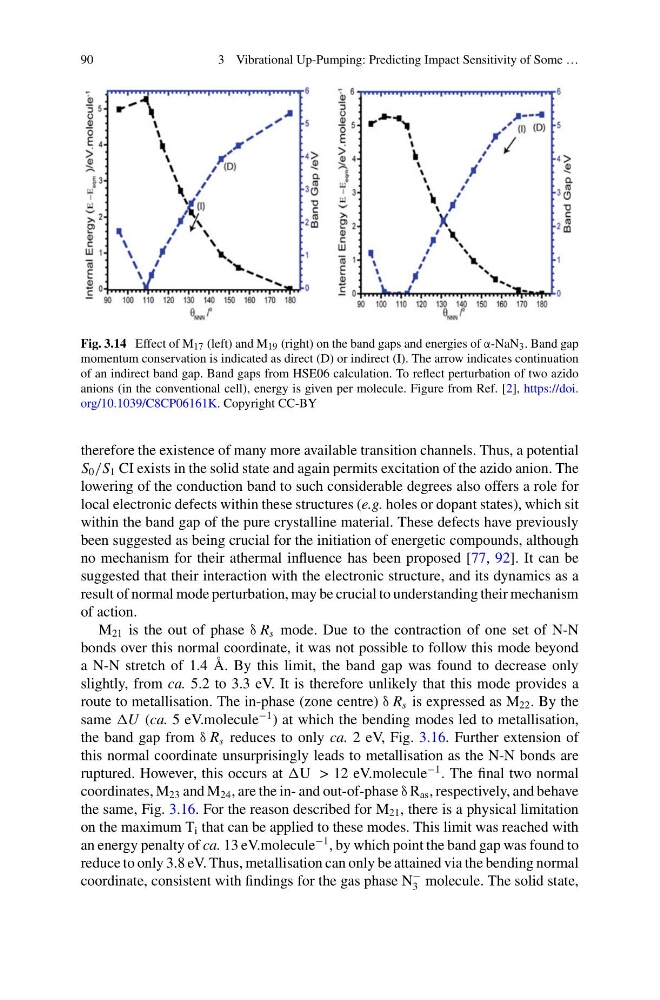
Fig. 3.14 Effect of M 17 (left) and M 19 (right) on the band gaps and energies of α-NaN 3 . Band gap
momentum conservation is indicated as direct (D) or indirect (I). The arrow indicates continuation
of an indirect band gap. Band gaps from HSE06 calculation. To reflect perturbation of two azido
anions (in the conventional cell), energy is given per molecule. Figure from Ref. [2], https://doi.
org/10.1039/C8CP06161K. Copyright CC-BY
therefore the existence of many more available transition channels. Thus, a potential
S 0 /S 1 CI exists in the solid state and again permits excitation of the azido anion. The
lowering of the conduction band to such considerable degrees also offers a role for
local electronic defects within these structures (e.g. holes or dopant states), which sit
within the band gap of the pure crystalline material. These defects have previously
been suggested as being crucial for the initiation of energetic compounds, although
no mechanism for their athermal influence has been proposed [77, 92]. It can be
suggested that their interaction with the electronic structure, and its dynamics as a
result of normal mode perturbation, may be crucial to understanding their mechanism
of action.
M 21 is the out of phase δ R s mode. Due to the contraction of one set of N-N
bonds over this normal coordinate, it was not possible to follow this mode beyond
a N-N stretch of 1.4 Å. By this limit, the band gap was found to decrease only
slightly, from ca. 5.2 to 3.3 eV. It is therefore unlikely that this mode provides a
route to metallisation. The in-phase (zone centre) δ R s is expressed as M 22 . By the
same U (ca. 5 eV.molecule
−1 ) at which the bending modes led to metallisation,
the band gap from δ R s reduces to only ca. 2 eV, Fig. 3.16. Further extension of
this normal coordinate unsurprisingly leads to metallisation as the N-N bonds are
ruptured. However, this occurs at U > 12 eV.molecule
−1 . The final two normal
coordinates, M 23 and M 24 , are the in- and out-of-phase δ R as , respectively, and behave
the same, Fig. 3.16. For the reason described for M 21 , there is a physical limitation
on the maximum T i that can be applied to these modes. This limit was reached with
an energy penalty of ca. 13 eV.molecule
−1 , by which point the band gap was found to
reduce to only 3.8 eV. Thus, metallisation can only be attained via the bending normal
coordinate, consistent with findings for the gas phase N
−
3 molecule. The solid state,
3 Vibrational Up-Pumping: Predicting Impact Sensitivity of Some …
Fig. 3.14 Effect of M 17 (left) and M 19 (right) on the band gaps and energies of α-NaN 3 . Band gap
momentum conservation is indicated as direct (D) or indirect (I). The arrow indicates continuation
of an indirect band gap. Band gaps from HSE06 calculation. To reflect perturbation of two azido
anions (in the conventional cell), energy is given per molecule. Figure from Ref. [2], https://doi.
org/10.1039/C8CP06161K. Copyright CC-BY
therefore the existence of many more available transition channels. Thus, a potential
S 0 /S 1 CI exists in the solid state and again permits excitation of the azido anion. The
lowering of the conduction band to such considerable degrees also offers a role for
local electronic defects within these structures (e.g. holes or dopant states), which sit
within the band gap of the pure crystalline material. These defects have previously
been suggested as being crucial for the initiation of energetic compounds, although
no mechanism for their athermal influence has been proposed [77, 92]. It can be
suggested that their interaction with the electronic structure, and its dynamics as a
result of normal mode perturbation, may be crucial to understanding their mechanism
of action.
M 21 is the out of phase δ R s mode. Due to the contraction of one set of N-N
bonds over this normal coordinate, it was not possible to follow this mode beyond
a N-N stretch of 1.4 Å. By this limit, the band gap was found to decrease only
slightly, from ca. 5.2 to 3.3 eV. It is therefore unlikely that this mode provides a
route to metallisation. The in-phase (zone centre) δ R s is expressed as M 22 . By the
same U (ca. 5 eV.molecule
−1 ) at which the bending modes led to metallisation,
the band gap from δ R s reduces to only ca. 2 eV, Fig. 3.16. Further extension of
this normal coordinate unsurprisingly leads to metallisation as the N-N bonds are
ruptured. However, this occurs at U > 12 eV.molecule
−1 . The final two normal
coordinates, M 23 and M 24 , are the in- and out-of-phase δ R as , respectively, and behave
the same, Fig. 3.16. For the reason described for M 21 , there is a physical limitation
on the maximum T i that can be applied to these modes. This limit was reached with
an energy penalty of ca. 13 eV.molecule
−1 , by which point the band gap was found to
reduce to only 3.8 eV. Thus, metallisation can only be attained via the bending normal
coordinate, consistent with findings for the gas phase N
−
3 molecule. The solid state,