

3.5 Results and Discussion
81
θ NNN = 150
◦ , the dissociation barrier on the S 1 PES also decreases, albeit minimally
(from 1 eV to 0.88 eV). However, at this angle, dissociation on the S 1 surface is no
longer energetically favourable. If θ NNN is reduced further to 120
◦ (i.e. the geometry of the CI), the barrier to dissociation on the T 1 PES remains approximately
the same as at θ NNN = 150
◦ , 0.69 eV, although that on the S 0 surface drops drastically, from 3.6 to 1.6 eV, Fig. 3.7b. The dissociation barrier on the T 1 PES decreases
to 0.34 eV at θ NNN = 110
◦ , and is completely absent at θ NNN = 100
◦ . At both
θ N N N = 110
◦ and θ N N N = 100
◦ , dissociation on the T 1 PES is overall exothermic,
Fig. 3.7c–d. It follows that, near the T 1 /S 0 CI, dissociation of N
−
3 is more accessible
than under equilibrium, linear geometry.
The energies required to reach the CI for the pure azido anion are larger than are
generally considered attainable by measurement of temperatures under mild impacts
(typically < 3000 K). However, this energy translates into orders of 1.5 eV/molecule,
increasing with stronger impacts [17]. Furthermore, it has been shown that localisation of up-pumped energy in the region of defects can be substantially higher [6], and
sufficient to overcome bond dissociation barriers [14]. It is also worth mentioning
that the periodicity of the crystalline state leads to a reduction in the energy separation between ground and excited states, particularly in the sensitive azide materials.
Thus, smaller energies will be required to achieve this excitation in these materials.
The interaction of cations with the azido anion in polymeric and molecular systems
also reduces the frequency of the bending vibrational mode. The U associated with
these bends therefore decrease further. Critically, it is evident that electronic excitation of the azido anion can be achieved by a purely mechanical route, via the bending
motion of the molecule.
3.5.2 Metallisation in the Azides: Case Study of α-NaN 3
To assess the validity of the gas phase calculations within the solid state, the band
structure was followed as a function of the normal mode eigenvectors using an
example energetic azide, α-NaN 3 . With discussion of external vibrational modes, it
is non-trivial to define the eigenvector as a function of an internal coordinate. Instead,
it is convenient to define a perturbative term associated with ‘walking’ along each
eigenvector,
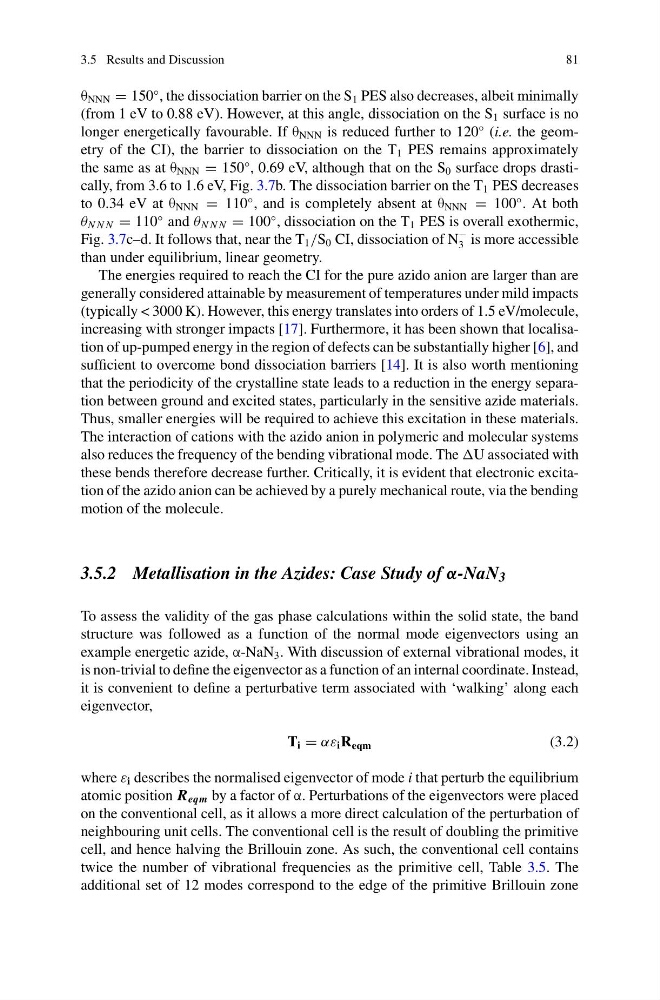
T i = αε i R eqm
(3.2)
where ε i describes the normalised eigenvector of mode i that perturb the equilibrium
atomic position R eqm by a factor of α. Perturbations of the eigenvectors were placed
on the conventional cell, as it allows a more direct calculation of the perturbation of
neighbouring unit cells. The conventional cell is the result of doubling the primitive
cell, and hence halving the Brillouin zone. As such, the conventional cell contains
twice the number of vibrational frequencies as the primitive cell, Table 3.5. The
additional set of 12 modes correspond to the edge of the primitive Brillouin zone
81
θ NNN = 150
◦ , the dissociation barrier on the S 1 PES also decreases, albeit minimally
(from 1 eV to 0.88 eV). However, at this angle, dissociation on the S 1 surface is no
longer energetically favourable. If θ NNN is reduced further to 120
◦ (i.e. the geometry of the CI), the barrier to dissociation on the T 1 PES remains approximately
the same as at θ NNN = 150
◦ , 0.69 eV, although that on the S 0 surface drops drastically, from 3.6 to 1.6 eV, Fig. 3.7b. The dissociation barrier on the T 1 PES decreases
to 0.34 eV at θ NNN = 110
◦ , and is completely absent at θ NNN = 100
◦ . At both
θ N N N = 110
◦ and θ N N N = 100
◦ , dissociation on the T 1 PES is overall exothermic,
Fig. 3.7c–d. It follows that, near the T 1 /S 0 CI, dissociation of N
−
3 is more accessible
than under equilibrium, linear geometry.
The energies required to reach the CI for the pure azido anion are larger than are
generally considered attainable by measurement of temperatures under mild impacts
(typically < 3000 K). However, this energy translates into orders of 1.5 eV/molecule,
increasing with stronger impacts [17]. Furthermore, it has been shown that localisation of up-pumped energy in the region of defects can be substantially higher [6], and
sufficient to overcome bond dissociation barriers [14]. It is also worth mentioning
that the periodicity of the crystalline state leads to a reduction in the energy separation between ground and excited states, particularly in the sensitive azide materials.
Thus, smaller energies will be required to achieve this excitation in these materials.
The interaction of cations with the azido anion in polymeric and molecular systems
also reduces the frequency of the bending vibrational mode. The U associated with
these bends therefore decrease further. Critically, it is evident that electronic excitation of the azido anion can be achieved by a purely mechanical route, via the bending
motion of the molecule.
3.5.2 Metallisation in the Azides: Case Study of α-NaN 3
To assess the validity of the gas phase calculations within the solid state, the band
structure was followed as a function of the normal mode eigenvectors using an
example energetic azide, α-NaN 3 . With discussion of external vibrational modes, it
is non-trivial to define the eigenvector as a function of an internal coordinate. Instead,
it is convenient to define a perturbative term associated with ‘walking’ along each
eigenvector,
T i = αε i R eqm
(3.2)
where ε i describes the normalised eigenvector of mode i that perturb the equilibrium
atomic position R eqm by a factor of α. Perturbations of the eigenvectors were placed
on the conventional cell, as it allows a more direct calculation of the perturbation of
neighbouring unit cells. The conventional cell is the result of doubling the primitive
cell, and hence halving the Brillouin zone. As such, the conventional cell contains
twice the number of vibrational frequencies as the primitive cell, Table 3.5. The
additional set of 12 modes correspond to the edge of the primitive Brillouin zone