

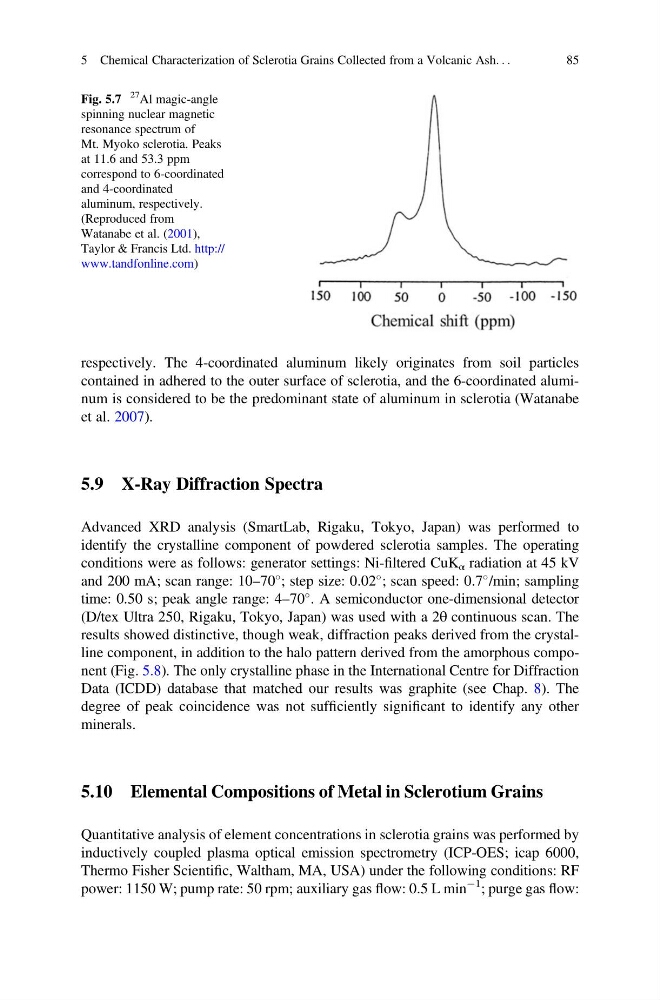
respectively. The 4-coordinated aluminum likely originates from soil particles
contained in adhered to the outer surface of sclerotia, and the 6-coordinated aluminum is considered to be the predominant state of aluminum in sclerotia (Watanabe
et al. 2007).
5.9 X-Ray Diffraction Spectra
Advanced XRD analysis (SmartLab, Rigaku, Tokyo, Japan) was performed to
identify the crystalline component of powdered sclerotia samples. The operating
conditions were as follows: generator settings: Ni-filtered CuK α radiation at 45 kV
and 200 mA; scan range: 10–70
; step size: 0.02
; scan speed: 0.7
/min; sampling
time: 0.50 s; peak angle range: 4–70
. A semiconductor one-dimensional detector
(D/tex Ultra 250, Rigaku, Tokyo, Japan) was used with a 2θ continuous scan. The
results showed distinctive, though weak, diffraction peaks derived from the crystalline component, in addition to the halo pattern derived from the amorphous component (Fig. 5.8). The only crystalline phase in the International Centre for Diffraction
Data (ICDD) database that matched our results was graphite (see Chap. 8). The
degree of peak coincidence was not sufficiently significant to identify any other
minerals.
5.10 Elemental Compositions of Metal in Sclerotium Grains
Quantitative analysis of element concentrations in sclerotia grains was performed by
inductively coupled plasma optical emission spectrometry (ICP-OES; icap 6000,
Thermo Fisher Scientific, Waltham, MA, USA) under the following conditions: RF
power: 1150 W; pump rate: 50 rpm; auxiliary gas flow: 0.5 L min
À1 ; purge gas flow:
Fig. 5.7
27
Al magic-angle
spinning nuclear magnetic
resonance spectrum of
Mt. Myoko sclerotia. Peaks
at 11.6 and 53.3 ppm
correspond to 6-coordinated
and 4-coordinated
aluminum, respectively.
(Reproduced from
Watanabe et al. (2001),
Taylor & Francis Ltd. http://
www.tandfonline.com)
5 Chemical Characterization of Sclerotia Grains Collected from a Volcanic Ash. . .
85
contained in adhered to the outer surface of sclerotia, and the 6-coordinated aluminum is considered to be the predominant state of aluminum in sclerotia (Watanabe
et al. 2007).
5.9 X-Ray Diffraction Spectra
Advanced XRD analysis (SmartLab, Rigaku, Tokyo, Japan) was performed to
identify the crystalline component of powdered sclerotia samples. The operating
conditions were as follows: generator settings: Ni-filtered CuK α radiation at 45 kV
and 200 mA; scan range: 10–70
; step size: 0.02
; scan speed: 0.7
/min; sampling
time: 0.50 s; peak angle range: 4–70
. A semiconductor one-dimensional detector
(D/tex Ultra 250, Rigaku, Tokyo, Japan) was used with a 2θ continuous scan. The
results showed distinctive, though weak, diffraction peaks derived from the crystalline component, in addition to the halo pattern derived from the amorphous component (Fig. 5.8). The only crystalline phase in the International Centre for Diffraction
Data (ICDD) database that matched our results was graphite (see Chap. 8). The
degree of peak coincidence was not sufficiently significant to identify any other
minerals.
5.10 Elemental Compositions of Metal in Sclerotium Grains
Quantitative analysis of element concentrations in sclerotia grains was performed by
inductively coupled plasma optical emission spectrometry (ICP-OES; icap 6000,
Thermo Fisher Scientific, Waltham, MA, USA) under the following conditions: RF
power: 1150 W; pump rate: 50 rpm; auxiliary gas flow: 0.5 L min
À1 ; purge gas flow:
Fig. 5.7
27
Al magic-angle
spinning nuclear magnetic
resonance spectrum of
Mt. Myoko sclerotia. Peaks
at 11.6 and 53.3 ppm
correspond to 6-coordinated
and 4-coordinated
aluminum, respectively.
(Reproduced from
Watanabe et al. (2001),
Taylor & Francis Ltd. http://
www.tandfonline.com)
5 Chemical Characterization of Sclerotia Grains Collected from a Volcanic Ash. . .
85