

Laccaria sp. at Akita, Arthrinium arundinis at Mt. Chokai, Inonotus sp. at Iwaki, and
Tuber sp. at Nagano.
The main ectomycorrhizal fungi associated with soil mesofauna were Laccaria
laccata for Acari at Akita, Chokai, and Minamiosawa; Inonotus sp. for Acari at
Akita; Paxillus obscurosporus for Collembola at Chokai and Minamiosawa;
Phyllactinia sp. for Acari at Chokai; Tuber aestivum for Acari at Chokai, Iwaki,
and Minamiosawa; Inocybe sp. for Collembola at Chokai and Iwaki; and
Trichoderma viride for Acari at Iwaki and for Collembola at Akita and Iwaki.
A summary of the ectomycorrhizal fungi identified in soil, sclerotia, and
mesofauna samples at the four study sites is shown in Figs. 3.12, 3.13, 3.14, 3.15
and 3.16. The vertical red boxes in these figures highlight ectomycorrhizal species
identified across sclerotia, mesofauna, and soil samples. Interestingly, at Chokai,
Iwaki, and Nagano, where ectomycorrhizal fungal sclerotia were relatively abundant, the same species were less abundant or undetected in Acari and/or Collembola.
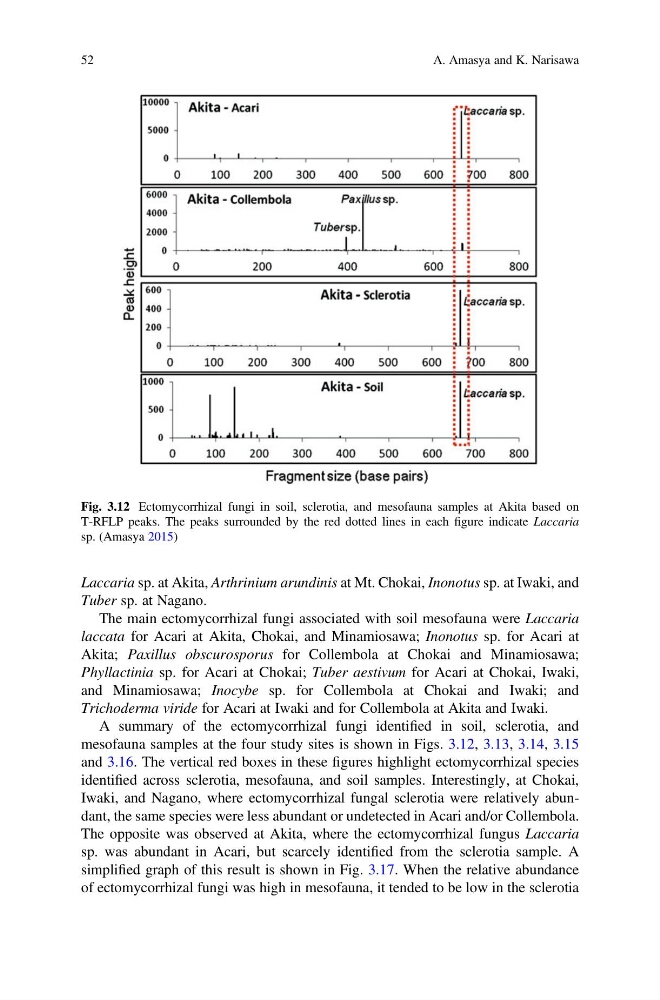
The opposite was observed at Akita, where the ectomycorrhizal fungus Laccaria
sp. was abundant in Acari, but scarcely identified from the sclerotia sample. A
simplified graph of this result is shown in Fig. 3.17. When the relative abundance
of ectomycorrhizal fungi was high in mesofauna, it tended to be low in the sclerotia
Fig. 3.12 Ectomycorrhizal fungi in soil, sclerotia, and mesofauna samples at Akita based on
T-RFLP peaks. The peaks surrounded by the red dotted lines in each figure indicate Laccaria
sp. (Amasya 2015)
52
A. Amasya and K. Narisawa
Tuber sp. at Nagano.
The main ectomycorrhizal fungi associated with soil mesofauna were Laccaria
laccata for Acari at Akita, Chokai, and Minamiosawa; Inonotus sp. for Acari at
Akita; Paxillus obscurosporus for Collembola at Chokai and Minamiosawa;
Phyllactinia sp. for Acari at Chokai; Tuber aestivum for Acari at Chokai, Iwaki,
and Minamiosawa; Inocybe sp. for Collembola at Chokai and Iwaki; and
Trichoderma viride for Acari at Iwaki and for Collembola at Akita and Iwaki.
A summary of the ectomycorrhizal fungi identified in soil, sclerotia, and
mesofauna samples at the four study sites is shown in Figs. 3.12, 3.13, 3.14, 3.15
and 3.16. The vertical red boxes in these figures highlight ectomycorrhizal species
identified across sclerotia, mesofauna, and soil samples. Interestingly, at Chokai,
Iwaki, and Nagano, where ectomycorrhizal fungal sclerotia were relatively abundant, the same species were less abundant or undetected in Acari and/or Collembola.
The opposite was observed at Akita, where the ectomycorrhizal fungus Laccaria
sp. was abundant in Acari, but scarcely identified from the sclerotia sample. A
simplified graph of this result is shown in Fig. 3.17. When the relative abundance
of ectomycorrhizal fungi was high in mesofauna, it tended to be low in the sclerotia
Fig. 3.12 Ectomycorrhizal fungi in soil, sclerotia, and mesofauna samples at Akita based on
T-RFLP peaks. The peaks surrounded by the red dotted lines in each figure indicate Laccaria
sp. (Amasya 2015)
52
A. Amasya and K. Narisawa