

3.2.2 Results and Discussion
3.2.2.1 Soil Mesofauna Characteristics
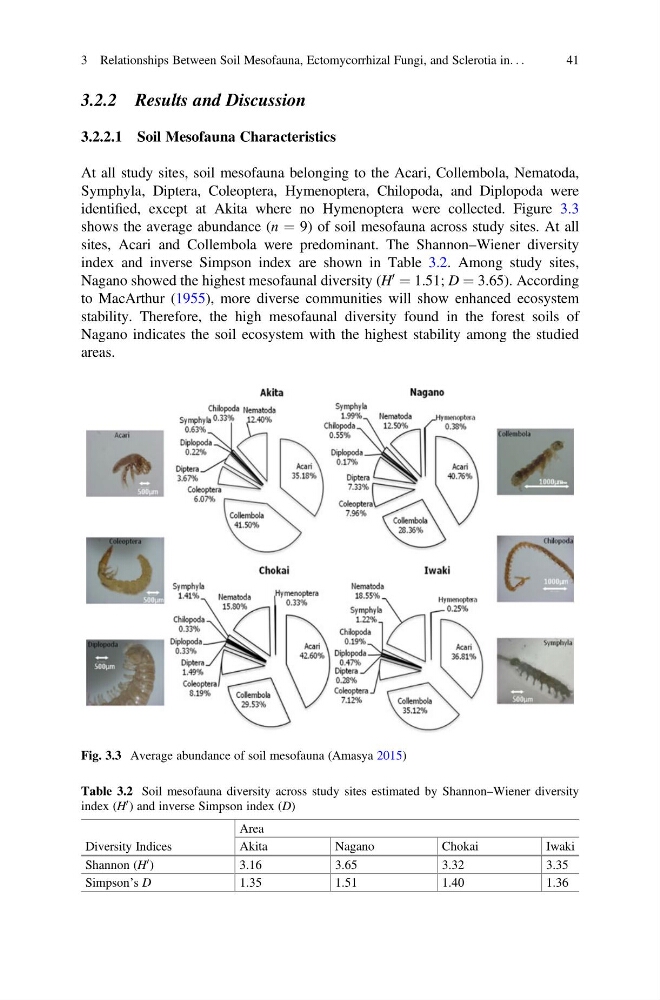
At all study sites, soil mesofauna belonging to the Acari, Collembola, Nematoda,
Symphyla, Diptera, Coleoptera, Hymenoptera, Chilopoda, and Diplopoda were
identified, except at Akita where no Hymenoptera were collected. Figure 3.3
shows the average abundance (n ¼ 9) of soil mesofauna across study sites. At all
sites, Acari and Collembola were predominant. The Shannon–Wiener diversity
index and inverse Simpson index are shown in Table 3.2. Among study sites,
Nagano showed the highest mesofaunal diversity (H
0
¼ 1.51; D ¼ 3.65). According
to MacArthur (1955), more diverse communities will show enhanced ecosystem
stability. Therefore, the high mesofaunal diversity found in the forest soils of
Nagano indicates the soil ecosystem with the highest stability among the studied
areas.
Fig. 3.3 Average abundance of soil mesofauna (Amasya 2015)
Table 3.2 Soil mesofauna diversity across study sites estimated by Shannon–Wiener diversity
index (H
0 ) and inverse Simpson index (D)
Diversity Indices
Area
Akita
Nagano
Chokai
Iwaki
Shannon (H
0 )
3.16
3.65
3.32
3.35
Simpson’s D
1.35
1.51
1.40
1.36
3 Relationships Between Soil Mesofauna, Ectomycorrhizal Fungi, and Sclerotia in. . .
41
3.2.2.1 Soil Mesofauna Characteristics
At all study sites, soil mesofauna belonging to the Acari, Collembola, Nematoda,
Symphyla, Diptera, Coleoptera, Hymenoptera, Chilopoda, and Diplopoda were
identified, except at Akita where no Hymenoptera were collected. Figure 3.3
shows the average abundance (n ¼ 9) of soil mesofauna across study sites. At all
sites, Acari and Collembola were predominant. The Shannon–Wiener diversity
index and inverse Simpson index are shown in Table 3.2. Among study sites,
Nagano showed the highest mesofaunal diversity (H
0
¼ 1.51; D ¼ 3.65). According
to MacArthur (1955), more diverse communities will show enhanced ecosystem
stability. Therefore, the high mesofaunal diversity found in the forest soils of
Nagano indicates the soil ecosystem with the highest stability among the studied
areas.
Fig. 3.3 Average abundance of soil mesofauna (Amasya 2015)
Table 3.2 Soil mesofauna diversity across study sites estimated by Shannon–Wiener diversity
index (H
0 ) and inverse Simpson index (D)
Diversity Indices
Area
Akita
Nagano
Chokai
Iwaki
Shannon (H
0 )
3.16
3.65
3.32
3.35
Simpson’s D
1.35
1.51
1.40
1.36
3 Relationships Between Soil Mesofauna, Ectomycorrhizal Fungi, and Sclerotia in. . .
41