

10.1.2.2 Measurement of Sclerotia Grain Content
Distilled water (500 mL) was added to 30 g of oven-dried soil (105
C, 24 h), then
stirred, and the floating sclerotia grains (>0.5 mm in diameter) were collected by
using tweezers and air-dried. Sclerotia grain content was determined based on the
count or the weight of oven-dried sclerotia grains per gram of oven-dried soil.
10.1.2.3 Scanning Electron Microscopy and Energy Dispersive X-ray
Spectroscopy of Sclerotia Grains
Sclerotia grains were sliced in half with a sterilized knife and the internal morphological features were observed using a scanning electron microscope (SEM) (S-800:
Hitachi Ltd., Tokyo, Japan). The elemental composition of the internal structures
(targeted area: 100–200 μm) was determined by using energy dispersive X-ray
spectrometry (EDS) (PV9900I, EDAX Mahwah, NJ, USA).
10.1.2.4 Chemical Analyses
All soil samples were air-dried and passed through a 0.5-mm sieve for elemental
analysis or through a 2.0-mm sieve for determination of humus composition, cation
exchange capacity (CEC), content of exchangeable bases (Na, K, Mg, Ca), selective
dissolution, Al Ex , and pH value. Analyses of element composition, humus composition, CEC, exchangeable bases, and mineral composition were performed only for
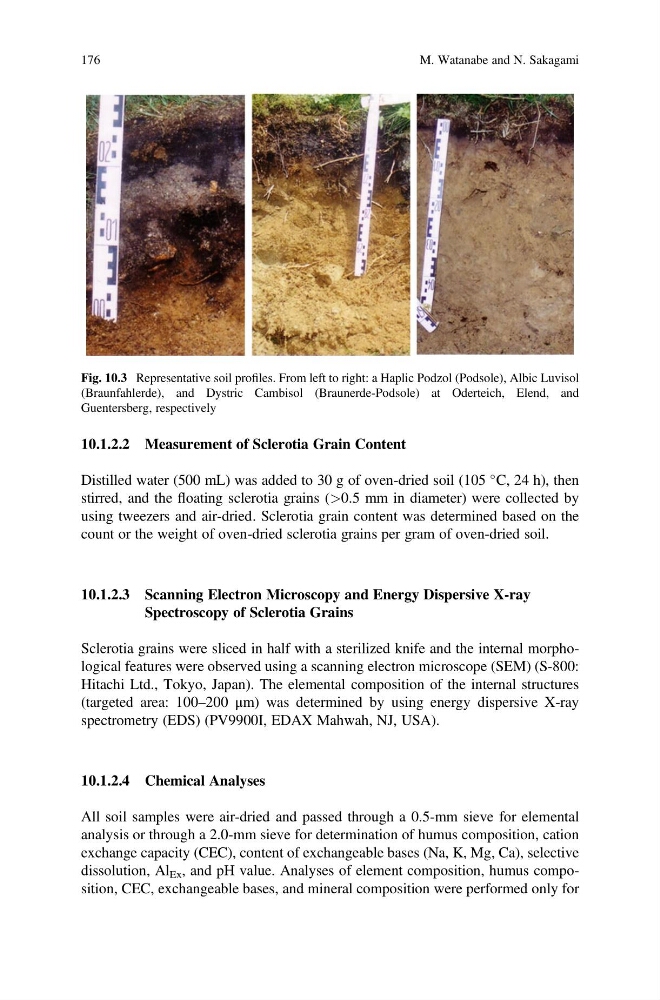
Fig. 10.3 Representative soil profiles. From left to right: a Haplic Podzol (Podsole), Albic Luvisol
(Braunfahlerde), and Dystric Cambisol (Braunerde-Podsole) at Oderteich, Elend, and
Guentersberg, respectively
176
M. Watanabe and N. Sakagami
Distilled water (500 mL) was added to 30 g of oven-dried soil (105
C, 24 h), then
stirred, and the floating sclerotia grains (>0.5 mm in diameter) were collected by
using tweezers and air-dried. Sclerotia grain content was determined based on the
count or the weight of oven-dried sclerotia grains per gram of oven-dried soil.
10.1.2.3 Scanning Electron Microscopy and Energy Dispersive X-ray
Spectroscopy of Sclerotia Grains
Sclerotia grains were sliced in half with a sterilized knife and the internal morphological features were observed using a scanning electron microscope (SEM) (S-800:
Hitachi Ltd., Tokyo, Japan). The elemental composition of the internal structures
(targeted area: 100–200 μm) was determined by using energy dispersive X-ray
spectrometry (EDS) (PV9900I, EDAX Mahwah, NJ, USA).
10.1.2.4 Chemical Analyses
All soil samples were air-dried and passed through a 0.5-mm sieve for elemental
analysis or through a 2.0-mm sieve for determination of humus composition, cation
exchange capacity (CEC), content of exchangeable bases (Na, K, Mg, Ca), selective
dissolution, Al Ex , and pH value. Analyses of element composition, humus composition, CEC, exchangeable bases, and mineral composition were performed only for
Fig. 10.3 Representative soil profiles. From left to right: a Haplic Podzol (Podsole), Albic Luvisol
(Braunfahlerde), and Dystric Cambisol (Braunerde-Podsole) at Oderteich, Elend, and
Guentersberg, respectively
176
M. Watanabe and N. Sakagami