

10.1 Distribution of Sclerotia Grains in Forest Soil Profiles
in the Harz Mountains
10.1.1 Introduction
Kumada and Hurst (1967) examined sclerotia grains of Cenococcum graniforme
(currently Cenococcum geophilum) in Podzols in Britain and Sweden. They showed
that the density of sclerotia grains was higher in the B horizon than in the A horizon.
Studies of sclerotia grains in Andosols in Japan showed that sclerotia grains collected from acidic forest soils contain aluminum in the form of aluminum–humus
complexes. Furthermore, the distribution of sclerotia grains in several Andosol
profiles in Japan indicated that sclerotia grains are present in surface A and buried
A horizons of nonallophanic (organic bonding aluminum/amorphous aluminum
[Al p /Al o ] > 0.5) soils, and that the mean weight of individual sclerotia grains was
highly correlated with the content of exchangeable aluminum (Al Ex ) (Watanabe et al.
2001, 2002). These findings suggest that the development of sclerotia grains in
Andosols is dependent on the status of active aluminum in the soil and may be part of
a symbiotic relationship, protecting plant roots from toxic aluminum ions. We
performed a comparative study in the Harz Mountains of central Germany, examining the distribution of sclerotia grains and the chemical properties of non-volcanic
ash soils to determine whether aluminum status in soils is an important factor for
sclerotium development at low pH.
10.1.2 Materials and Methods
10.1.2.1 Geography and Soil Profiles of the Study Area
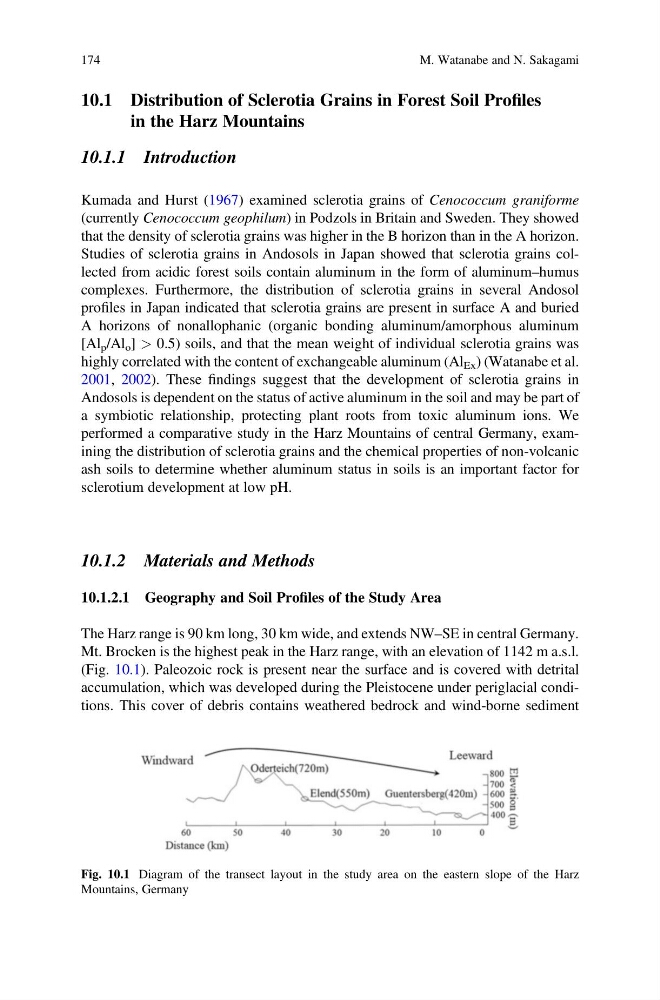
The Harz range is 90 km long, 30 km wide, and extends NW–SE in central Germany.
Mt. Brocken is the highest peak in the Harz range, with an elevation of 1142 m a.s.l.
(Fig. 10.1). Paleozoic rock is present near the surface and is covered with detrital
accumulation, which was developed during the Pleistocene under periglacial conditions. This cover of debris contains weathered bedrock and wind-borne sediment
Fig. 10.1 Diagram of the transect layout in the study area on the eastern slope of the Harz
Mountains, Germany
174
M. Watanabe and N. Sakagami
in the Harz Mountains
10.1.1 Introduction
Kumada and Hurst (1967) examined sclerotia grains of Cenococcum graniforme
(currently Cenococcum geophilum) in Podzols in Britain and Sweden. They showed
that the density of sclerotia grains was higher in the B horizon than in the A horizon.
Studies of sclerotia grains in Andosols in Japan showed that sclerotia grains collected from acidic forest soils contain aluminum in the form of aluminum–humus
complexes. Furthermore, the distribution of sclerotia grains in several Andosol
profiles in Japan indicated that sclerotia grains are present in surface A and buried
A horizons of nonallophanic (organic bonding aluminum/amorphous aluminum
[Al p /Al o ] > 0.5) soils, and that the mean weight of individual sclerotia grains was
highly correlated with the content of exchangeable aluminum (Al Ex ) (Watanabe et al.
2001, 2002). These findings suggest that the development of sclerotia grains in
Andosols is dependent on the status of active aluminum in the soil and may be part of
a symbiotic relationship, protecting plant roots from toxic aluminum ions. We
performed a comparative study in the Harz Mountains of central Germany, examining the distribution of sclerotia grains and the chemical properties of non-volcanic
ash soils to determine whether aluminum status in soils is an important factor for
sclerotium development at low pH.
10.1.2 Materials and Methods
10.1.2.1 Geography and Soil Profiles of the Study Area
The Harz range is 90 km long, 30 km wide, and extends NW–SE in central Germany.
Mt. Brocken is the highest peak in the Harz range, with an elevation of 1142 m a.s.l.
(Fig. 10.1). Paleozoic rock is present near the surface and is covered with detrital
accumulation, which was developed during the Pleistocene under periglacial conditions. This cover of debris contains weathered bedrock and wind-borne sediment
Fig. 10.1 Diagram of the transect layout in the study area on the eastern slope of the Harz
Mountains, Germany
174
M. Watanabe and N. Sakagami