

9.1 Introduction
Cenococcum geophilum Fr. (Cg) is known for its vast habitat range (LoBuglio
1999). Ectomycorrhiza of Cg have a worldwide distribution from temperate to
arctic-alpine climatic zones, and have even been observed above the Arctic Circle
in Alaska and the Canadian High Arctic (75
33
0 N, 84
40
0 W) and at timber line in the
Washington and Oregon Cascade mountain range as an important symbiont of trees
(Trappe 1964, 1988; Haselwandter and Read 1982; Bledsoe et al. 1989). Such wide
distribution of Cg suggests the adaptability of it against severe environments. The
experiment, which demonstrated that Cg still grew in soils under exposure of
simulated rain at pH 2.5 (Meier et al. 1989), suggests one of the excel ability in
soil ecosystem. According to Trappe (1969), sclerotia of Cg tend to be particularly
abundant near Cg mycorrhizae. It is also well known that mycorrhizal root tips and
sclerotia have their maximum production in autumn (e.g., Vogt et al. 1981, 1982;
Lussenhop and Fogel 1999).
Watanabe et al. (2002) reported that Cg sclerotia distribute in acidic soils which
are non-allophanic (Al p /Al o > 0.5), and tend to form larger grains in soils with a
higher content of exchangeable aluminum (Al Ex ) which is potentially phyto-toxic for
plant roots. Watanabe et al. (2007b) reported the
14
C ages of sclerotia collected from
buried A horizons of Fulvic Andosol in Mt. Myoko, central Japan, as ca. 300–1200year BP and thus they exhibited its persistence as a structural organic component in
soils.
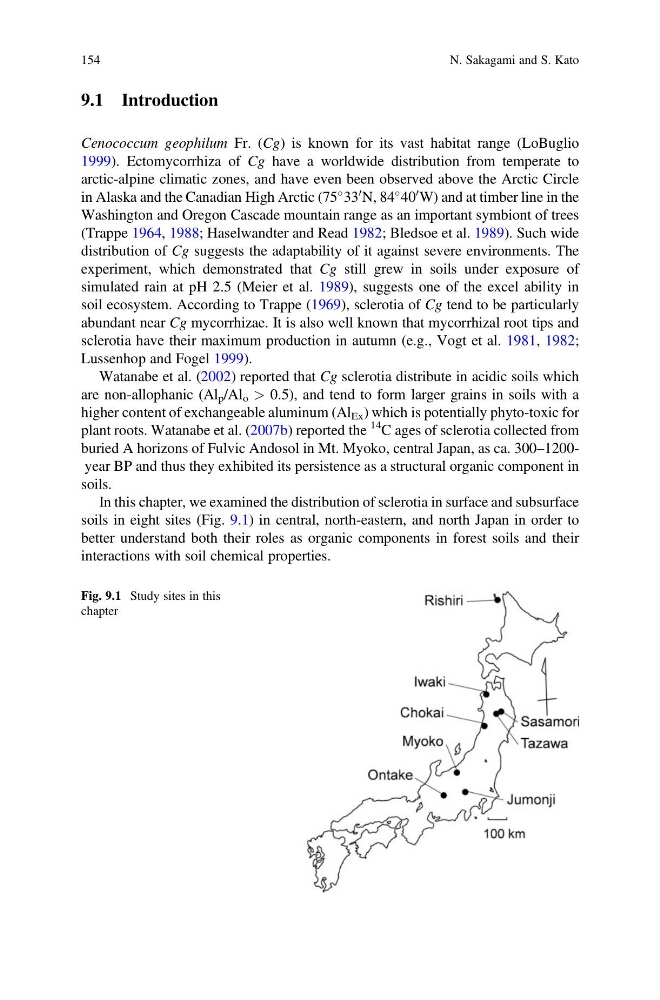
In this chapter, we examined the distribution of sclerotia in surface and subsurface
soils in eight sites (Fig. 9.1) in central, north-eastern, and north Japan in order to
better understand both their roles as organic components in forest soils and their
interactions with soil chemical properties.
Fig. 9.1 Study sites in this
chapter
154
N. Sakagami and S. Kato
Cenococcum geophilum Fr. (Cg) is known for its vast habitat range (LoBuglio
1999). Ectomycorrhiza of Cg have a worldwide distribution from temperate to
arctic-alpine climatic zones, and have even been observed above the Arctic Circle
in Alaska and the Canadian High Arctic (75
33
0 N, 84
40
0 W) and at timber line in the
Washington and Oregon Cascade mountain range as an important symbiont of trees
(Trappe 1964, 1988; Haselwandter and Read 1982; Bledsoe et al. 1989). Such wide
distribution of Cg suggests the adaptability of it against severe environments. The
experiment, which demonstrated that Cg still grew in soils under exposure of
simulated rain at pH 2.5 (Meier et al. 1989), suggests one of the excel ability in
soil ecosystem. According to Trappe (1969), sclerotia of Cg tend to be particularly
abundant near Cg mycorrhizae. It is also well known that mycorrhizal root tips and
sclerotia have their maximum production in autumn (e.g., Vogt et al. 1981, 1982;
Lussenhop and Fogel 1999).
Watanabe et al. (2002) reported that Cg sclerotia distribute in acidic soils which
are non-allophanic (Al p /Al o > 0.5), and tend to form larger grains in soils with a
higher content of exchangeable aluminum (Al Ex ) which is potentially phyto-toxic for
plant roots. Watanabe et al. (2007b) reported the
14
C ages of sclerotia collected from
buried A horizons of Fulvic Andosol in Mt. Myoko, central Japan, as ca. 300–1200year BP and thus they exhibited its persistence as a structural organic component in
soils.
In this chapter, we examined the distribution of sclerotia in surface and subsurface
soils in eight sites (Fig. 9.1) in central, north-eastern, and north Japan in order to
better understand both their roles as organic components in forest soils and their
interactions with soil chemical properties.
Fig. 9.1 Study sites in this
chapter
154
N. Sakagami and S. Kato