

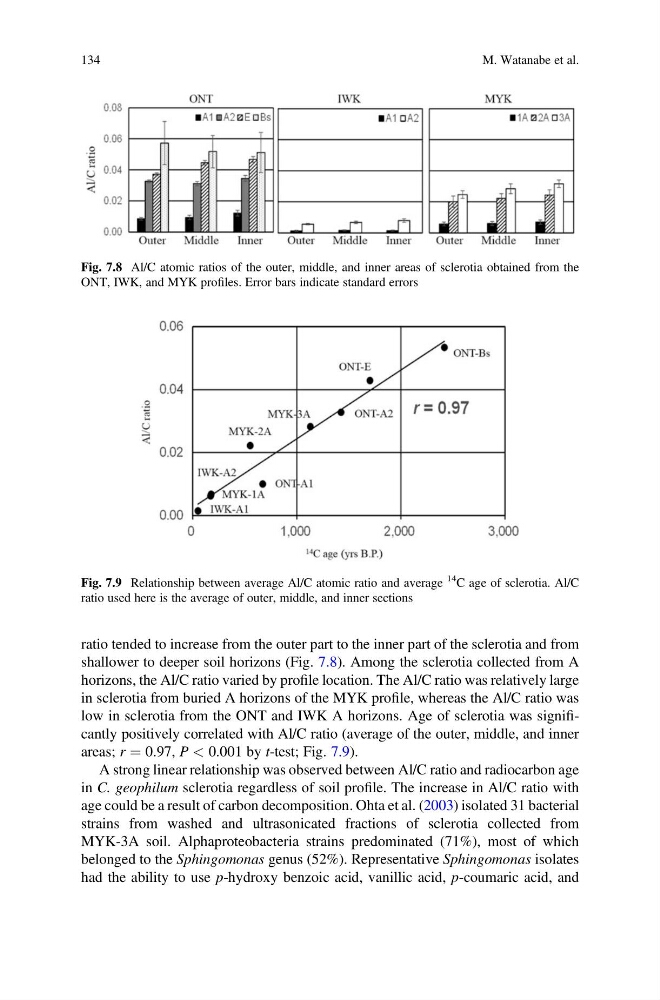
ratio tended to increase from the outer part to the inner part of the sclerotia and from
shallower to deeper soil horizons (Fig. 7.8). Among the sclerotia collected from A
horizons, the Al/C ratio varied by profile location. The Al/C ratio was relatively large
in sclerotia from buried A horizons of the MYK profile, whereas the Al/C ratio was
low in sclerotia from the ONT and IWK A horizons. Age of sclerotia was significantly positively correlated with Al/C ratio (average of the outer, middle, and inner
areas; r ¼ 0.97, P < 0.001 by t-test; Fig. 7.9).
A strong linear relationship was observed between Al/C ratio and radiocarbon age
in C. geophilum sclerotia regardless of soil profile. The increase in Al/C ratio with
age could be a result of carbon decomposition. Ohta et al. (2003) isolated 31 bacterial
strains from washed and ultrasonicated fractions of sclerotia collected from
MYK-3A soil. Alphaproteobacteria strains predominated (71%), most of which
belonged to the Sphingomonas genus (52%). Representative Sphingomonas isolates
had the ability to use p-hydroxy benzoic acid, vanillic acid, p-coumaric acid, and
Fig. 7.8 Al/C atomic ratios of the outer, middle, and inner areas of sclerotia obtained from the
ONT, IWK, and MYK profiles. Error bars indicate standard errors
Fig. 7.9 Relationship between average Al/C atomic ratio and average
14 C age of sclerotia. Al/C
ratio used here is the average of outer, middle, and inner sections
134
M. Watanabe et al.
shallower to deeper soil horizons (Fig. 7.8). Among the sclerotia collected from A
horizons, the Al/C ratio varied by profile location. The Al/C ratio was relatively large
in sclerotia from buried A horizons of the MYK profile, whereas the Al/C ratio was
low in sclerotia from the ONT and IWK A horizons. Age of sclerotia was significantly positively correlated with Al/C ratio (average of the outer, middle, and inner
areas; r ¼ 0.97, P < 0.001 by t-test; Fig. 7.9).
A strong linear relationship was observed between Al/C ratio and radiocarbon age
in C. geophilum sclerotia regardless of soil profile. The increase in Al/C ratio with
age could be a result of carbon decomposition. Ohta et al. (2003) isolated 31 bacterial
strains from washed and ultrasonicated fractions of sclerotia collected from
MYK-3A soil. Alphaproteobacteria strains predominated (71%), most of which
belonged to the Sphingomonas genus (52%). Representative Sphingomonas isolates
had the ability to use p-hydroxy benzoic acid, vanillic acid, p-coumaric acid, and
Fig. 7.8 Al/C atomic ratios of the outer, middle, and inner areas of sclerotia obtained from the
ONT, IWK, and MYK profiles. Error bars indicate standard errors
Fig. 7.9 Relationship between average Al/C atomic ratio and average
14 C age of sclerotia. Al/C
ratio used here is the average of outer, middle, and inner sections
134
M. Watanabe et al.