

the AMS ion source. The
14 C/
12 C data from the samples were normalized using
14 C/
12 C standards. New oxalic acid (NIST SRM 4990C) was used as a standard
material.
14 C dates were calculated according to the procedure described by Stuiver
and Polach (1977) and are given as Libby ages (year BP). For MYK sclerotia, we
used the
14 C dates reported by Watanabe et al. (2007b).
7.3.1.3 SEM-EDS Analysis of Sclerotia
Five sclerotia grains from each horizon (excluding the BA and Bw horizons of IWK)
were washed with distilled water in an ultrasonic bath at a frequency of 38 kHz for
5 min and then dried in air. Intact grains without cracks in their rinds were selected
for analysis and sliced in half with a sterilized knife so that the elemental composition of the outer, middle, and inner areas of each grain could be determined
(Fig. 7.1). The elemental composition of each of the five sclerotia from each horizon
was determined with a thermal field emission scanning electron microscope
(JSM-7001F, JEOL, Tokyo, Japan; accelerating voltage, 15 kV) and an EDS
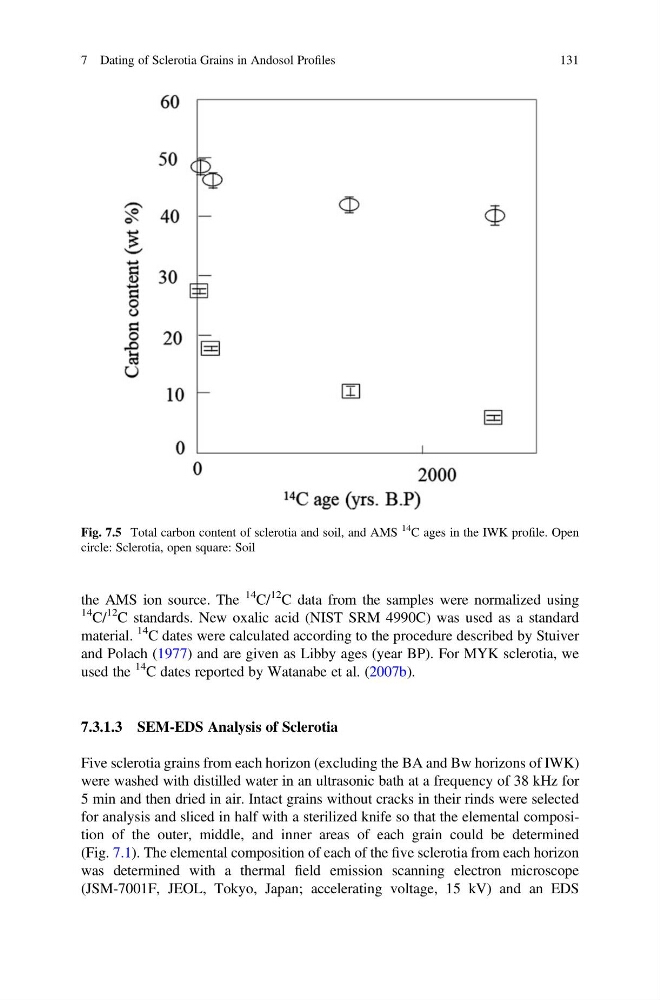
Fig. 7.5 Total carbon content of sclerotia and soil, and AMS
14
C ages in the IWK profile. Open
circle: Sclerotia, open square: Soil
7 Dating of Sclerotia Grains in Andosol Profiles
131
14 C/
12 C data from the samples were normalized using
14 C/
12 C standards. New oxalic acid (NIST SRM 4990C) was used as a standard
material.
14 C dates were calculated according to the procedure described by Stuiver
and Polach (1977) and are given as Libby ages (year BP). For MYK sclerotia, we
used the
14 C dates reported by Watanabe et al. (2007b).
7.3.1.3 SEM-EDS Analysis of Sclerotia
Five sclerotia grains from each horizon (excluding the BA and Bw horizons of IWK)
were washed with distilled water in an ultrasonic bath at a frequency of 38 kHz for
5 min and then dried in air. Intact grains without cracks in their rinds were selected
for analysis and sliced in half with a sterilized knife so that the elemental composition of the outer, middle, and inner areas of each grain could be determined
(Fig. 7.1). The elemental composition of each of the five sclerotia from each horizon
was determined with a thermal field emission scanning electron microscope
(JSM-7001F, JEOL, Tokyo, Japan; accelerating voltage, 15 kV) and an EDS
Fig. 7.5 Total carbon content of sclerotia and soil, and AMS
14
C ages in the IWK profile. Open
circle: Sclerotia, open square: Soil
7 Dating of Sclerotia Grains in Andosol Profiles
131