

Grains with diameters of <1 mm were collected by means of a flotation technique
using distilled water. The collected sclerotia were washed with distilled water to
remove soil adhering to their surfaces using an ultrasonic bath (US-1 generator, Iuchi
(AS ONE) Corp., Osaka; 70 W, 38 kHz, 5 min) and dried at 105
C for 24 h. The
weights and diameters of the samples were measured with a microbalance (AX26,
Mettler Toledo, Tokyo, Japan) and a digital high-density video microscope
(VH-7000, Keyence Corp., Osaka, Japan), respectively. The dried sclerotia were
separated into three size categories by diameter: large, >2 mm; medium, 1–2 mm;
and small, <1 mm.
AMS measurements of
14 C/
12 C ratios were performed with the tandem accelerator at the Micro Analysis Laboratory at The University of Tokyo, with an accelerating voltage of 5 MV, according to a previously reported procedure (Matsuzaki
et al. 2004). Briefly, all sclerotia samples were oxidized to CO 2 gas, which was
purified and then graphitized by hydrogenation over an iron powder catalyst. The
graphite samples were pressed with iron powder into cathode cones that were set at
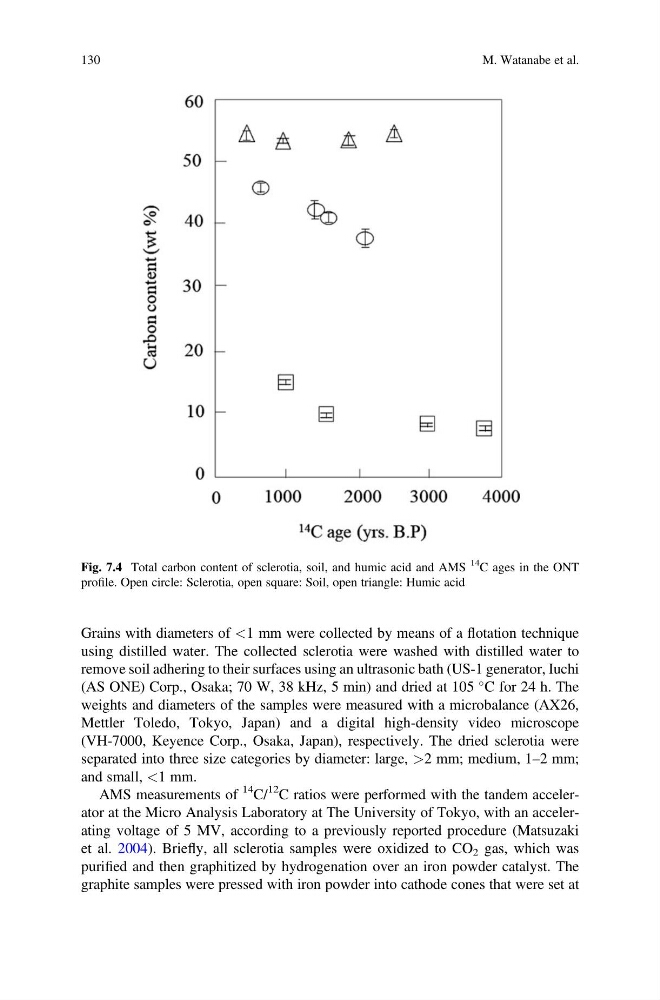
Fig. 7.4 Total carbon content of sclerotia, soil, and humic acid and AMS
14
C ages in the ONT
profile. Open circle: Sclerotia, open square: Soil, open triangle: Humic acid
130
M. Watanabe et al.
using distilled water. The collected sclerotia were washed with distilled water to
remove soil adhering to their surfaces using an ultrasonic bath (US-1 generator, Iuchi
(AS ONE) Corp., Osaka; 70 W, 38 kHz, 5 min) and dried at 105
C for 24 h. The
weights and diameters of the samples were measured with a microbalance (AX26,
Mettler Toledo, Tokyo, Japan) and a digital high-density video microscope
(VH-7000, Keyence Corp., Osaka, Japan), respectively. The dried sclerotia were
separated into three size categories by diameter: large, >2 mm; medium, 1–2 mm;
and small, <1 mm.
AMS measurements of
14 C/
12 C ratios were performed with the tandem accelerator at the Micro Analysis Laboratory at The University of Tokyo, with an accelerating voltage of 5 MV, according to a previously reported procedure (Matsuzaki
et al. 2004). Briefly, all sclerotia samples were oxidized to CO 2 gas, which was
purified and then graphitized by hydrogenation over an iron powder catalyst. The
graphite samples were pressed with iron powder into cathode cones that were set at
Fig. 7.4 Total carbon content of sclerotia, soil, and humic acid and AMS
14
C ages in the ONT
profile. Open circle: Sclerotia, open square: Soil, open triangle: Humic acid
130
M. Watanabe et al.