

7.2.2.1 MYK Profile
Figure 7.1 represents the distribution of
14 C ages of sclerotia in the Asadaira, Myoko
profile. Grains found in horizon 1A, 2A, and 3A were dated at 95 Æ 40 to
240 Æ 35 year BP, 305 Æ 30 to 1000 Æ 95 year BP, and 1020 Æ 35 to
1200 Æ 35 year BP, respectively. The ages were not calibrated for calendar age,
due to the large variation in atmospheric CO 2 over the past 200 years. The
14
C ages
of the grains in horizons 1A and 3A were concordant with the ages of the tephras,
although some grains in the 2A horizons were dated as younger than the deposition
age of the overlaid tephra, KG-b (650 Æ 100 year BP). As the thickness of KG-b
tephra was 3 cm or less and the depth of the tephra was 12–15 cm from surface, we
concluded that relatively young grains could have been formed by fungi colonizing
plant roots that extended into the 2A horizon.
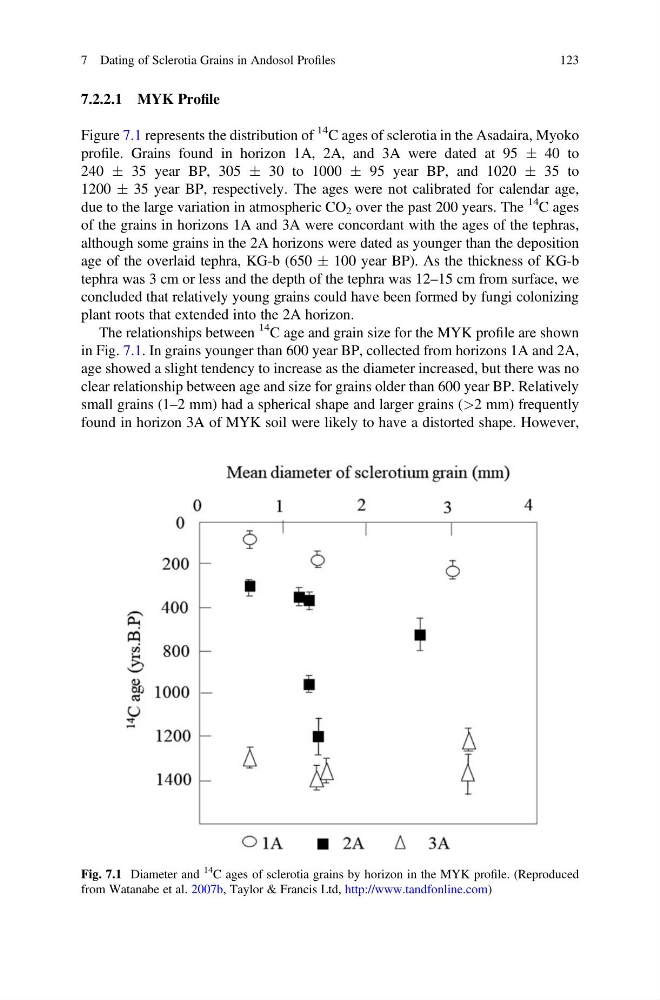
The relationships between
14 C age and grain size for the MYK profile are shown
in Fig. 7.1. In grains younger than 600 year BP, collected from horizons 1A and 2A,
age showed a slight tendency to increase as the diameter increased, but there was no
clear relationship between age and size for grains older than 600 year BP. Relatively
small grains (1–2 mm) had a spherical shape and larger grains (>2 mm) frequently
found in horizon 3A of MYK soil were likely to have a distorted shape. However,
Fig. 7.1 Diameter and
14
C ages of sclerotia grains by horizon in the MYK profile. (Reproduced
from Watanabe et al. 2007b, Taylor & Francis Ltd, http://www.tandfonline.com)
7 Dating of Sclerotia Grains in Andosol Profiles
123
Figure 7.1 represents the distribution of
14 C ages of sclerotia in the Asadaira, Myoko
profile. Grains found in horizon 1A, 2A, and 3A were dated at 95 Æ 40 to
240 Æ 35 year BP, 305 Æ 30 to 1000 Æ 95 year BP, and 1020 Æ 35 to
1200 Æ 35 year BP, respectively. The ages were not calibrated for calendar age,
due to the large variation in atmospheric CO 2 over the past 200 years. The
14
C ages
of the grains in horizons 1A and 3A were concordant with the ages of the tephras,
although some grains in the 2A horizons were dated as younger than the deposition
age of the overlaid tephra, KG-b (650 Æ 100 year BP). As the thickness of KG-b
tephra was 3 cm or less and the depth of the tephra was 12–15 cm from surface, we
concluded that relatively young grains could have been formed by fungi colonizing
plant roots that extended into the 2A horizon.
The relationships between
14 C age and grain size for the MYK profile are shown
in Fig. 7.1. In grains younger than 600 year BP, collected from horizons 1A and 2A,
age showed a slight tendency to increase as the diameter increased, but there was no
clear relationship between age and size for grains older than 600 year BP. Relatively
small grains (1–2 mm) had a spherical shape and larger grains (>2 mm) frequently
found in horizon 3A of MYK soil were likely to have a distorted shape. However,
Fig. 7.1 Diameter and
14
C ages of sclerotia grains by horizon in the MYK profile. (Reproduced
from Watanabe et al. 2007b, Taylor & Francis Ltd, http://www.tandfonline.com)
7 Dating of Sclerotia Grains in Andosol Profiles
123