

quite different soil properties (Iwami, Hiratsuka and Utsunomiya soils (Murayama
1988).
These studies suggest that there might be some essential difference in microbial
decomposition process between arabinose and xylose of plant materials. Two classes
of enzymes are responsible for release of the xylose residues from xylan structure of
plant materials, endoxylanases, and ß-xylosidases (Khosravi et al. 2015). On the
other hand, the complete release of arabinose residues from hemicelluloses and
pectin requires the concerted action of four arabinanolytic enzymes;
endoarabinanase, exoarabinanase, α-L-arabinofuranosidases, and arabinoxylan
arabinofuranohydrolase (Seiboth and Metz 2011; Khosravi et al. 2015). Furthermore, microbial catabolic pentose pathway of L-arabinose requires additional composite enzyme system to that of D-xylose (Nevoigt 2008: Khosravi et al. 2015).
These suggest that arabinose is less-preferred carbon source than xylose for
microroganisms. Derrien et al. (2006, 2007) reported that the turnover of arabinose
in particulate organic matter in a cultivated soil is slower than that of xylose and
glucose.
The more recalcitrant nature to microbial consumption of arabinose than xylose
of plant materials may contribute to accumulation of arabinose, hence to a much
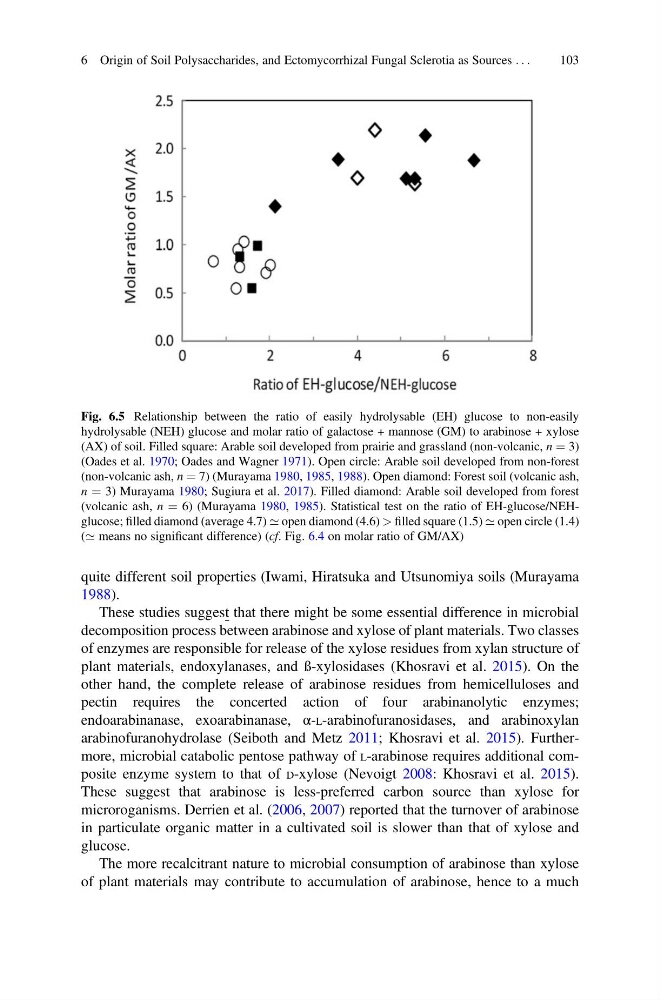
Fig. 6.5 Relationship between the ratio of easily hydrolysable (EH) glucose to non-easily
hydrolysable (NEH) glucose and molar ratio of galactose + mannose (GM) to arabinose + xylose
(AX) of soil. Filled square: Arable soil developed from prairie and grassland (non-volcanic, n ¼ 3)
(Oades et al. 1970; Oades and Wagner 1971). Open circle: Arable soil developed from non-forest
(non-volcanic ash, n ¼ 7) (Murayama 1980, 1985, 1988). Open diamond: Forest soil (volcanic ash,
n ¼ 3) Murayama 1980; Sugiura et al. 2017). Filled diamond: Arable soil developed from forest
(volcanic ash, n ¼ 6) (Murayama 1980, 1985). Statistical test on the ratio of EH-glucose/NEHglucose; filled diamond (average 4.7) ’ open diamond (4.6) > filled square (1.5) ’ open circle (1.4)
(’ means no significant difference) (cf. Fig. 6.4 on molar ratio of GM/AX)
6 Origin of Soil Polysaccharides, and Ectomycorrhizal Fungal Sclerotia as Sources . . .
103
1988).
These studies suggest that there might be some essential difference in microbial
decomposition process between arabinose and xylose of plant materials. Two classes
of enzymes are responsible for release of the xylose residues from xylan structure of
plant materials, endoxylanases, and ß-xylosidases (Khosravi et al. 2015). On the
other hand, the complete release of arabinose residues from hemicelluloses and
pectin requires the concerted action of four arabinanolytic enzymes;
endoarabinanase, exoarabinanase, α-L-arabinofuranosidases, and arabinoxylan
arabinofuranohydrolase (Seiboth and Metz 2011; Khosravi et al. 2015). Furthermore, microbial catabolic pentose pathway of L-arabinose requires additional composite enzyme system to that of D-xylose (Nevoigt 2008: Khosravi et al. 2015).
These suggest that arabinose is less-preferred carbon source than xylose for
microroganisms. Derrien et al. (2006, 2007) reported that the turnover of arabinose
in particulate organic matter in a cultivated soil is slower than that of xylose and
glucose.
The more recalcitrant nature to microbial consumption of arabinose than xylose
of plant materials may contribute to accumulation of arabinose, hence to a much
Fig. 6.5 Relationship between the ratio of easily hydrolysable (EH) glucose to non-easily
hydrolysable (NEH) glucose and molar ratio of galactose + mannose (GM) to arabinose + xylose
(AX) of soil. Filled square: Arable soil developed from prairie and grassland (non-volcanic, n ¼ 3)
(Oades et al. 1970; Oades and Wagner 1971). Open circle: Arable soil developed from non-forest
(non-volcanic ash, n ¼ 7) (Murayama 1980, 1985, 1988). Open diamond: Forest soil (volcanic ash,
n ¼ 3) Murayama 1980; Sugiura et al. 2017). Filled diamond: Arable soil developed from forest
(volcanic ash, n ¼ 6) (Murayama 1980, 1985). Statistical test on the ratio of EH-glucose/NEHglucose; filled diamond (average 4.7) ’ open diamond (4.6) > filled square (1.5) ’ open circle (1.4)
(’ means no significant difference) (cf. Fig. 6.4 on molar ratio of GM/AX)
6 Origin of Soil Polysaccharides, and Ectomycorrhizal Fungal Sclerotia as Sources . . .
103