

properties when it discharged with the wastewater. These
components may disrupt the reoxygenation capacity of the
water besides cutting-off the sunlight receival to the water
bodies, thus distressed the aquatic lives’ biological activities
(Nassar and Magdy 1997). The situation is more go downhill
upon the introduction of different dyestuffs with varying
chemical properties used in these industries. This occurrence
has further complicated the treatment process of the textile
wastewater.
The textile wastewater can be of harmful toward human
health and the environment. The wastewater normally related to the high concentration of the chemical oxygen demand
(COD), high temperature and pH value, strong color and low
biodegradability (Gao et al. 2007). Table 1 shows the regulation of the permitted content of textile wastewater in
India. The stringent regulation of the wastewater content has
become the major concern of the industrial players since the
textile wastewater contained of extremely high chemical
contents.
The main problem faced by the environment authorities
or the industrial players is the removal of the color due to the
remaining recalcitrant dyes. The elimination of the color
from the wastewater has become the great challenge for
many decades. Figure 2 summarizes the environmental
burden caused by the textile industries. To date, many great
efforts have been devoted, and yet, there is no single and
economical process of decolorization has come to totally
succeed in treating the textile wastewater. The utilization of
the conventional approaches such as adsorption,
coagulation/flocculation, chemical oxidation, so on and so
forth have gained so much attempts and still have been
tested with some new substances such as new coagulant and
adsorbent. Recently, the appliance of new single or combination processes such as ultrasonic, electrochemical as well
as photochemical processes has attracted much attention for
the textile wastewater treatment. Of all the methods, membrane separation process has been rapidly evolved in its
technology, and yet, resulting in the promising outcomes.
This chapter is to bring an overview of the treatment
process of textile wastewater that is considered as one of the
most threaten pollutions in humankind. Although many
treatment processes of the real and synthetic textile
wastewaters are available and practiced, only few processes
have been implemented using the newest technologies such
as advanced membranes approaches. Therefore, this chapter
will be discussing the textile wastewater treatment using the
cutting-edge membrane technologies. Besides, the brief
discussion on the conventional treatment processes has also
included.
2 Conventional Textile Wastewater
Treatment Process
Many great efforts and techniques have been explored in
removing dyes and other contaminants from the textile
wastewater for the past few decades. These processes include
coagulation/flocculation, adsorption, ion exchange, oxidation
as well as biological treatment process. These techniques
nevertheless may have advantages and disadvantages.
2.1 Coagulation/flocculation
Coagulation/flocculation (Fig. 3) is a common and essential
physicochemical treatment employed in textile wastewater
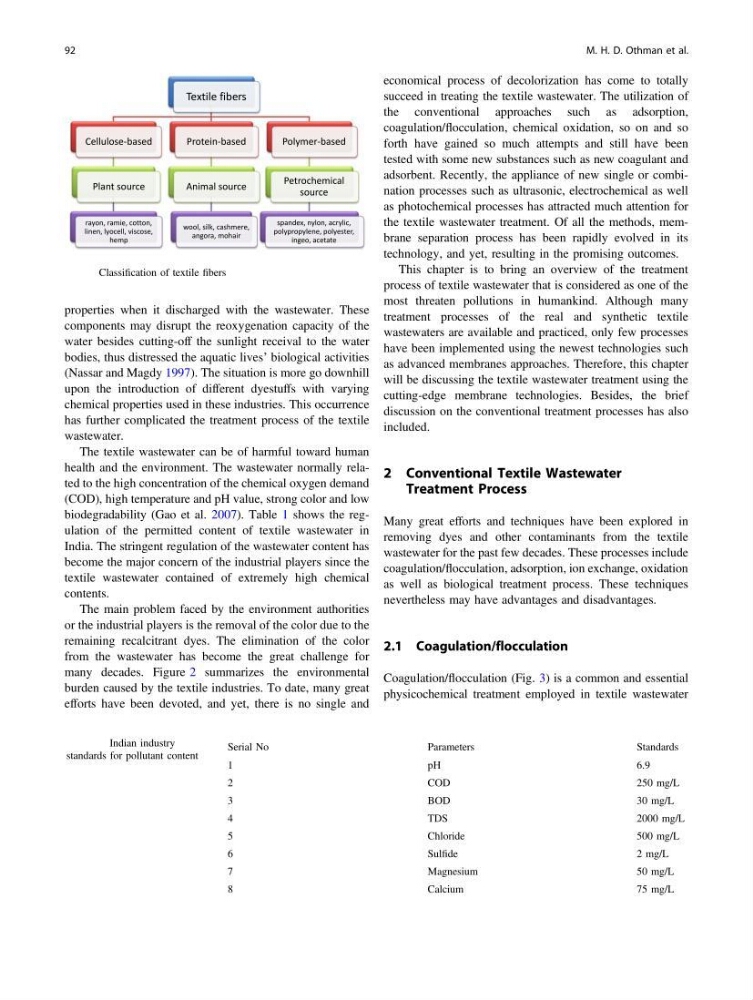
Textile fibers
Cellulose-based
Plant source
rayon, ramie, cotton,
linen, lyocell, viscose,
hemp
Protein-based
Animal source
wool, silk, cashmere,
angora, mohair
Polymer-based
Petrochemical
source
spandex, nylon, acrylic,
polypropylene, polyester,
ingeo, acetate
Fig. 1 Classification of textile fibers
Table 1 Indian industry
standards for pollutant content
Serial No
Parameters
Standards
1
pH
6.9
2
COD
250 mg/L
3
BOD
30 mg/L
4
TDS
2000 mg/L
5
Chloride
500 mg/L
6
Sulfide
2 mg/L
7
Magnesium
50 mg/L
8
Calcium
75 mg/L
92
M. H. D. Othman et al.
components may disrupt the reoxygenation capacity of the
water besides cutting-off the sunlight receival to the water
bodies, thus distressed the aquatic lives’ biological activities
(Nassar and Magdy 1997). The situation is more go downhill
upon the introduction of different dyestuffs with varying
chemical properties used in these industries. This occurrence
has further complicated the treatment process of the textile
wastewater.
The textile wastewater can be of harmful toward human
health and the environment. The wastewater normally related to the high concentration of the chemical oxygen demand
(COD), high temperature and pH value, strong color and low
biodegradability (Gao et al. 2007). Table 1 shows the regulation of the permitted content of textile wastewater in
India. The stringent regulation of the wastewater content has
become the major concern of the industrial players since the
textile wastewater contained of extremely high chemical
contents.
The main problem faced by the environment authorities
or the industrial players is the removal of the color due to the
remaining recalcitrant dyes. The elimination of the color
from the wastewater has become the great challenge for
many decades. Figure 2 summarizes the environmental
burden caused by the textile industries. To date, many great
efforts have been devoted, and yet, there is no single and
economical process of decolorization has come to totally
succeed in treating the textile wastewater. The utilization of
the conventional approaches such as adsorption,
coagulation/flocculation, chemical oxidation, so on and so
forth have gained so much attempts and still have been
tested with some new substances such as new coagulant and
adsorbent. Recently, the appliance of new single or combination processes such as ultrasonic, electrochemical as well
as photochemical processes has attracted much attention for
the textile wastewater treatment. Of all the methods, membrane separation process has been rapidly evolved in its
technology, and yet, resulting in the promising outcomes.
This chapter is to bring an overview of the treatment
process of textile wastewater that is considered as one of the
most threaten pollutions in humankind. Although many
treatment processes of the real and synthetic textile
wastewaters are available and practiced, only few processes
have been implemented using the newest technologies such
as advanced membranes approaches. Therefore, this chapter
will be discussing the textile wastewater treatment using the
cutting-edge membrane technologies. Besides, the brief
discussion on the conventional treatment processes has also
included.
2 Conventional Textile Wastewater
Treatment Process
Many great efforts and techniques have been explored in
removing dyes and other contaminants from the textile
wastewater for the past few decades. These processes include
coagulation/flocculation, adsorption, ion exchange, oxidation
as well as biological treatment process. These techniques
nevertheless may have advantages and disadvantages.
2.1 Coagulation/flocculation
Coagulation/flocculation (Fig. 3) is a common and essential
physicochemical treatment employed in textile wastewater
Textile fibers
Cellulose-based
Plant source
rayon, ramie, cotton,
linen, lyocell, viscose,
hemp
Protein-based
Animal source
wool, silk, cashmere,
angora, mohair
Polymer-based
Petrochemical
source
spandex, nylon, acrylic,
polypropylene, polyester,
ingeo, acetate
Fig. 1 Classification of textile fibers
Table 1 Indian industry
standards for pollutant content
Serial No
Parameters
Standards
1
pH
6.9
2
COD
250 mg/L
3
BOD
30 mg/L
4
TDS
2000 mg/L
5
Chloride
500 mg/L
6
Sulfide
2 mg/L
7
Magnesium
50 mg/L
8
Calcium
75 mg/L
92
M. H. D. Othman et al.