

2 Separation Principles and Mechanisms
Membranes are thin films used to transport gases due to
differences in their permeability rates. The permeability of
gases in a membrane material is highly reliant on its structure, size, shape, polarization, and the interaction of membrane materials with permeant species (Lalia et al. 2013).
The membrane is a permeable barrier which controls the
permeability of various gases due to the applied driving
forces of pressure, temperature, concentration, and electric
charges difference of each gas. The solubility strength of any
gas species in the membrane materials determines the
compatibility of membrane for permeant. The permeability
or permeability coefficient of gas passing through membrane
is the product of thermodynamic parameter, i.e., the solubility coefficient and kinetic parameter, i.e., diffusion coefficient. The solubility coefficient is the amount of gas
absorbed on the membrane surface at given pressure and
temperature, while the diffusion coefficient shows how fast
the gas is passed through the membrane (Shekhawat et al.
2003).
The pore flow and solution diffusion are the two phenomena used to describe the membrane separation process.
In the solution diffusion, the concentration difference is used
to dissolve permeates in the membrane materials and then
diffuse them. While, in the pore flow, the pressure-driven
convective flow in the pores is used to separate permeates
(Rongwong et al. 2012). Mostly, the solution diffusion is
suggested for gas transports through polymeric membranes
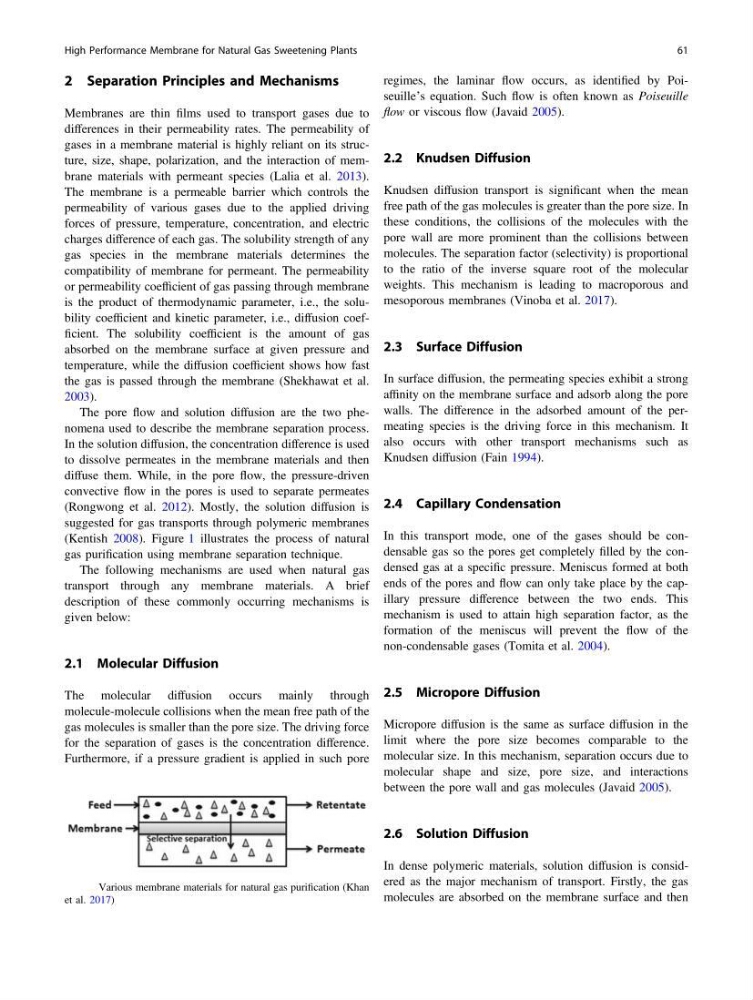
(Kentish 2008). Figure 1 illustrates the process of natural
gas purification using membrane separation technique.
The following mechanisms are used when natural gas
transport through any membrane materials. A brief
description of these commonly occurring mechanisms is
given below:
2.1 Molecular Diffusion
The molecular diffusion occurs mainly through
molecule-molecule collisions when the mean free path of the
gas molecules is smaller than the pore size. The driving force
for the separation of gases is the concentration difference.
Furthermore, if a pressure gradient is applied in such pore
regimes, the laminar flow occurs, as identified by Poiseuille’s equation. Such flow is often known as Poiseuille
flow or viscous flow (Javaid 2005).
2.2 Knudsen Diffusion
Knudsen diffusion transport is significant when the mean
free path of the gas molecules is greater than the pore size. In
these conditions, the collisions of the molecules with the
pore wall are more prominent than the collisions between
molecules. The separation factor (selectivity) is proportional
to the ratio of the inverse square root of the molecular
weights. This mechanism is leading to macroporous and
mesoporous membranes (Vinoba et al. 2017).
2.3 Surface Diffusion
In surface diffusion, the permeating species exhibit a strong
affinity on the membrane surface and adsorb along the pore
walls. The difference in the adsorbed amount of the permeating species is the driving force in this mechanism. It
also occurs with other transport mechanisms such as
Knudsen diffusion (Fain 1994).
2.4 Capillary Condensation
In this transport mode, one of the gases should be condensable gas so the pores get completely filled by the condensed gas at a specific pressure. Meniscus formed at both
ends of the pores and flow can only take place by the capillary pressure difference between the two ends. This
mechanism is used to attain high separation factor, as the
formation of the meniscus will prevent the flow of the
non-condensable gases (Tomita et al. 2004).
2.5 Micropore Diffusion
Micropore diffusion is the same as surface diffusion in the
limit where the pore size becomes comparable to the
molecular size. In this mechanism, separation occurs due to
molecular shape and size, pore size, and interactions
between the pore wall and gas molecules (Javaid 2005).
2.6 Solution Diffusion
In dense polymeric materials, solution diffusion is considered as the major mechanism of transport. Firstly, the gas
molecules are absorbed on the membrane surface and then
Fig. 1 Various membrane materials for natural gas purification (Khan
et al. 2017)
High Performance Membrane for Natural Gas Sweetening Plants
61
Membranes are thin films used to transport gases due to
differences in their permeability rates. The permeability of
gases in a membrane material is highly reliant on its structure, size, shape, polarization, and the interaction of membrane materials with permeant species (Lalia et al. 2013).
The membrane is a permeable barrier which controls the
permeability of various gases due to the applied driving
forces of pressure, temperature, concentration, and electric
charges difference of each gas. The solubility strength of any
gas species in the membrane materials determines the
compatibility of membrane for permeant. The permeability
or permeability coefficient of gas passing through membrane
is the product of thermodynamic parameter, i.e., the solubility coefficient and kinetic parameter, i.e., diffusion coefficient. The solubility coefficient is the amount of gas
absorbed on the membrane surface at given pressure and
temperature, while the diffusion coefficient shows how fast
the gas is passed through the membrane (Shekhawat et al.
2003).
The pore flow and solution diffusion are the two phenomena used to describe the membrane separation process.
In the solution diffusion, the concentration difference is used
to dissolve permeates in the membrane materials and then
diffuse them. While, in the pore flow, the pressure-driven
convective flow in the pores is used to separate permeates
(Rongwong et al. 2012). Mostly, the solution diffusion is
suggested for gas transports through polymeric membranes
(Kentish 2008). Figure 1 illustrates the process of natural
gas purification using membrane separation technique.
The following mechanisms are used when natural gas
transport through any membrane materials. A brief
description of these commonly occurring mechanisms is
given below:
2.1 Molecular Diffusion
The molecular diffusion occurs mainly through
molecule-molecule collisions when the mean free path of the
gas molecules is smaller than the pore size. The driving force
for the separation of gases is the concentration difference.
Furthermore, if a pressure gradient is applied in such pore
regimes, the laminar flow occurs, as identified by Poiseuille’s equation. Such flow is often known as Poiseuille
flow or viscous flow (Javaid 2005).
2.2 Knudsen Diffusion
Knudsen diffusion transport is significant when the mean
free path of the gas molecules is greater than the pore size. In
these conditions, the collisions of the molecules with the
pore wall are more prominent than the collisions between
molecules. The separation factor (selectivity) is proportional
to the ratio of the inverse square root of the molecular
weights. This mechanism is leading to macroporous and
mesoporous membranes (Vinoba et al. 2017).
2.3 Surface Diffusion
In surface diffusion, the permeating species exhibit a strong
affinity on the membrane surface and adsorb along the pore
walls. The difference in the adsorbed amount of the permeating species is the driving force in this mechanism. It
also occurs with other transport mechanisms such as
Knudsen diffusion (Fain 1994).
2.4 Capillary Condensation
In this transport mode, one of the gases should be condensable gas so the pores get completely filled by the condensed gas at a specific pressure. Meniscus formed at both
ends of the pores and flow can only take place by the capillary pressure difference between the two ends. This
mechanism is used to attain high separation factor, as the
formation of the meniscus will prevent the flow of the
non-condensable gases (Tomita et al. 2004).
2.5 Micropore Diffusion
Micropore diffusion is the same as surface diffusion in the
limit where the pore size becomes comparable to the
molecular size. In this mechanism, separation occurs due to
molecular shape and size, pore size, and interactions
between the pore wall and gas molecules (Javaid 2005).
2.6 Solution Diffusion
In dense polymeric materials, solution diffusion is considered as the major mechanism of transport. Firstly, the gas
molecules are absorbed on the membrane surface and then
Fig. 1 Various membrane materials for natural gas purification (Khan
et al. 2017)
High Performance Membrane for Natural Gas Sweetening Plants
61