

technology for cleaning of natural gas efficiently (Lampinen
2014; Sun et al. 2015; Zhao et al. 2010).
Membrane system shows great potential for natural gas
sweetening since it possesses numerous environmental
advantages such as (1) low operational and investment cost
with high CH 4 production up to >96% (Sun et al. 2015),
(2) fewer space requirements (Basu et al. 2011), (3) easy
maintenance without hazardous chemicals (Khan et al.
2017), (4) low maintenance cost (Song et al. 2012a, b),
(5) simplicity in the operational and environmentally
friendly process without chemical additives (Ahn et al.
2010), and (6) simple and easy process with low energy
needs (Mohshim et al. 2013).
Membrane technology became the part of gas separation
when Thomas Graham measured the permeation rates of all
the gases and gave the first description of the solution diffusion model, and his work on porous membranes led to
Graham’s law of diffusion in 1850 (Weller and Steiner
1950). To date, the membrane technology is dominated by
polymeric materials owing to the low cost and easy processing (Dong et al. 2013). Although polymeric materials
showed encouraging results for gas separation, they suffer
from some drawbacks (Sridhar et al. 2007a). Low membrane
selectivity is the major inconvenient loss in gas separation
that demands a multi-stage separation system which likely to
impart higher capital cost. In addition, polymeric membranes
commonly could not maintain their performance and thus
deteriorate in extreme environmental operating conditions of
high temperature and pressure. The chain swelling in the
presence of highly corrosive components in the feed, plasticization, compaction, and aging of membranes are the main
reasons of problematic phenomena (Liu et al. 2002).
Moreover, all conventional polymeric membranes are
inevitably bounded by Robeson’s upper boundary. Since the
development of membrane materials exceeding, the upper
bound limit has become the major challenge for new
researchers. Currently, inorganic membrane materials have
gained much attention owing to their excellent separation
performance; improve chemical and thermal resistance to the
harsh environment and long operational life. The selectivity
of inorganic membranes is exceptionally high so as to surpass the Robeson’s upper boundary. Unfortunately, its high
cost and complex fabrication process, intrinsic fragility, and
the low surface to volume ratio have hindered their further
industrial application in the separation process. Furthermore,
despite the availability of highly selective polymer materials,
membrane fabrication process was not sufficiently advanced
to make useful membranes (Aroon et al. 2010).
Therefore, many attempts have been made to fabricate a
mixed matrix membrane (MMM) for gas separation and
proved to be an alternative to overcome this limitation of
polymeric membranes. To date, various potential MMMs
have been explored and well documented in literature highlighting the advantages and limitations suffered by the
resulted membranes (Adams et al. 2010; Aroon et al. 2010;
Chaidou et al. 2012; Dorosti et al. 2014; Li et al. 2013;
Ordoñez and Balkus 2010; Shahid and Nijmeijer 2014).
Generally, the incorporation of inorganic particles into the
polymer matrix would surely improves the membrane properties due to the superiority of the dispersed phase itself. In
actual practice, MMMs development is often encountered
with the deterioration of membrane performance. The
incompatibility between the polymer and inorganic material
is regarded as the main factor that leads to the defective
interface. The development of MMM is a surely interesting
approach with robustness, moderate cost, and high thermal,
chemical, and mechanical stability. Selection of fillers
remains as the heart of MMM development to ensure good
compatibility with the polymer matrix, consequently, boost
the membrane performance exceeding the Robeson upper
bound (Khan et al. 2018a, b, c). The further main challenges
for natural gas processing using MMM are material cost, CH 4
loss, and plasticization at high pressure operation. In this
contribution, the main challenges, advantages, and limitations of the membrane separation technology for natural gas
purification are thoroughly discussed. Lastly, the future
research developments and directions for raw natural gas
processing through membrane technology are also presented.
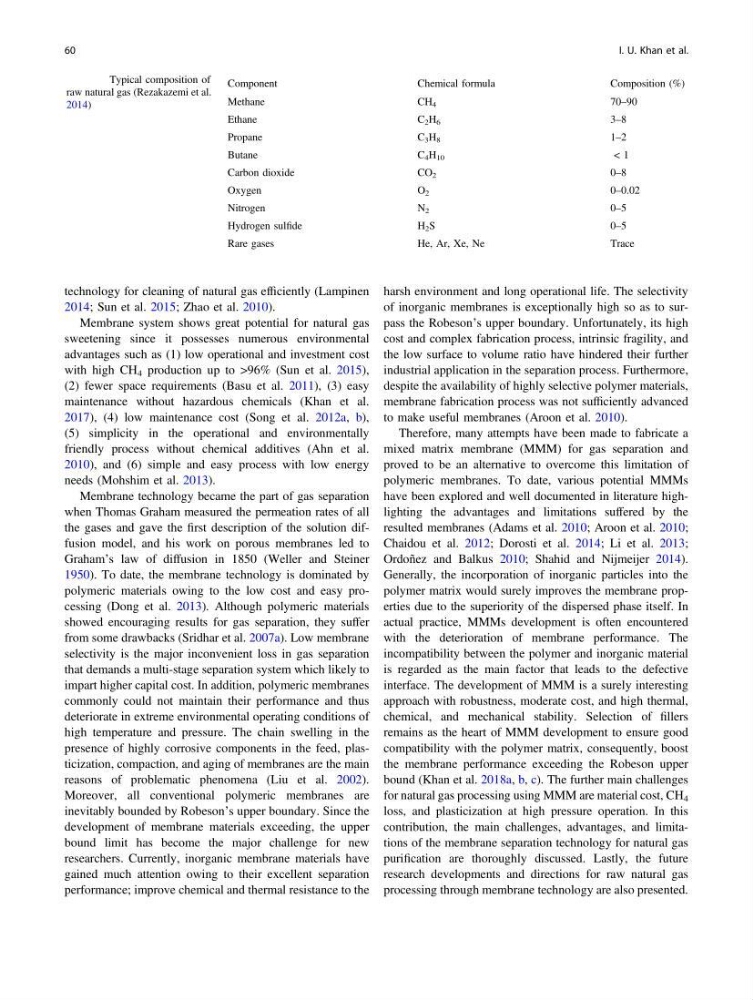
Table 1 Typical composition of
raw natural gas (Rezakazemi et al.
2014)
Component
Chemical formula
Composition (%)
Methane
CH 4
70–90
Ethane
C 2 H 6
3–8
Propane
C 3 H 8
1–2
Butane
C 4 H 10
< 1
Carbon dioxide
CO 2
0–8
Oxygen
O 2
0–0.02
Nitrogen
N 2
0–5
Hydrogen sulfide
H 2 S
0 –5
Rare gases
He, Ar, Xe, Ne
Trace
60
I. U. Khan et al.
2014; Sun et al. 2015; Zhao et al. 2010).
Membrane system shows great potential for natural gas
sweetening since it possesses numerous environmental
advantages such as (1) low operational and investment cost
with high CH 4 production up to >96% (Sun et al. 2015),
(2) fewer space requirements (Basu et al. 2011), (3) easy
maintenance without hazardous chemicals (Khan et al.
2017), (4) low maintenance cost (Song et al. 2012a, b),
(5) simplicity in the operational and environmentally
friendly process without chemical additives (Ahn et al.
2010), and (6) simple and easy process with low energy
needs (Mohshim et al. 2013).
Membrane technology became the part of gas separation
when Thomas Graham measured the permeation rates of all
the gases and gave the first description of the solution diffusion model, and his work on porous membranes led to
Graham’s law of diffusion in 1850 (Weller and Steiner
1950). To date, the membrane technology is dominated by
polymeric materials owing to the low cost and easy processing (Dong et al. 2013). Although polymeric materials
showed encouraging results for gas separation, they suffer
from some drawbacks (Sridhar et al. 2007a). Low membrane
selectivity is the major inconvenient loss in gas separation
that demands a multi-stage separation system which likely to
impart higher capital cost. In addition, polymeric membranes
commonly could not maintain their performance and thus
deteriorate in extreme environmental operating conditions of
high temperature and pressure. The chain swelling in the
presence of highly corrosive components in the feed, plasticization, compaction, and aging of membranes are the main
reasons of problematic phenomena (Liu et al. 2002).
Moreover, all conventional polymeric membranes are
inevitably bounded by Robeson’s upper boundary. Since the
development of membrane materials exceeding, the upper
bound limit has become the major challenge for new
researchers. Currently, inorganic membrane materials have
gained much attention owing to their excellent separation
performance; improve chemical and thermal resistance to the
harsh environment and long operational life. The selectivity
of inorganic membranes is exceptionally high so as to surpass the Robeson’s upper boundary. Unfortunately, its high
cost and complex fabrication process, intrinsic fragility, and
the low surface to volume ratio have hindered their further
industrial application in the separation process. Furthermore,
despite the availability of highly selective polymer materials,
membrane fabrication process was not sufficiently advanced
to make useful membranes (Aroon et al. 2010).
Therefore, many attempts have been made to fabricate a
mixed matrix membrane (MMM) for gas separation and
proved to be an alternative to overcome this limitation of
polymeric membranes. To date, various potential MMMs
have been explored and well documented in literature highlighting the advantages and limitations suffered by the
resulted membranes (Adams et al. 2010; Aroon et al. 2010;
Chaidou et al. 2012; Dorosti et al. 2014; Li et al. 2013;
Ordoñez and Balkus 2010; Shahid and Nijmeijer 2014).
Generally, the incorporation of inorganic particles into the
polymer matrix would surely improves the membrane properties due to the superiority of the dispersed phase itself. In
actual practice, MMMs development is often encountered
with the deterioration of membrane performance. The
incompatibility between the polymer and inorganic material
is regarded as the main factor that leads to the defective
interface. The development of MMM is a surely interesting
approach with robustness, moderate cost, and high thermal,
chemical, and mechanical stability. Selection of fillers
remains as the heart of MMM development to ensure good
compatibility with the polymer matrix, consequently, boost
the membrane performance exceeding the Robeson upper
bound (Khan et al. 2018a, b, c). The further main challenges
for natural gas processing using MMM are material cost, CH 4
loss, and plasticization at high pressure operation. In this
contribution, the main challenges, advantages, and limitations of the membrane separation technology for natural gas
purification are thoroughly discussed. Lastly, the future
research developments and directions for raw natural gas
processing through membrane technology are also presented.
Table 1 Typical composition of
raw natural gas (Rezakazemi et al.
2014)
Component
Chemical formula
Composition (%)
Methane
CH 4
70–90
Ethane
C 2 H 6
3–8
Propane
C 3 H 8
1–2
Butane
C 4 H 10
< 1
Carbon dioxide
CO 2
0–8
Oxygen
O 2
0–0.02
Nitrogen
N 2
0–5
Hydrogen sulfide
H 2 S
0 –5
Rare gases
He, Ar, Xe, Ne
Trace
60
I. U. Khan et al.