

6 General BWRO Process Considerations
6.1 Process Configurations
Process configuration of membrane modules in a BWRO
system can be arranged either in a single stage or multiple
stages (Burn and Gray 2015). A stage is termed as the
number of membrane module elements fitted in one pressure
vessel used for concentrate treatment as determined by plant
design output. For instance, single- and double-stage process
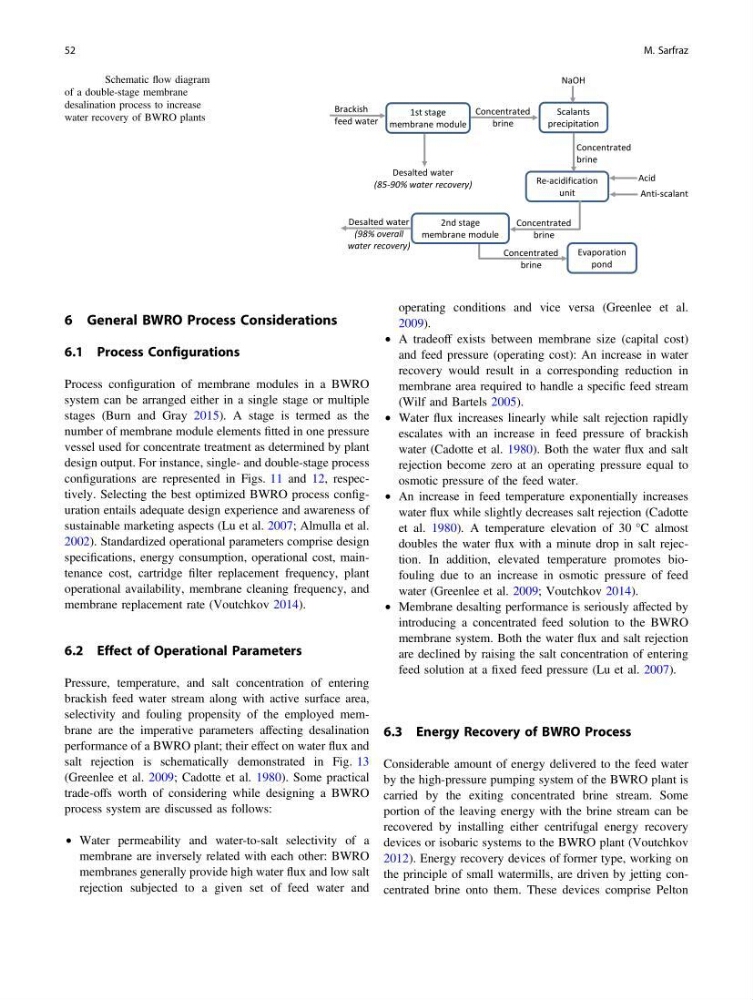
configurations are represented in Figs. 11 and 12, respectively. Selecting the best optimized BWRO process configuration entails adequate design experience and awareness of
sustainable marketing aspects (Lu et al. 2007; Almulla et al.
2002). Standardized operational parameters comprise design
specifications, energy consumption, operational cost, maintenance cost, cartridge filter replacement frequency, plant
operational availability, membrane cleaning frequency, and
membrane replacement rate (Voutchkov 2014).
6.2 Effect of Operational Parameters
Pressure, temperature, and salt concentration of entering
brackish feed water stream along with active surface area,
selectivity and fouling propensity of the employed membrane are the imperative parameters affecting desalination
performance of a BWRO plant; their effect on water flux and
salt rejection is schematically demonstrated in Fig. 13
(Greenlee et al. 2009; Cadotte et al. 1980). Some practical
trade-offs worth of considering while designing a BWRO
process system are discussed as follows:
• Water permeability and water-to-salt selectivity of a
membrane are inversely related with each other: BWRO
membranes generally provide high water flux and low salt
rejection subjected to a given set of feed water and
operating conditions and vice versa (Greenlee et al.
2009).
• A tradeoff exists between membrane size (capital cost)
and feed pressure (operating cost): An increase in water
recovery would result in a corresponding reduction in
membrane area required to handle a specific feed stream
(Wilf and Bartels 2005).
• Water flux increases linearly while salt rejection rapidly
escalates with an increase in feed pressure of brackish
water (Cadotte et al. 1980). Both the water flux and salt
rejection become zero at an operating pressure equal to
osmotic pressure of the feed water.
• An increase in feed temperature exponentially increases
water flux while slightly decreases salt rejection (Cadotte
et al. 1980). A temperature elevation of 30 °C almost
doubles the water flux with a minute drop in salt rejection. In addition, elevated temperature promotes biofouling due to an increase in osmotic pressure of feed
water (Greenlee et al. 2009; Voutchkov 2014).
• Membrane desalting performance is seriously affected by
introducing a concentrated feed solution to the BWRO
membrane system. Both the water flux and salt rejection
are declined by raising the salt concentration of entering
feed solution at a fixed feed pressure (Lu et al. 2007).
6.3 Energy Recovery of BWRO Process
Considerable amount of energy delivered to the feed water
by the high-pressure pumping system of the BWRO plant is
carried by the exiting concentrated brine stream. Some
portion of the leaving energy with the brine stream can be
recovered by installing either centrifugal energy recovery
devices or isobaric systems to the BWRO plant (Voutchkov
2012). Energy recovery devices of former type, working on
the principle of small watermills, are driven by jetting concentrated brine onto them. These devices comprise Pelton
Scalants
precipitation
Re-acidification
unit
Evaporation
pond
Brackish
feed water
Concentrated
brine
Desalted water
(85-90% water recovery)
NaOH
Anti-scalant
Concentrated
brine
Desalted water
(98% overall
water recovery)
Concentrated
brine
1st stage
membrane module
Acid
2nd stage
membrane module
Concentrated
brine
Fig. 12 Schematic flow diagram
of a double-stage membrane
desalination process to increase
water recovery of BWRO plants
52
M. Sarfraz
6.1 Process Configurations
Process configuration of membrane modules in a BWRO
system can be arranged either in a single stage or multiple
stages (Burn and Gray 2015). A stage is termed as the
number of membrane module elements fitted in one pressure
vessel used for concentrate treatment as determined by plant
design output. For instance, single- and double-stage process
configurations are represented in Figs. 11 and 12, respectively. Selecting the best optimized BWRO process configuration entails adequate design experience and awareness of
sustainable marketing aspects (Lu et al. 2007; Almulla et al.
2002). Standardized operational parameters comprise design
specifications, energy consumption, operational cost, maintenance cost, cartridge filter replacement frequency, plant
operational availability, membrane cleaning frequency, and
membrane replacement rate (Voutchkov 2014).
6.2 Effect of Operational Parameters
Pressure, temperature, and salt concentration of entering
brackish feed water stream along with active surface area,
selectivity and fouling propensity of the employed membrane are the imperative parameters affecting desalination
performance of a BWRO plant; their effect on water flux and
salt rejection is schematically demonstrated in Fig. 13
(Greenlee et al. 2009; Cadotte et al. 1980). Some practical
trade-offs worth of considering while designing a BWRO
process system are discussed as follows:
• Water permeability and water-to-salt selectivity of a
membrane are inversely related with each other: BWRO
membranes generally provide high water flux and low salt
rejection subjected to a given set of feed water and
operating conditions and vice versa (Greenlee et al.
2009).
• A tradeoff exists between membrane size (capital cost)
and feed pressure (operating cost): An increase in water
recovery would result in a corresponding reduction in
membrane area required to handle a specific feed stream
(Wilf and Bartels 2005).
• Water flux increases linearly while salt rejection rapidly
escalates with an increase in feed pressure of brackish
water (Cadotte et al. 1980). Both the water flux and salt
rejection become zero at an operating pressure equal to
osmotic pressure of the feed water.
• An increase in feed temperature exponentially increases
water flux while slightly decreases salt rejection (Cadotte
et al. 1980). A temperature elevation of 30 °C almost
doubles the water flux with a minute drop in salt rejection. In addition, elevated temperature promotes biofouling due to an increase in osmotic pressure of feed
water (Greenlee et al. 2009; Voutchkov 2014).
• Membrane desalting performance is seriously affected by
introducing a concentrated feed solution to the BWRO
membrane system. Both the water flux and salt rejection
are declined by raising the salt concentration of entering
feed solution at a fixed feed pressure (Lu et al. 2007).
6.3 Energy Recovery of BWRO Process
Considerable amount of energy delivered to the feed water
by the high-pressure pumping system of the BWRO plant is
carried by the exiting concentrated brine stream. Some
portion of the leaving energy with the brine stream can be
recovered by installing either centrifugal energy recovery
devices or isobaric systems to the BWRO plant (Voutchkov
2012). Energy recovery devices of former type, working on
the principle of small watermills, are driven by jetting concentrated brine onto them. These devices comprise Pelton
Scalants
precipitation
Re-acidification
unit
Evaporation
pond
Brackish
feed water
Concentrated
brine
Desalted water
(85-90% water recovery)
NaOH
Anti-scalant
Concentrated
brine
Desalted water
(98% overall
water recovery)
Concentrated
brine
1st stage
membrane module
Acid
2nd stage
membrane module
Concentrated
brine
Fig. 12 Schematic flow diagram
of a double-stage membrane
desalination process to increase
water recovery of BWRO plants
52
M. Sarfraz