

low fouling susceptibility, low cost, provision for elevated
mass transfer rates, and minimal feed pretreatment requirements of spiral wound modules. Owing to these valuable
characteristics, spiral wound modules are commonly used
for large-scale treatment of brackish water rendering a clean
water recovery up to 90% (Lee et al. 2011; Joshi et al. 2004).
Insufficient feed pretreatment may, however, promote module fouling entailing frequent cleaning. Single-envelope
spiral wound modules may lead to high feed-side pressure
drop; the excessive pressure drop may be overcome by using
multiple-envelope modules (Fritzmann et al. 2007).
4.3 Tubular Modules
Tubular modules, being simple in design and fabrication,
encompass a vast membrane area in a smaller-sized module
housing. They comprise several smaller-diameter selective
membrane-containing porous tubes fitted inside a single
larger supporting pressure vessel as shown in Fig. 7. The
nested polymer membranes are usually cast on plastic,
fiberglass, ceramic, carbon, or paper tubes while the support
tube is made of plastic, fiberglass, or steel (Baker 2004;
Dupont et al. 1982; Casey 1984). High-pressure saline feed
water goes into the tube from its one end, radially permeated
product water through each tube is collected in permeate
collection header, while the axially flowing rejected concentrated brine is expelled from other tube end. In a typical
larger BWRO plant, multiple tube bundles can be assembled
in series or parallel configuration in a larger casing in order
to enhance system production capacity as shown in Fig. 8
(Dupont et al. 1982).
Manufacturing cost of tubular membranes and their
modules is generally high. They also depict low package
density owing to their low surface area-to-volume ratio
(Kucera 2010). However, improved liquid hydrokinetics
Table 4 A short comparison and
selection criteria for main types of
BWRO module designs (Baker
2012; Kucera 2010)
Parameter
Plate and
frame
Spiral wound
Tubular
Hollow
fiber
Manufacturing cost ($/m
2 )
High (50–
200)
Moderate (5–
100)
Moderate
(10–50)
Low (5–
20)
Packing density (m
2
/m
3
)
150–500
500–1200
20–400
500–
5000
Limited to specific types of membrane
material
No
No
Yes
Yes
Fouling tendency
Moderate
High
Low
Very high
Ease of cleaning
Good
Poor
Excellent
Poor
Suitability for high-pressure operation
Yes
Yes
No
Yes
Permeate-side pressure drop
Low
Moderate
Moderate
High
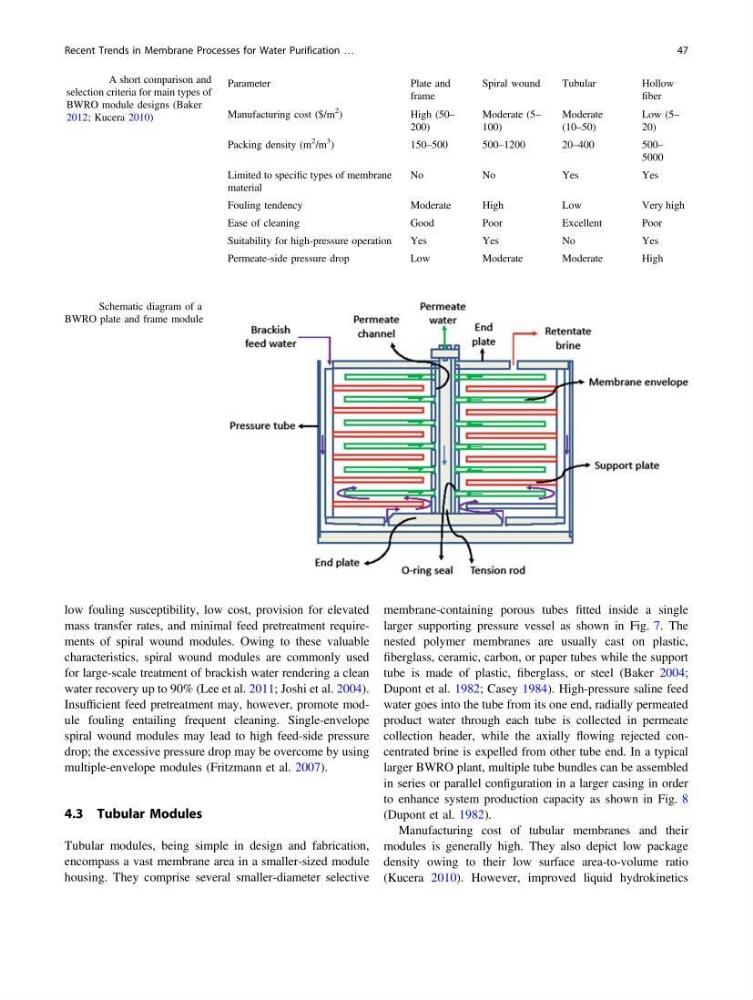
Fig. 4 Schematic diagram of a
BWRO plate and frame module
Recent Trends in Membrane Processes for Water Purification …
47
mass transfer rates, and minimal feed pretreatment requirements of spiral wound modules. Owing to these valuable
characteristics, spiral wound modules are commonly used
for large-scale treatment of brackish water rendering a clean
water recovery up to 90% (Lee et al. 2011; Joshi et al. 2004).
Insufficient feed pretreatment may, however, promote module fouling entailing frequent cleaning. Single-envelope
spiral wound modules may lead to high feed-side pressure
drop; the excessive pressure drop may be overcome by using
multiple-envelope modules (Fritzmann et al. 2007).
4.3 Tubular Modules
Tubular modules, being simple in design and fabrication,
encompass a vast membrane area in a smaller-sized module
housing. They comprise several smaller-diameter selective
membrane-containing porous tubes fitted inside a single
larger supporting pressure vessel as shown in Fig. 7. The
nested polymer membranes are usually cast on plastic,
fiberglass, ceramic, carbon, or paper tubes while the support
tube is made of plastic, fiberglass, or steel (Baker 2004;
Dupont et al. 1982; Casey 1984). High-pressure saline feed
water goes into the tube from its one end, radially permeated
product water through each tube is collected in permeate
collection header, while the axially flowing rejected concentrated brine is expelled from other tube end. In a typical
larger BWRO plant, multiple tube bundles can be assembled
in series or parallel configuration in a larger casing in order
to enhance system production capacity as shown in Fig. 8
(Dupont et al. 1982).
Manufacturing cost of tubular membranes and their
modules is generally high. They also depict low package
density owing to their low surface area-to-volume ratio
(Kucera 2010). However, improved liquid hydrokinetics
Table 4 A short comparison and
selection criteria for main types of
BWRO module designs (Baker
2012; Kucera 2010)
Parameter
Plate and
frame
Spiral wound
Tubular
Hollow
fiber
Manufacturing cost ($/m
2 )
High (50–
200)
Moderate (5–
100)
Moderate
(10–50)
Low (5–
20)
Packing density (m
2
/m
3
)
150–500
500–1200
20–400
500–
5000
Limited to specific types of membrane
material
No
No
Yes
Yes
Fouling tendency
Moderate
High
Low
Very high
Ease of cleaning
Good
Poor
Excellent
Poor
Suitability for high-pressure operation
Yes
Yes
No
Yes
Permeate-side pressure drop
Low
Moderate
Moderate
High
Fig. 4 Schematic diagram of a
BWRO plate and frame module
Recent Trends in Membrane Processes for Water Purification …
47