

material (MacNeil 1988; Belfort 1984). The whole structure
is housed inside a pressure shell. The schematic diagram of
such a BWRO membrane module system is illustrated in
Fig. 4 (Baker 2004). Brackish water being introduced from
shell side of the module is distributed across each plate, pure
water permeates through membrane envelopes and is
received in the central permeate collecting pipe. Concentrated brine is taken from other end of the module.
Plate and frame modules are pricey units having tiresome
fabrication design and low surface area-to-volume ratio.
Formation of stagnant zones within module assembly may
lead to fouling, which can, however, be cleaned easily. Ease
of maintenance makes them a good choice for desalinating
highly fouling brackish water feed streams on a relatively
small scale.
4.2 Spiral Wound Modules
The Gulf General Atomic with financial support of the Office
of Saline Water initiated the development of spiral wound
modules and commercialized them to carry out membrane
separation processes on large industrial scale (Westmoreland
1968; Bray 1968; Kremen 1977). Later on, design and
configuration of spiral wound modules have been revised to
reduce cost and enhance process efficiency of these systems
(Schneider 1989; Mannapperuma 1994; Doll 1984; Ng et al.
2008). Currently, these type of units are the most popular
forms of industrial membrane module systems being used in
BWRO desalination plants to obtain clean water.
A spiral wound module comprises a number of
polyamide-based thin-film composite membrane leaves/
envelopes and feed/concentrate mesh spacers spirally
wrapped around a central pierced permeate receiving pipe as
shown in Fig. 5 (Westmoreland 1968; Kucera 2010; MacNeil 1988; Kucera 2014). A typical membrane envelope is
made by sandwiching a permeate weaved spacer between
two membrane sheets followed by gluing the sandwiched
structure from three sides while leaving the fourth side of the
leaf opened. A number of such leaves are alternately positioned with feed webbed spacers to provide flow paths for
feed/concentrate streams, promote turbulence, and control
concentration polarization effects. In order to minimize
undue pressure drop in a single-envelope module, a number
of membrane envelopes are attached to the central axial
pierced permeate collecting tube in a multi-envelope spiral
wound module as depicted in Fig. 6. Normally, 4–6 spiral
wound modules are housed in series inside a particular
tubular pressure vessel.
Brackish feed water being entered from one side of the
module moves in axial direction along the surface of
membrane envelope. Major portion of feed water permeated
through the membrane surface travels towards the module
center in a spiral direction and is collected as clean water in
the central perforated collection pipe. The concentrated brine
traveling axially along the membrane surface exits the unit at
the other end of the module.
Advantageous factors of hollow fiber modules such as
higher membrane surface to volume ratio, better packing
density, and higher production rate are offset by inherently
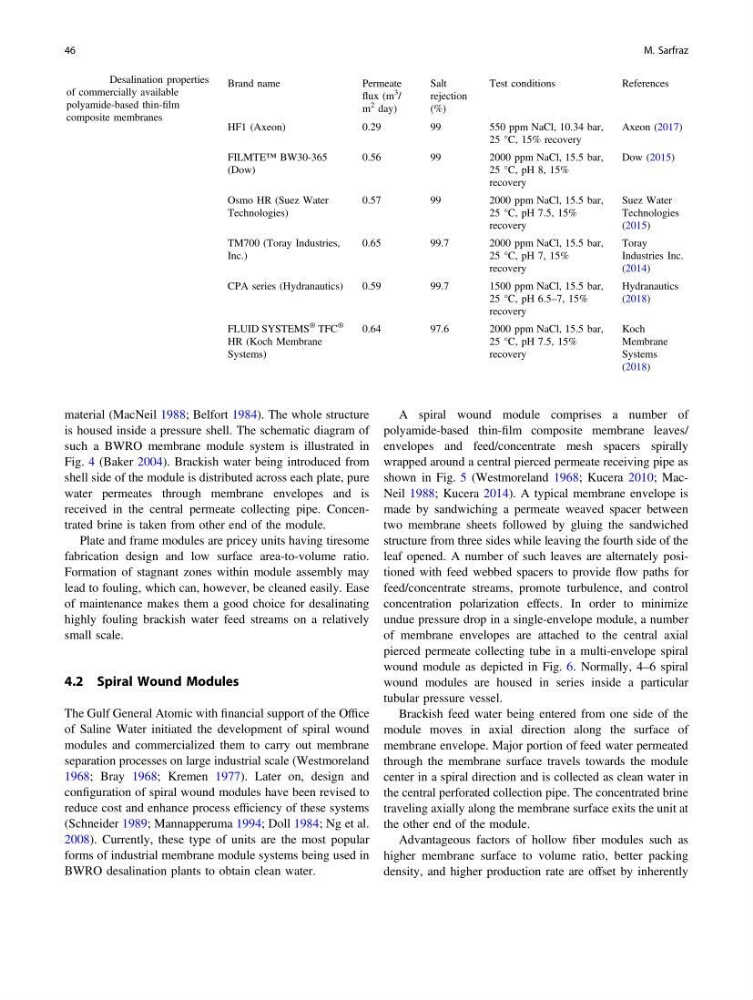
Table 3 Desalination properties
of commercially available
polyamide-based thin-film
composite membranes
Brand name
Permeate
flux (m
3
/
m
2 day)
Salt
rejection
(%)
Test conditions
References
HF1 (Axeon)
0.29
99
550 ppm NaCl, 10.34 bar,
25 °C, 15% recovery
Axeon (2017)
FILMTE™ BW30-365
(Dow)
0.56
99
2000 ppm NaCl, 15.5 bar,
25 °C, pH 8, 15%
recovery
Dow (2015)
Osmo HR (Suez Water
Technologies)
0.57
99
2000 ppm NaCl, 15.5 bar,
25 °C, pH 7.5, 15%
recovery
Suez Water
Technologies
(2015)
TM700 (Toray Industries,
Inc.)
0.65
99.7
2000 ppm NaCl, 15.5 bar,
25 °C, pH 7, 15%
recovery
Toray
Industries Inc.
(2014)
CPA series (Hydranautics)
0.59
99.7
1500 ppm NaCl, 15.5 bar,
25 °C, pH 6.5–7, 15%
recovery
Hydranautics
(2018)
FLUID SYSTEMS
® TFC
®
HR (Koch Membrane
Systems)
0.64
97.6
2000 ppm NaCl, 15.5 bar,
25 °C, pH 7.5, 15%
recovery
Koch
Membrane
Systems
(2018)
46
M. Sarfraz
is housed inside a pressure shell. The schematic diagram of
such a BWRO membrane module system is illustrated in
Fig. 4 (Baker 2004). Brackish water being introduced from
shell side of the module is distributed across each plate, pure
water permeates through membrane envelopes and is
received in the central permeate collecting pipe. Concentrated brine is taken from other end of the module.
Plate and frame modules are pricey units having tiresome
fabrication design and low surface area-to-volume ratio.
Formation of stagnant zones within module assembly may
lead to fouling, which can, however, be cleaned easily. Ease
of maintenance makes them a good choice for desalinating
highly fouling brackish water feed streams on a relatively
small scale.
4.2 Spiral Wound Modules
The Gulf General Atomic with financial support of the Office
of Saline Water initiated the development of spiral wound
modules and commercialized them to carry out membrane
separation processes on large industrial scale (Westmoreland
1968; Bray 1968; Kremen 1977). Later on, design and
configuration of spiral wound modules have been revised to
reduce cost and enhance process efficiency of these systems
(Schneider 1989; Mannapperuma 1994; Doll 1984; Ng et al.
2008). Currently, these type of units are the most popular
forms of industrial membrane module systems being used in
BWRO desalination plants to obtain clean water.
A spiral wound module comprises a number of
polyamide-based thin-film composite membrane leaves/
envelopes and feed/concentrate mesh spacers spirally
wrapped around a central pierced permeate receiving pipe as
shown in Fig. 5 (Westmoreland 1968; Kucera 2010; MacNeil 1988; Kucera 2014). A typical membrane envelope is
made by sandwiching a permeate weaved spacer between
two membrane sheets followed by gluing the sandwiched
structure from three sides while leaving the fourth side of the
leaf opened. A number of such leaves are alternately positioned with feed webbed spacers to provide flow paths for
feed/concentrate streams, promote turbulence, and control
concentration polarization effects. In order to minimize
undue pressure drop in a single-envelope module, a number
of membrane envelopes are attached to the central axial
pierced permeate collecting tube in a multi-envelope spiral
wound module as depicted in Fig. 6. Normally, 4–6 spiral
wound modules are housed in series inside a particular
tubular pressure vessel.
Brackish feed water being entered from one side of the
module moves in axial direction along the surface of
membrane envelope. Major portion of feed water permeated
through the membrane surface travels towards the module
center in a spiral direction and is collected as clean water in
the central perforated collection pipe. The concentrated brine
traveling axially along the membrane surface exits the unit at
the other end of the module.
Advantageous factors of hollow fiber modules such as
higher membrane surface to volume ratio, better packing
density, and higher production rate are offset by inherently
Table 3 Desalination properties
of commercially available
polyamide-based thin-film
composite membranes
Brand name
Permeate
flux (m
3
/
m
2 day)
Salt
rejection
(%)
Test conditions
References
HF1 (Axeon)
0.29
99
550 ppm NaCl, 10.34 bar,
25 °C, 15% recovery
Axeon (2017)
FILMTE™ BW30-365
(Dow)
0.56
99
2000 ppm NaCl, 15.5 bar,
25 °C, pH 8, 15%
recovery
Dow (2015)
Osmo HR (Suez Water
Technologies)
0.57
99
2000 ppm NaCl, 15.5 bar,
25 °C, pH 7.5, 15%
recovery
Suez Water
Technologies
(2015)
TM700 (Toray Industries,
Inc.)
0.65
99.7
2000 ppm NaCl, 15.5 bar,
25 °C, pH 7, 15%
recovery
Toray
Industries Inc.
(2014)
CPA series (Hydranautics)
0.59
99.7
1500 ppm NaCl, 15.5 bar,
25 °C, pH 6.5–7, 15%
recovery
Hydranautics
(2018)
FLUID SYSTEMS
® TFC
®
HR (Koch Membrane
Systems)
0.64
97.6
2000 ppm NaCl, 15.5 bar,
25 °C, pH 7.5, 15%
recovery
Koch
Membrane
Systems
(2018)
46
M. Sarfraz