

spectrum shows the absorption peak of the original BP-1
membrane at a wave number of 1020 cm
−1 that corresponds
to the C–N stretching of the quaternary amine. In the
alkali-treated membrane, the intensity of this peak decreased
with the immersion time, indicating that the quaternary
amine groups in the BP-1 membrane (anion-exchange layer,
AEL for short) decomposed.
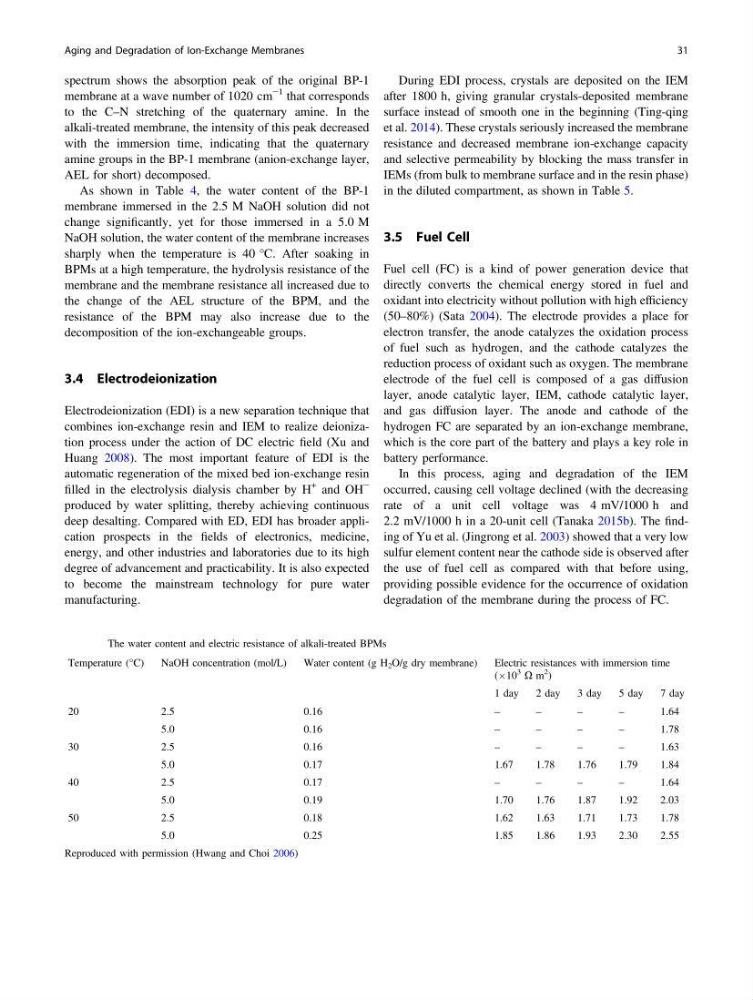
As shown in Table 4, the water content of the BP-1
membrane immersed in the 2.5 M NaOH solution did not
change significantly, yet for those immersed in a 5.0 M
NaOH solution, the water content of the membrane increases
sharply when the temperature is 40 °C. After soaking in
BPMs at a high temperature, the hydrolysis resistance of the
membrane and the membrane resistance all increased due to
the change of the AEL structure of the BPM, and the
resistance of the BPM may also increase due to the
decomposition of the ion-exchangeable groups.
3.4 Electrodeionization
Electrodeionization (EDI) is a new separation technique that
combines ion-exchange resin and IEM to realize deionization process under the action of DC electric field (Xu and
Huang 2008). The most important feature of EDI is the
automatic regeneration of the mixed bed ion-exchange resin
filled in the electrolysis dialysis chamber by H
+ and OH
−
produced by water splitting, thereby achieving continuous
deep desalting. Compared with ED, EDI has broader application prospects in the fields of electronics, medicine,
energy, and other industries and laboratories due to its high
degree of advancement and practicability. It is also expected
to become the mainstream technology for pure water
manufacturing.
During EDI process, crystals are deposited on the IEM
after 1800 h, giving granular crystals-deposited membrane
surface instead of smooth one in the beginning (Ting-qing
et al. 2014). These crystals seriously increased the membrane
resistance and decreased membrane ion-exchange capacity
and selective permeability by blocking the mass transfer in
IEMs (from bulk to membrane surface and in the resin phase)
in the diluted compartment, as shown in Table 5.
3.5 Fuel Cell
Fuel cell (FC) is a kind of power generation device that
directly converts the chemical energy stored in fuel and
oxidant into electricity without pollution with high efficiency
(50–80%) (Sata 2004). The electrode provides a place for
electron transfer, the anode catalyzes the oxidation process
of fuel such as hydrogen, and the cathode catalyzes the
reduction process of oxidant such as oxygen. The membrane
electrode of the fuel cell is composed of a gas diffusion
layer, anode catalytic layer, IEM, cathode catalytic layer,
and gas diffusion layer. The anode and cathode of the
hydrogen FC are separated by an ion-exchange membrane,
which is the core part of the battery and plays a key role in
battery performance.
In this process, aging and degradation of the IEM
occurred, causing cell voltage declined (with the decreasing
rate of a unit cell voltage was 4 mV/1000 h and
2.2 mV/1000 h in a 20-unit cell (Tanaka 2015b). The finding of Yu et al. (Jingrong et al. 2003) showed that a very low
sulfur element content near the cathode side is observed after
the use of fuel cell as compared with that before using,
providing possible evidence for the occurrence of oxidation
degradation of the membrane during the process of FC.
Table 4 The water content and electric resistance of alkali-treated BPMs
Temperature (°C)
NaOH concentration (mol/L)
Water content (g H 2 O/g dry membrane)
Electric resistances with immersion time
(Â10
3 X m
2
)
1 day
2 day
3 day
5 day
7 day
20
2.5
0.16
–
–
–
–
1.64
5.0
0.16
–
–
–
–
1.78
30
2.5
0.16
–
–
–
–
1.63
5.0
0.17
1.67
1.78
1.76
1.79
1.84
40
2.5
0.17
–
–
–
–
1.64
5.0
0.19
1.70
1.76
1.87
1.92
2.03
50
2.5
0.18
1.62
1.63
1.71
1.73
1.78
5.0
0.25
1.85
1.86
1.93
2.30
2.55
Reproduced with permission (Hwang and Choi 2006)
Aging and Degradation of Ion-Exchange Membranes
31
membrane at a wave number of 1020 cm
−1 that corresponds
to the C–N stretching of the quaternary amine. In the
alkali-treated membrane, the intensity of this peak decreased
with the immersion time, indicating that the quaternary
amine groups in the BP-1 membrane (anion-exchange layer,
AEL for short) decomposed.
As shown in Table 4, the water content of the BP-1
membrane immersed in the 2.5 M NaOH solution did not
change significantly, yet for those immersed in a 5.0 M
NaOH solution, the water content of the membrane increases
sharply when the temperature is 40 °C. After soaking in
BPMs at a high temperature, the hydrolysis resistance of the
membrane and the membrane resistance all increased due to
the change of the AEL structure of the BPM, and the
resistance of the BPM may also increase due to the
decomposition of the ion-exchangeable groups.
3.4 Electrodeionization
Electrodeionization (EDI) is a new separation technique that
combines ion-exchange resin and IEM to realize deionization process under the action of DC electric field (Xu and
Huang 2008). The most important feature of EDI is the
automatic regeneration of the mixed bed ion-exchange resin
filled in the electrolysis dialysis chamber by H
+ and OH
−
produced by water splitting, thereby achieving continuous
deep desalting. Compared with ED, EDI has broader application prospects in the fields of electronics, medicine,
energy, and other industries and laboratories due to its high
degree of advancement and practicability. It is also expected
to become the mainstream technology for pure water
manufacturing.
During EDI process, crystals are deposited on the IEM
after 1800 h, giving granular crystals-deposited membrane
surface instead of smooth one in the beginning (Ting-qing
et al. 2014). These crystals seriously increased the membrane
resistance and decreased membrane ion-exchange capacity
and selective permeability by blocking the mass transfer in
IEMs (from bulk to membrane surface and in the resin phase)
in the diluted compartment, as shown in Table 5.
3.5 Fuel Cell
Fuel cell (FC) is a kind of power generation device that
directly converts the chemical energy stored in fuel and
oxidant into electricity without pollution with high efficiency
(50–80%) (Sata 2004). The electrode provides a place for
electron transfer, the anode catalyzes the oxidation process
of fuel such as hydrogen, and the cathode catalyzes the
reduction process of oxidant such as oxygen. The membrane
electrode of the fuel cell is composed of a gas diffusion
layer, anode catalytic layer, IEM, cathode catalytic layer,
and gas diffusion layer. The anode and cathode of the
hydrogen FC are separated by an ion-exchange membrane,
which is the core part of the battery and plays a key role in
battery performance.
In this process, aging and degradation of the IEM
occurred, causing cell voltage declined (with the decreasing
rate of a unit cell voltage was 4 mV/1000 h and
2.2 mV/1000 h in a 20-unit cell (Tanaka 2015b). The finding of Yu et al. (Jingrong et al. 2003) showed that a very low
sulfur element content near the cathode side is observed after
the use of fuel cell as compared with that before using,
providing possible evidence for the occurrence of oxidation
degradation of the membrane during the process of FC.
Table 4 The water content and electric resistance of alkali-treated BPMs
Temperature (°C)
NaOH concentration (mol/L)
Water content (g H 2 O/g dry membrane)
Electric resistances with immersion time
(Â10
3 X m
2
)
1 day
2 day
3 day
5 day
7 day
20
2.5
0.16
–
–
–
–
1.64
5.0
0.16
–
–
–
–
1.78
30
2.5
0.16
–
–
–
–
1.63
5.0
0.17
1.67
1.78
1.76
1.79
1.84
40
2.5
0.17
–
–
–
–
1.64
5.0
0.19
1.70
1.76
1.87
1.92
2.03
50
2.5
0.18
1.62
1.63
1.71
1.73
1.78
5.0
0.25
1.85
1.86
1.93
2.30
2.55
Reproduced with permission (Hwang and Choi 2006)
Aging and Degradation of Ion-Exchange Membranes
31