

3.2 Reverse Electrodialysis
Reverse electrodialysis (RED) is a technology based on the
energy conversion process of charged ions through
ion-exchange membranes to generate electricity. Obviously,
IEM is one of the core elements of RED process, and its
physical and chemical properties play a decisive role in the
performance of RED (Xia et al. 2018; Ngai Yin et al. 2014).
During the research of RED, Zhang (2017) found that the
ion-exchange capacity and the contact angle of the AEM
(tailor-made and commercial ones) changed after adding
bovine serum albumin (BSA) and sodium alginate
(SA) aqueous solution (content is 0.5%) as organic pollutants.
The ion-exchange capacity and the contact angle of the
AEM before and after fouling are shown in Table 3. The
ion-exchange capacity of the contaminated AEM increased,
indicating pollutants absorption. Meanwhile, the contact
angles of the two AEMs both increased after pollution.
These change of the AEM characteristics reflected the
membrane aging.
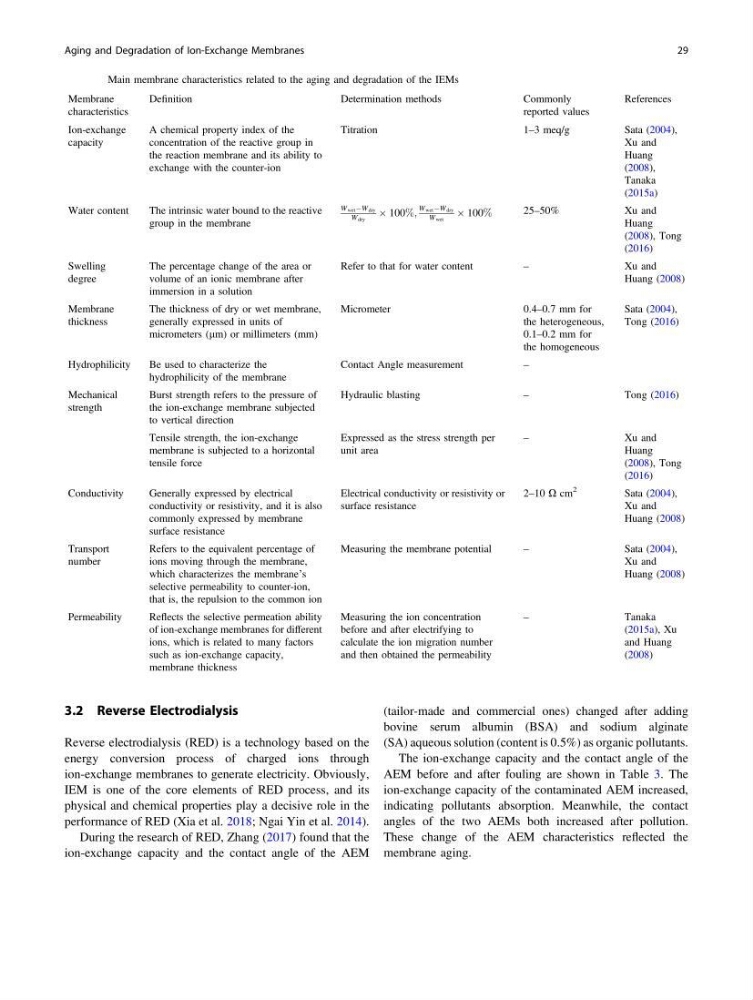
Table 1 Main membrane characteristics related to the aging and degradation of the IEMs
Membrane
characteristics
Definition
Determination methods
Commonly
reported values
References
Ion-exchange
capacity
A chemical property index of the
concentration of the reactive group in
the reaction membrane and its ability to
exchange with the counter-ion
Titration
1–3 meq/g
Sata (2004),
Xu and
Huang
(2008),
Tanaka
(2015a)
Water content
The intrinsic water bound to the reactive
group in the membrane
WwetÀWdry
Wdry
 100%;
WwetÀWdry
Wwet
 100%
25–50%
Xu and
Huang
(2008), Tong
(2016)
Swelling
degree
The percentage change of the area or
volume of an ionic membrane after
immersion in a solution
Refer to that for water content
–
Xu and
Huang (2008)
Membrane
thickness
The thickness of dry or wet membrane,
generally expressed in units of
micrometers (lm) or millimeters (mm)
Micrometer
0.4–0.7 mm for
the heterogeneous,
0.1–0.2 mm for
the homogeneous
Sata (2004),
Tong (2016)
Hydrophilicity
Be used to characterize the
hydrophilicity of the membrane
Contact Angle measurement
–
Mechanical
strength
Burst strength refers to the pressure of
the ion-exchange membrane subjected
to vertical direction
Hydraulic blasting
–
Tong (2016)
Tensile strength, the ion-exchange
membrane is subjected to a horizontal
tensile force
Expressed as the stress strength per
unit area
–
Xu and
Huang
(2008), Tong
(2016)
Conductivity
Generally expressed by electrical
conductivity or resistivity, and it is also
commonly expressed by membrane
surface resistance
Electrical conductivity or resistivity or
surface resistance
2–10 X cm
2
Sata (2004),
Xu and
Huang (2008)
Transport
number
Refers to the equivalent percentage of
ions moving through the membrane,
which characterizes the membrane’s
selective permeability to counter-ion,
that is, the repulsion to the common ion
Measuring the membrane potential
–
Sata (2004),
Xu and
Huang (2008)
Permeability
Reflects the selective permeation ability
of ion-exchange membranes for different
ions, which is related to many factors
such as ion-exchange capacity,
membrane thickness
Measuring the ion concentration
before and after electrifying to
calculate the ion migration number
and then obtained the permeability
–
Tanaka
(2015a), Xu
and Huang
(2008)
Aging and Degradation of Ion-Exchange Membranes
29
Reverse electrodialysis (RED) is a technology based on the
energy conversion process of charged ions through
ion-exchange membranes to generate electricity. Obviously,
IEM is one of the core elements of RED process, and its
physical and chemical properties play a decisive role in the
performance of RED (Xia et al. 2018; Ngai Yin et al. 2014).
During the research of RED, Zhang (2017) found that the
ion-exchange capacity and the contact angle of the AEM
(tailor-made and commercial ones) changed after adding
bovine serum albumin (BSA) and sodium alginate
(SA) aqueous solution (content is 0.5%) as organic pollutants.
The ion-exchange capacity and the contact angle of the
AEM before and after fouling are shown in Table 3. The
ion-exchange capacity of the contaminated AEM increased,
indicating pollutants absorption. Meanwhile, the contact
angles of the two AEMs both increased after pollution.
These change of the AEM characteristics reflected the
membrane aging.
Table 1 Main membrane characteristics related to the aging and degradation of the IEMs
Membrane
characteristics
Definition
Determination methods
Commonly
reported values
References
Ion-exchange
capacity
A chemical property index of the
concentration of the reactive group in
the reaction membrane and its ability to
exchange with the counter-ion
Titration
1–3 meq/g
Sata (2004),
Xu and
Huang
(2008),
Tanaka
(2015a)
Water content
The intrinsic water bound to the reactive
group in the membrane
WwetÀWdry
Wdry
 100%;
WwetÀWdry
Wwet
 100%
25–50%
Xu and
Huang
(2008), Tong
(2016)
Swelling
degree
The percentage change of the area or
volume of an ionic membrane after
immersion in a solution
Refer to that for water content
–
Xu and
Huang (2008)
Membrane
thickness
The thickness of dry or wet membrane,
generally expressed in units of
micrometers (lm) or millimeters (mm)
Micrometer
0.4–0.7 mm for
the heterogeneous,
0.1–0.2 mm for
the homogeneous
Sata (2004),
Tong (2016)
Hydrophilicity
Be used to characterize the
hydrophilicity of the membrane
Contact Angle measurement
–
Mechanical
strength
Burst strength refers to the pressure of
the ion-exchange membrane subjected
to vertical direction
Hydraulic blasting
–
Tong (2016)
Tensile strength, the ion-exchange
membrane is subjected to a horizontal
tensile force
Expressed as the stress strength per
unit area
–
Xu and
Huang
(2008), Tong
(2016)
Conductivity
Generally expressed by electrical
conductivity or resistivity, and it is also
commonly expressed by membrane
surface resistance
Electrical conductivity or resistivity or
surface resistance
2–10 X cm
2
Sata (2004),
Xu and
Huang (2008)
Transport
number
Refers to the equivalent percentage of
ions moving through the membrane,
which characterizes the membrane’s
selective permeability to counter-ion,
that is, the repulsion to the common ion
Measuring the membrane potential
–
Sata (2004),
Xu and
Huang (2008)
Permeability
Reflects the selective permeation ability
of ion-exchange membranes for different
ions, which is related to many factors
such as ion-exchange capacity,
membrane thickness
Measuring the ion concentration
before and after electrifying to
calculate the ion migration number
and then obtained the permeability
–
Tanaka
(2015a), Xu
and Huang
(2008)
Aging and Degradation of Ion-Exchange Membranes
29