

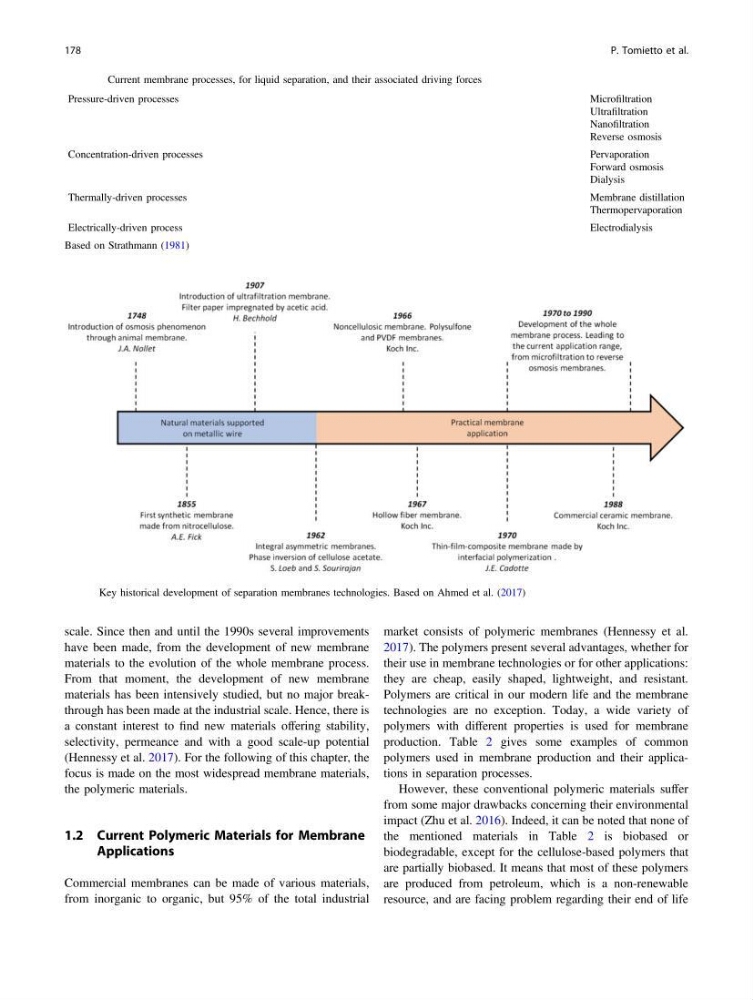
scale. Since then and until the 1990s several improvements
have been made, from the development of new membrane
materials to the evolution of the whole membrane process.
From that moment, the development of new membrane
materials has been intensively studied, but no major breakthrough has been made at the industrial scale. Hence, there is
a constant interest to find new materials offering stability,
selectivity, permeance and with a good scale-up potential
(Hennessy et al. 2017). For the following of this chapter, the
focus is made on the most widespread membrane materials,
the polymeric materials.
1.2 Current Polymeric Materials for Membrane
Applications
Commercial membranes can be made of various materials,
from inorganic to organic, but 95% of the total industrial
market consists of polymeric membranes (Hennessy et al.
2017). The polymers present several advantages, whether for
their use in membrane technologies or for other applications:
they are cheap, easily shaped, lightweight, and resistant.
Polymers are critical in our modern life and the membrane
technologies are no exception. Today, a wide variety of
polymers with different properties is used for membrane
production. Table 2 gives some examples of common
polymers used in membrane production and their applications in separation processes.
However, these conventional polymeric materials suffer
from some major drawbacks concerning their environmental
impact (Zhu et al. 2016). Indeed, it can be noted that none of
the mentioned materials in Table 2 is biobased or
biodegradable, except for the cellulose-based polymers that
are partially biobased. It means that most of these polymers
are produced from petroleum, which is a non-renewable
resource, and are facing problem regarding their end of life
Table 1 Current membrane processes, for liquid separation, and their associated driving forces
Pressure-driven processes
Microfiltration
Ultrafiltration
Nanofiltration
Reverse osmosis
Concentration-driven processes
Pervaporation
Forward osmosis
Dialysis
Thermally-driven processes
Membrane distillation
Thermopervaporation
Electrically-driven process
Electrodialysis
Based on Strathmann (1981)
Fig. 1 Key historical development of separation membranes technologies. Based on Ahmed et al. (2017)
178
P. Tomietto et al.
have been made, from the development of new membrane
materials to the evolution of the whole membrane process.
From that moment, the development of new membrane
materials has been intensively studied, but no major breakthrough has been made at the industrial scale. Hence, there is
a constant interest to find new materials offering stability,
selectivity, permeance and with a good scale-up potential
(Hennessy et al. 2017). For the following of this chapter, the
focus is made on the most widespread membrane materials,
the polymeric materials.
1.2 Current Polymeric Materials for Membrane
Applications
Commercial membranes can be made of various materials,
from inorganic to organic, but 95% of the total industrial
market consists of polymeric membranes (Hennessy et al.
2017). The polymers present several advantages, whether for
their use in membrane technologies or for other applications:
they are cheap, easily shaped, lightweight, and resistant.
Polymers are critical in our modern life and the membrane
technologies are no exception. Today, a wide variety of
polymers with different properties is used for membrane
production. Table 2 gives some examples of common
polymers used in membrane production and their applications in separation processes.
However, these conventional polymeric materials suffer
from some major drawbacks concerning their environmental
impact (Zhu et al. 2016). Indeed, it can be noted that none of
the mentioned materials in Table 2 is biobased or
biodegradable, except for the cellulose-based polymers that
are partially biobased. It means that most of these polymers
are produced from petroleum, which is a non-renewable
resource, and are facing problem regarding their end of life
Table 1 Current membrane processes, for liquid separation, and their associated driving forces
Pressure-driven processes
Microfiltration
Ultrafiltration
Nanofiltration
Reverse osmosis
Concentration-driven processes
Pervaporation
Forward osmosis
Dialysis
Thermally-driven processes
Membrane distillation
Thermopervaporation
Electrically-driven process
Electrodialysis
Based on Strathmann (1981)
Fig. 1 Key historical development of separation membranes technologies. Based on Ahmed et al. (2017)
178
P. Tomietto et al.