

easily caused more serious pore blocking (Hwang et al.
2007), thus improving solid rejection capacity. In general,
the separation and concentration process for leaf proteins can
improve by operation condition optimization.
Except for flux behavior and separation performance, the
effects of operation conditions on protein purity and filtration
productivity were also analyzed. As shown in Table 9, all
concentration tests possess a much higher protein percentage
of dry matter than feed, implying that the protein percentage
of dry matter significantly improved. Besides, the great shear
stress, high temperature, high TMP, and membrane with
larger MWCO exhibited a better protein percentage of dry
matter in retentate (Luo et al. 2010), since many impurity
matters passed through membrane and promoted the purity
in retentate. Furthermore, production efficiency for leaf
protein separation was evaluated by a new concept of productivity (Regula et al. 2014). Table 10 illustrates that a high
rotating speed effectively accelerates the concentration process and has a much higher productivity. The membrane
with larger pore size could use less time to concentrate more
leaf protein solution; thus, it had a higher productivity.
Moreover, the higher values for shear stress, temperature,
and TMP also shortened concentration time and improved
productivity. In addition, high temperature and TMP also
shorten concentration time and have better productivity.
Therefore, operating with US100P at high TMP, high
rotating speed, and high temperature can improve the UF
process efficiency for Luzerne juice.
3 Conclusions
The benefits of high SEF for improving the flux behavior
and membrane selectivity in protein solution filtration have
been well-confirmed in the scientific literatures. For the milk
solution filtration, the effect of hydraulic conditions on
effluent quality, flux behavior, and energy consumption was
studied by BBRSM for process optimization. The process
parameter models for effluent quality, flux behavior, and
energy consumption were produced to simulate the SEF of
protein solution filtration. Then pore blocking models were
utilized to revealing the membrane fouling mechanism. Due
to the high shear stress, fouling layer was limited and pore
blocking became the main fouling mechanism. Meanwhile,
during the concentration process of milk solution, the concentration polarization was alleviated and most milk proteins
were concentrated into the retentate solution. Cheese products were produced from the retentate solution with high
(a)
(b)
(c)
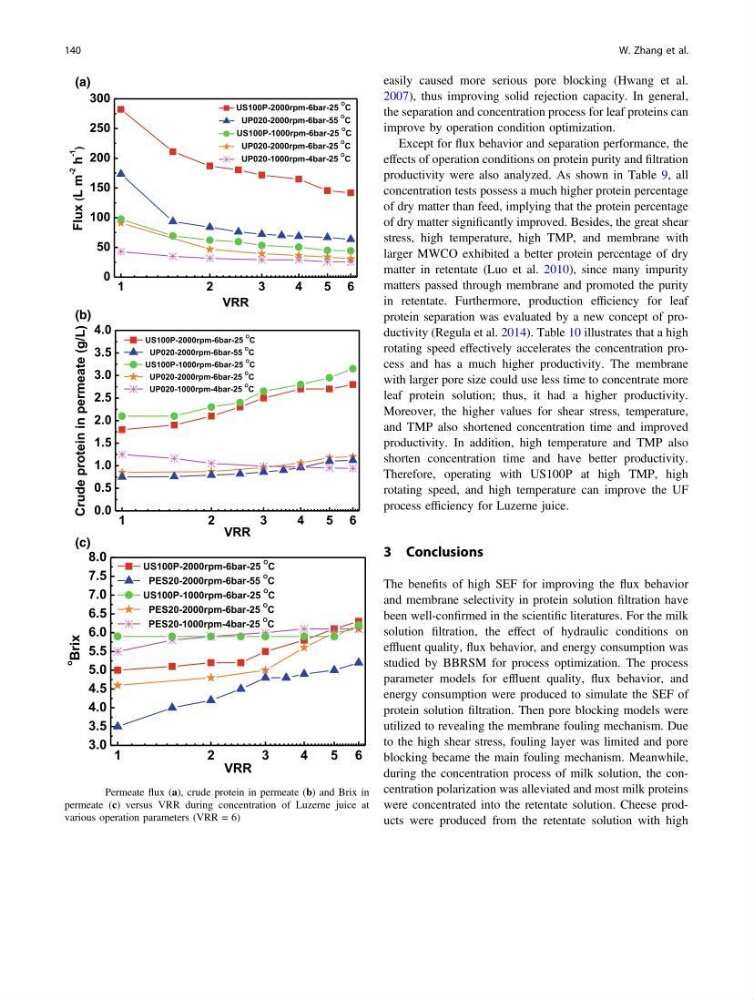
Fig. 15 Permeate flux (a), crude protein in permeate (b) and Brix in
permeate (c) versus VRR during concentration of Luzerne juice at
various operation parameters (VRR = 6)
140
W. Zhang et al.
2007), thus improving solid rejection capacity. In general,
the separation and concentration process for leaf proteins can
improve by operation condition optimization.
Except for flux behavior and separation performance, the
effects of operation conditions on protein purity and filtration
productivity were also analyzed. As shown in Table 9, all
concentration tests possess a much higher protein percentage
of dry matter than feed, implying that the protein percentage
of dry matter significantly improved. Besides, the great shear
stress, high temperature, high TMP, and membrane with
larger MWCO exhibited a better protein percentage of dry
matter in retentate (Luo et al. 2010), since many impurity
matters passed through membrane and promoted the purity
in retentate. Furthermore, production efficiency for leaf
protein separation was evaluated by a new concept of productivity (Regula et al. 2014). Table 10 illustrates that a high
rotating speed effectively accelerates the concentration process and has a much higher productivity. The membrane
with larger pore size could use less time to concentrate more
leaf protein solution; thus, it had a higher productivity.
Moreover, the higher values for shear stress, temperature,
and TMP also shortened concentration time and improved
productivity. In addition, high temperature and TMP also
shorten concentration time and have better productivity.
Therefore, operating with US100P at high TMP, high
rotating speed, and high temperature can improve the UF
process efficiency for Luzerne juice.
3 Conclusions
The benefits of high SEF for improving the flux behavior
and membrane selectivity in protein solution filtration have
been well-confirmed in the scientific literatures. For the milk
solution filtration, the effect of hydraulic conditions on
effluent quality, flux behavior, and energy consumption was
studied by BBRSM for process optimization. The process
parameter models for effluent quality, flux behavior, and
energy consumption were produced to simulate the SEF of
protein solution filtration. Then pore blocking models were
utilized to revealing the membrane fouling mechanism. Due
to the high shear stress, fouling layer was limited and pore
blocking became the main fouling mechanism. Meanwhile,
during the concentration process of milk solution, the concentration polarization was alleviated and most milk proteins
were concentrated into the retentate solution. Cheese products were produced from the retentate solution with high
(a)
(b)
(c)
Fig. 15 Permeate flux (a), crude protein in permeate (b) and Brix in
permeate (c) versus VRR during concentration of Luzerne juice at
various operation parameters (VRR = 6)
140
W. Zhang et al.