

Membrane Fouling Model
During the filtration process of leaf protein juice, permeate flux gradually elevates with TMP step by step. In
order to better understand this stepwise multisite fouling
phenomena, a stepwise multisite Darcy’s law model
(SMDM) is proposed to simulate the complex fouling process (Zhang et al. 2016). At the same time, the resistance
coefficient and compressibility for different steps and sites
could be calculated to characterize the fouling behavior
parameters. The results show that the simulation of SMDM
and experimental data is very similar. They could improve
the understanding of fouling process for protein separation
and promote membrane fouling control.
The conventional membrane fouling model [Darcy’s law
model (DM)] is based on the monofouling process, which
assumes uniform fouling affinity scales and binding energies
between foulants and membrane for fouling sites (Yang et al.
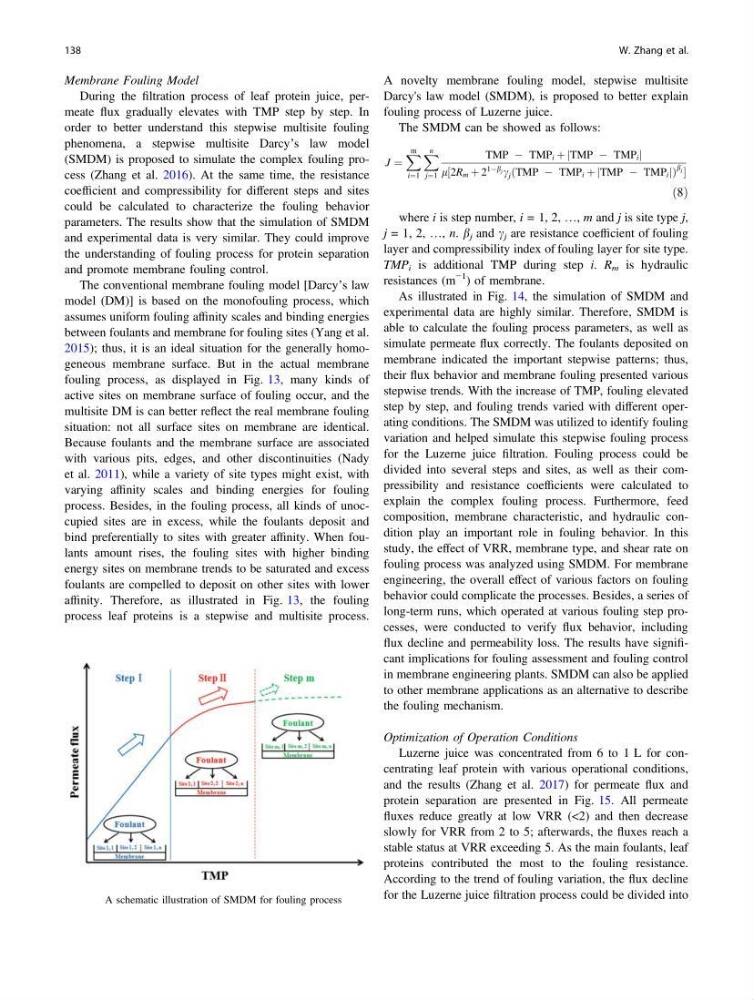
2015); thus, it is an ideal situation for the generally homogeneous membrane surface. But in the actual membrane
fouling process, as displayed in Fig. 13, many kinds of
active sites on membrane surface of fouling occur, and the
multisite DM is can better reflect the real membrane fouling
situation: not all surface sites on membrane are identical.
Because foulants and the membrane surface are associated
with various pits, edges, and other discontinuities (Nady
et al. 2011), while a variety of site types might exist, with
varying affinity scales and binding energies for fouling
process. Besides, in the fouling process, all kinds of unoccupied sites are in excess, while the foulants deposit and
bind preferentially to sites with greater affinity. When foulants amount rises, the fouling sites with higher binding
energy sites on membrane trends to be saturated and excess
foulants are compelled to deposit on other sites with lower
affinity. Therefore, as illustrated in Fig. 13, the fouling
process leaf proteins is a stepwise and multisite process.
A novelty membrane fouling model, stepwise multisite
Darcy's law model (SMDM), is proposed to better explain
fouling process of Luzerne juice.
The SMDM can be showed as follows:
J ¼
X m
i¼1
X n
j¼1
TMP À TMP i þ TMP À TMP i
j
j
l½2R m þ 2
1Àb j c j ðTMP À TMP i þ TMP À TMP i
j
j Þ
b j
ð8Þ
where i is step number, i = 1, 2, …, m and j is site type j,
j = 1, 2, …, n. b j and c j are resistance coefficient of fouling
layer and compressibility index of fouling layer for site type.
TMP i is additional TMP during step i. R m is hydraulic
resistances (m
−1 ) of membrane.
As illustrated in Fig. 14, the simulation of SMDM and
experimental data are highly similar. Therefore, SMDM is
able to calculate the fouling process parameters, as well as
simulate permeate flux correctly. The foulants deposited on
membrane indicated the important stepwise patterns; thus,
their flux behavior and membrane fouling presented various
stepwise trends. With the increase of TMP, fouling elevated
step by step, and fouling trends varied with different operating conditions. The SMDM was utilized to identify fouling
variation and helped simulate this stepwise fouling process
for the Luzerne juice filtration. Fouling process could be
divided into several steps and sites, as well as their compressibility and resistance coefficients were calculated to
explain the complex fouling process. Furthermore, feed
composition, membrane characteristic, and hydraulic condition play an important role in fouling behavior. In this
study, the effect of VRR, membrane type, and shear rate on
fouling process was analyzed using SMDM. For membrane
engineering, the overall effect of various factors on fouling
behavior could complicate the processes. Besides, a series of
long-term runs, which operated at various fouling step processes, were conducted to verify flux behavior, including
flux decline and permeability loss. The results have significant implications for fouling assessment and fouling control
in membrane engineering plants. SMDM can also be applied
to other membrane applications as an alternative to describe
the fouling mechanism.
Optimization of Operation Conditions
Luzerne juice was concentrated from 6 to 1 L for concentrating leaf protein with various operational conditions,
and the results (Zhang et al. 2017) for permeate flux and
protein separation are presented in Fig. 15. All permeate
fluxes reduce greatly at low VRR (<2) and then decrease
slowly for VRR from 2 to 5; afterwards, the fluxes reach a
stable status at VRR exceeding 5. As the main foulants, leaf
proteins contributed the most to the fouling resistance.
According to the trend of fouling variation, the flux decline
for the Luzerne juice filtration process could be divided into
Fig. 13 A schematic illustration of SMDM for fouling process
138
W. Zhang et al.
During the filtration process of leaf protein juice, permeate flux gradually elevates with TMP step by step. In
order to better understand this stepwise multisite fouling
phenomena, a stepwise multisite Darcy’s law model
(SMDM) is proposed to simulate the complex fouling process (Zhang et al. 2016). At the same time, the resistance
coefficient and compressibility for different steps and sites
could be calculated to characterize the fouling behavior
parameters. The results show that the simulation of SMDM
and experimental data is very similar. They could improve
the understanding of fouling process for protein separation
and promote membrane fouling control.
The conventional membrane fouling model [Darcy’s law
model (DM)] is based on the monofouling process, which
assumes uniform fouling affinity scales and binding energies
between foulants and membrane for fouling sites (Yang et al.
2015); thus, it is an ideal situation for the generally homogeneous membrane surface. But in the actual membrane
fouling process, as displayed in Fig. 13, many kinds of
active sites on membrane surface of fouling occur, and the
multisite DM is can better reflect the real membrane fouling
situation: not all surface sites on membrane are identical.
Because foulants and the membrane surface are associated
with various pits, edges, and other discontinuities (Nady
et al. 2011), while a variety of site types might exist, with
varying affinity scales and binding energies for fouling
process. Besides, in the fouling process, all kinds of unoccupied sites are in excess, while the foulants deposit and
bind preferentially to sites with greater affinity. When foulants amount rises, the fouling sites with higher binding
energy sites on membrane trends to be saturated and excess
foulants are compelled to deposit on other sites with lower
affinity. Therefore, as illustrated in Fig. 13, the fouling
process leaf proteins is a stepwise and multisite process.
A novelty membrane fouling model, stepwise multisite
Darcy's law model (SMDM), is proposed to better explain
fouling process of Luzerne juice.
The SMDM can be showed as follows:
J ¼
X m
i¼1
X n
j¼1
TMP À TMP i þ TMP À TMP i
j
j
l½2R m þ 2
1Àb j c j ðTMP À TMP i þ TMP À TMP i
j
j Þ
b j
ð8Þ
where i is step number, i = 1, 2, …, m and j is site type j,
j = 1, 2, …, n. b j and c j are resistance coefficient of fouling
layer and compressibility index of fouling layer for site type.
TMP i is additional TMP during step i. R m is hydraulic
resistances (m
−1 ) of membrane.
As illustrated in Fig. 14, the simulation of SMDM and
experimental data are highly similar. Therefore, SMDM is
able to calculate the fouling process parameters, as well as
simulate permeate flux correctly. The foulants deposited on
membrane indicated the important stepwise patterns; thus,
their flux behavior and membrane fouling presented various
stepwise trends. With the increase of TMP, fouling elevated
step by step, and fouling trends varied with different operating conditions. The SMDM was utilized to identify fouling
variation and helped simulate this stepwise fouling process
for the Luzerne juice filtration. Fouling process could be
divided into several steps and sites, as well as their compressibility and resistance coefficients were calculated to
explain the complex fouling process. Furthermore, feed
composition, membrane characteristic, and hydraulic condition play an important role in fouling behavior. In this
study, the effect of VRR, membrane type, and shear rate on
fouling process was analyzed using SMDM. For membrane
engineering, the overall effect of various factors on fouling
behavior could complicate the processes. Besides, a series of
long-term runs, which operated at various fouling step processes, were conducted to verify flux behavior, including
flux decline and permeability loss. The results have significant implications for fouling assessment and fouling control
in membrane engineering plants. SMDM can also be applied
to other membrane applications as an alternative to describe
the fouling mechanism.
Optimization of Operation Conditions
Luzerne juice was concentrated from 6 to 1 L for concentrating leaf protein with various operational conditions,
and the results (Zhang et al. 2017) for permeate flux and
protein separation are presented in Fig. 15. All permeate
fluxes reduce greatly at low VRR (<2) and then decrease
slowly for VRR from 2 to 5; afterwards, the fluxes reach a
stable status at VRR exceeding 5. As the main foulants, leaf
proteins contributed the most to the fouling resistance.
According to the trend of fouling variation, the flux decline
for the Luzerne juice filtration process could be divided into
Fig. 13 A schematic illustration of SMDM for fouling process
138
W. Zhang et al.