

process could separate large solutes (leaf protein), while
many small solutes passed through membrane. In comparison with DA and DRDM, CRDM had higher protein purity
and best clarification effect, due to its higher shear rate and
lower “secondary filtration” performance. In general,
CRDM, with more advantageous performance at flux
behavior and separation performance, is the best filtration
selection for leaf protein separation.
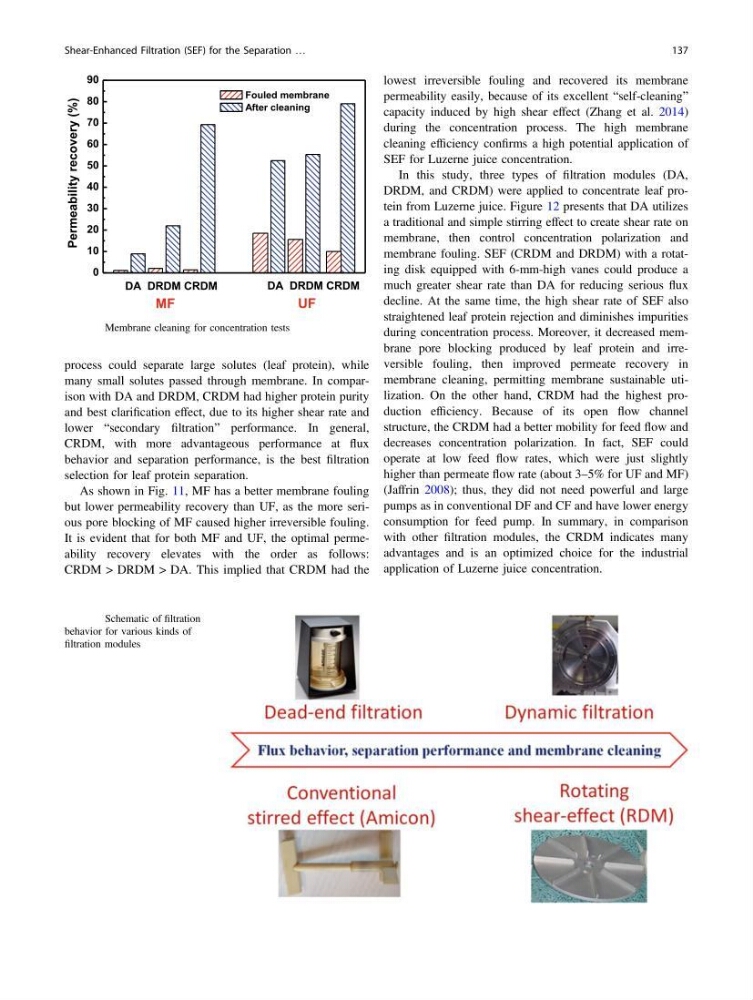
As shown in Fig. 11, MF has a better membrane fouling
but lower permeability recovery than UF, as the more serious pore blocking of MF caused higher irreversible fouling.
It is evident that for both MF and UF, the optimal permeability recovery elevates with the order as follows:
CRDM > DRDM > DA. This implied that CRDM had the
lowest irreversible fouling and recovered its membrane
permeability easily, because of its excellent “self-cleaning”
capacity induced by high shear effect (Zhang et al. 2014)
during the concentration process. The high membrane
cleaning efficiency confirms a high potential application of
SEF for Luzerne juice concentration.
In this study, three types of filtration modules (DA,
DRDM, and CRDM) were applied to concentrate leaf protein from Luzerne juice. Figure 12 presents that DA utilizes
a traditional and simple stirring effect to create shear rate on
membrane, then control concentration polarization and
membrane fouling. SEF (CRDM and DRDM) with a rotating disk equipped with 6-mm-high vanes could produce a
much greater shear rate than DA for reducing serious flux
decline. At the same time, the high shear rate of SEF also
straightened leaf protein rejection and diminishes impurities
during concentration process. Moreover, it decreased membrane pore blocking produced by leaf protein and irreversible fouling, then improved permeate recovery in
membrane cleaning, permitting membrane sustainable utilization. On the other hand, CRDM had the highest production efficiency. Because of its open flow channel
structure, the CRDM had a better mobility for feed flow and
decreases concentration polarization. In fact, SEF could
operate at low feed flow rates, which were just slightly
higher than permeate flow rate (about 3–5% for UF and MF)
(Jaffrin 2008); thus, they did not need powerful and large
pumps as in conventional DF and CF and have lower energy
consumption for feed pump. In summary, in comparison
with other filtration modules, the CRDM indicates many
advantages and is an optimized choice for the industrial
application of Luzerne juice concentration.
Fig. 11 Membrane cleaning for concentration tests
Fig. 12 Schematic of filtration
behavior for various kinds of
filtration modules
Shear-Enhanced Filtration (SEF) for the Separation …
137
many small solutes passed through membrane. In comparison with DA and DRDM, CRDM had higher protein purity
and best clarification effect, due to its higher shear rate and
lower “secondary filtration” performance. In general,
CRDM, with more advantageous performance at flux
behavior and separation performance, is the best filtration
selection for leaf protein separation.
As shown in Fig. 11, MF has a better membrane fouling
but lower permeability recovery than UF, as the more serious pore blocking of MF caused higher irreversible fouling.
It is evident that for both MF and UF, the optimal permeability recovery elevates with the order as follows:
CRDM > DRDM > DA. This implied that CRDM had the
lowest irreversible fouling and recovered its membrane
permeability easily, because of its excellent “self-cleaning”
capacity induced by high shear effect (Zhang et al. 2014)
during the concentration process. The high membrane
cleaning efficiency confirms a high potential application of
SEF for Luzerne juice concentration.
In this study, three types of filtration modules (DA,
DRDM, and CRDM) were applied to concentrate leaf protein from Luzerne juice. Figure 12 presents that DA utilizes
a traditional and simple stirring effect to create shear rate on
membrane, then control concentration polarization and
membrane fouling. SEF (CRDM and DRDM) with a rotating disk equipped with 6-mm-high vanes could produce a
much greater shear rate than DA for reducing serious flux
decline. At the same time, the high shear rate of SEF also
straightened leaf protein rejection and diminishes impurities
during concentration process. Moreover, it decreased membrane pore blocking produced by leaf protein and irreversible fouling, then improved permeate recovery in
membrane cleaning, permitting membrane sustainable utilization. On the other hand, CRDM had the highest production efficiency. Because of its open flow channel
structure, the CRDM had a better mobility for feed flow and
decreases concentration polarization. In fact, SEF could
operate at low feed flow rates, which were just slightly
higher than permeate flow rate (about 3–5% for UF and MF)
(Jaffrin 2008); thus, they did not need powerful and large
pumps as in conventional DF and CF and have lower energy
consumption for feed pump. In summary, in comparison
with other filtration modules, the CRDM indicates many
advantages and is an optimized choice for the industrial
application of Luzerne juice concentration.
Fig. 11 Membrane cleaning for concentration tests
Fig. 12 Schematic of filtration
behavior for various kinds of
filtration modules
Shear-Enhanced Filtration (SEF) for the Separation …
137