

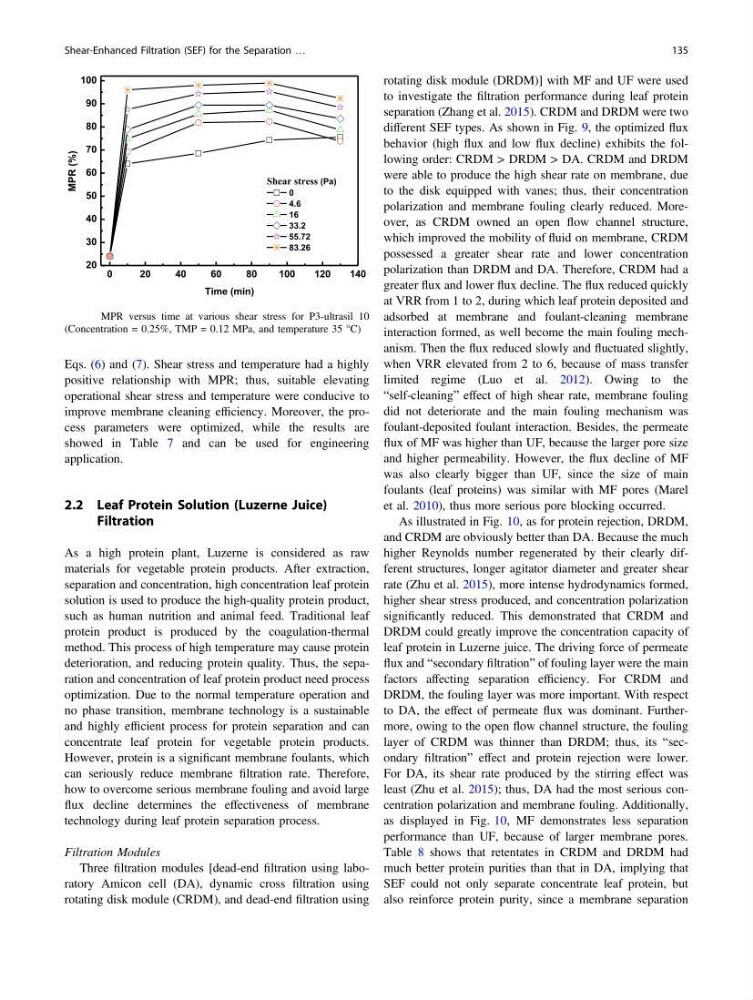
Eqs. (6) and (7). Shear stress and temperature had a highly
positive relationship with MPR; thus, suitable elevating
operational shear stress and temperature were conducive to
improve membrane cleaning efficiency. Moreover, the process parameters were optimized, while the results are
showed in Table 7 and can be used for engineering
application.
2.2 Leaf Protein Solution (Luzerne Juice)
Filtration
As a high protein plant, Luzerne is considered as raw
materials for vegetable protein products. After extraction,
separation and concentration, high concentration leaf protein
solution is used to produce the high-quality protein product,
such as human nutrition and animal feed. Traditional leaf
protein product is produced by the coagulation-thermal
method. This process of high temperature may cause protein
deterioration, and reducing protein quality. Thus, the separation and concentration of leaf protein product need process
optimization. Due to the normal temperature operation and
no phase transition, membrane technology is a sustainable
and highly efficient process for protein separation and can
concentrate leaf protein for vegetable protein products.
However, protein is a significant membrane foulants, which
can seriously reduce membrane filtration rate. Therefore,
how to overcome serious membrane fouling and avoid large
flux decline determines the effectiveness of membrane
technology during leaf protein separation process.
Filtration Modules
Three filtration modules [dead-end filtration using laboratory Amicon cell (DA), dynamic cross filtration using
rotating disk module (CRDM), and dead-end filtration using
rotating disk module (DRDM)] with MF and UF were used
to investigate the filtration performance during leaf protein
separation (Zhang et al. 2015). CRDM and DRDM were two
different SEF types. As shown in Fig. 9, the optimized flux
behavior (high flux and low flux decline) exhibits the following order: CRDM > DRDM > DA. CRDM and DRDM
were able to produce the high shear rate on membrane, due
to the disk equipped with vanes; thus, their concentration
polarization and membrane fouling clearly reduced. Moreover, as CRDM owned an open flow channel structure,
which improved the mobility of fluid on membrane, CRDM
possessed a greater shear rate and lower concentration
polarization than DRDM and DA. Therefore, CRDM had a
greater flux and lower flux decline. The flux reduced quickly
at VRR from 1 to 2, during which leaf protein deposited and
adsorbed at membrane and foulant-cleaning membrane
interaction formed, as well become the main fouling mechanism. Then the flux reduced slowly and fluctuated slightly,
when VRR elevated from 2 to 6, because of mass transfer
limited regime (Luo et al. 2012). Owing to the
“self-cleaning” effect of high shear rate, membrane fouling
did not deteriorate and the main fouling mechanism was
foulant-deposited foulant interaction. Besides, the permeate
flux of MF was higher than UF, because the larger pore size
and higher permeability. However, the flux decline of MF
was also clearly bigger than UF, since the size of main
foulants (leaf proteins) was similar with MF pores (Marel
et al. 2010), thus more serious pore blocking occurred.
As illustrated in Fig. 10, as for protein rejection, DRDM,
and CRDM are obviously better than DA. Because the much
higher Reynolds number regenerated by their clearly different structures, longer agitator diameter and greater shear
rate (Zhu et al. 2015), more intense hydrodynamics formed,
higher shear stress produced, and concentration polarization
significantly reduced. This demonstrated that CRDM and
DRDM could greatly improve the concentration capacity of
leaf protein in Luzerne juice. The driving force of permeate
flux and “secondary filtration” of fouling layer were the main
factors affecting separation efficiency. For CRDM and
DRDM, the fouling layer was more important. With respect
to DA, the effect of permeate flux was dominant. Furthermore, owing to the open flow channel structure, the fouling
layer of CRDM was thinner than DRDM; thus, its “secondary filtration” effect and protein rejection were lower.
For DA, its shear rate produced by the stirring effect was
least (Zhu et al. 2015); thus, DA had the most serious concentration polarization and membrane fouling. Additionally,
as displayed in Fig. 10, MF demonstrates less separation
performance than UF, because of larger membrane pores.
Table 8 shows that retentates in CRDM and DRDM had
much better protein purities than that in DA, implying that
SEF could not only separate concentrate leaf protein, but
also reinforce protein purity, since a membrane separation
Fig. 8 MPR versus time at various shear stress for P3-ultrasil 10
(Concentration = 0.25%, TMP = 0.12 MPa, and temperature 35 °C)
Shear-Enhanced Filtration (SEF) for the Separation …
135
positive relationship with MPR; thus, suitable elevating
operational shear stress and temperature were conducive to
improve membrane cleaning efficiency. Moreover, the process parameters were optimized, while the results are
showed in Table 7 and can be used for engineering
application.
2.2 Leaf Protein Solution (Luzerne Juice)
Filtration
As a high protein plant, Luzerne is considered as raw
materials for vegetable protein products. After extraction,
separation and concentration, high concentration leaf protein
solution is used to produce the high-quality protein product,
such as human nutrition and animal feed. Traditional leaf
protein product is produced by the coagulation-thermal
method. This process of high temperature may cause protein
deterioration, and reducing protein quality. Thus, the separation and concentration of leaf protein product need process
optimization. Due to the normal temperature operation and
no phase transition, membrane technology is a sustainable
and highly efficient process for protein separation and can
concentrate leaf protein for vegetable protein products.
However, protein is a significant membrane foulants, which
can seriously reduce membrane filtration rate. Therefore,
how to overcome serious membrane fouling and avoid large
flux decline determines the effectiveness of membrane
technology during leaf protein separation process.
Filtration Modules
Three filtration modules [dead-end filtration using laboratory Amicon cell (DA), dynamic cross filtration using
rotating disk module (CRDM), and dead-end filtration using
rotating disk module (DRDM)] with MF and UF were used
to investigate the filtration performance during leaf protein
separation (Zhang et al. 2015). CRDM and DRDM were two
different SEF types. As shown in Fig. 9, the optimized flux
behavior (high flux and low flux decline) exhibits the following order: CRDM > DRDM > DA. CRDM and DRDM
were able to produce the high shear rate on membrane, due
to the disk equipped with vanes; thus, their concentration
polarization and membrane fouling clearly reduced. Moreover, as CRDM owned an open flow channel structure,
which improved the mobility of fluid on membrane, CRDM
possessed a greater shear rate and lower concentration
polarization than DRDM and DA. Therefore, CRDM had a
greater flux and lower flux decline. The flux reduced quickly
at VRR from 1 to 2, during which leaf protein deposited and
adsorbed at membrane and foulant-cleaning membrane
interaction formed, as well become the main fouling mechanism. Then the flux reduced slowly and fluctuated slightly,
when VRR elevated from 2 to 6, because of mass transfer
limited regime (Luo et al. 2012). Owing to the
“self-cleaning” effect of high shear rate, membrane fouling
did not deteriorate and the main fouling mechanism was
foulant-deposited foulant interaction. Besides, the permeate
flux of MF was higher than UF, because the larger pore size
and higher permeability. However, the flux decline of MF
was also clearly bigger than UF, since the size of main
foulants (leaf proteins) was similar with MF pores (Marel
et al. 2010), thus more serious pore blocking occurred.
As illustrated in Fig. 10, as for protein rejection, DRDM,
and CRDM are obviously better than DA. Because the much
higher Reynolds number regenerated by their clearly different structures, longer agitator diameter and greater shear
rate (Zhu et al. 2015), more intense hydrodynamics formed,
higher shear stress produced, and concentration polarization
significantly reduced. This demonstrated that CRDM and
DRDM could greatly improve the concentration capacity of
leaf protein in Luzerne juice. The driving force of permeate
flux and “secondary filtration” of fouling layer were the main
factors affecting separation efficiency. For CRDM and
DRDM, the fouling layer was more important. With respect
to DA, the effect of permeate flux was dominant. Furthermore, owing to the open flow channel structure, the fouling
layer of CRDM was thinner than DRDM; thus, its “secondary filtration” effect and protein rejection were lower.
For DA, its shear rate produced by the stirring effect was
least (Zhu et al. 2015); thus, DA had the most serious concentration polarization and membrane fouling. Additionally,
as displayed in Fig. 10, MF demonstrates less separation
performance than UF, because of larger membrane pores.
Table 8 shows that retentates in CRDM and DRDM had
much better protein purities than that in DA, implying that
SEF could not only separate concentrate leaf protein, but
also reinforce protein purity, since a membrane separation
Fig. 8 MPR versus time at various shear stress for P3-ultrasil 10
(Concentration = 0.25%, TMP = 0.12 MPa, and temperature 35 °C)
Shear-Enhanced Filtration (SEF) for the Separation …
135