

Polymers of Nafion perfluorosulfonic acid are the most
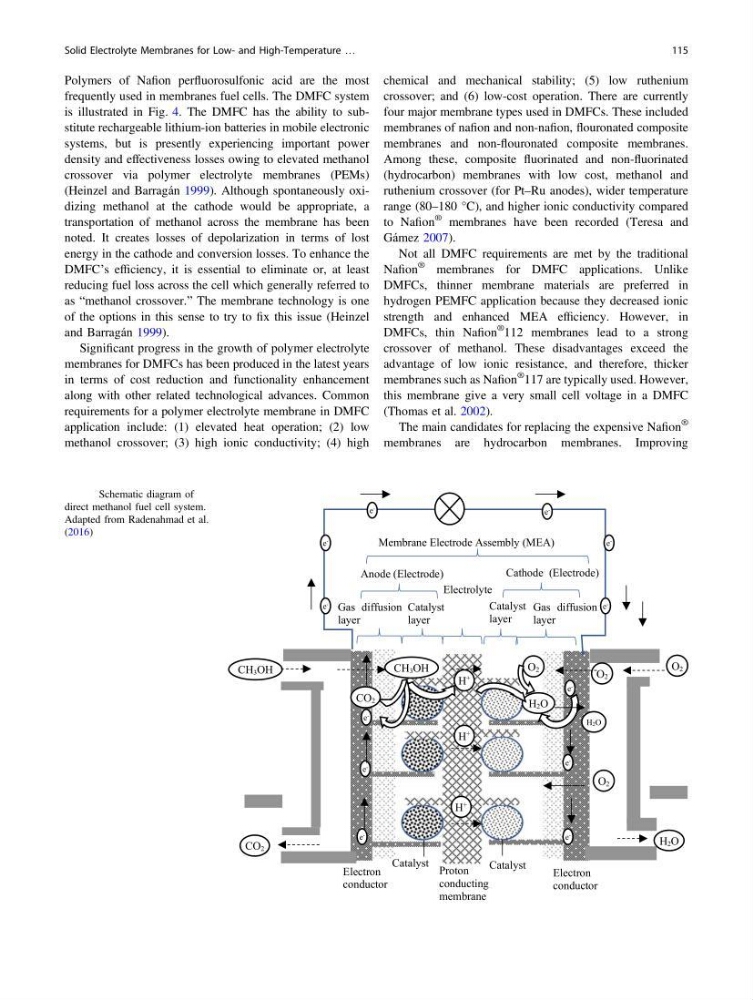
frequently used in membranes fuel cells. The DMFC system
is illustrated in Fig. 4. The DMFC has the ability to substitute rechargeable lithium-ion batteries in mobile electronic
systems, but is presently experiencing important power
density and effectiveness losses owing to elevated methanol
crossover via polymer electrolyte membranes (PEMs)
(Heinzel and Barragán 1999). Although spontaneously oxidizing methanol at the cathode would be appropriate, a
transportation of methanol across the membrane has been
noted. It creates losses of depolarization in terms of lost
energy in the cathode and conversion losses. To enhance the
DMFC’s efficiency, it is essential to eliminate or, at least
reducing fuel loss across the cell which generally referred to
as “methanol crossover.” The membrane technology is one
of the options in this sense to try to fix this issue (Heinzel
and Barragán 1999).
Significant progress in the growth of polymer electrolyte
membranes for DMFCs has been produced in the latest years
in terms of cost reduction and functionality enhancement
along with other related technological advances. Common
requirements for a polymer electrolyte membrane in DMFC
application include: (1) elevated heat operation; (2) low
methanol crossover; (3) high ionic conductivity; (4) high
chemical and mechanical stability; (5) low ruthenium
crossover; and (6) low-cost operation. There are currently
four major membrane types used in DMFCs. These included
membranes of nafion and non-nafion, flouronated composite
membranes and non-flouronated composite membranes.
Among these, composite fluorinated and non-fluorinated
(hydrocarbon) membranes with low cost, methanol and
ruthenium crossover (for Pt–Ru anodes), wider temperature
range (80–180 °C), and higher ionic conductivity compared
to Nafion
® membranes have been recorded (Teresa and
Gámez 2007).
Not all DMFC requirements are met by the traditional
Nafion
® membranes for DMFC applications. Unlike
DMFCs, thinner membrane materials are preferred in
hydrogen PEMFC application because they decreased ionic
strength and enhanced MEA efficiency. However, in
DMFCs, thin Nafion
® 112 membranes lead to a strong
crossover of methanol. These disadvantages exceed the
advantage of low ionic resistance, and therefore, thicker
membranes such as Nafion
® 117 are typically used. However,
this membrane give a very small cell voltage in a DMFC
(Thomas et al. 2002).
The main candidates for replacing the expensive Nafion
®
membranes are hydrocarbon membranes. Improving
CH 3 OH
H
+
H
+
H
+
e
-
e
-
e
-
e
-
e
-
e
-
O 2
H 2 O
H2O
O 2
O 2
Membrane Electrode Assembly (MEA)
Anode (Electrode)
Cathode (Electrode)
Electrolyte
Catalyst
layer
Catalyst
layer
Gas diffusion
layer
Gas diffusion
layer
Proton
conducting
membrane
Electron
conductor
Electron
conductor
Catalyst
Catalyst
e
-
e
-
e
-
e
-
e
-
e
-
O 2
H 2 O
CO 2
CH 3 OH
CO 2
Fig. 4 Schematic diagram of
direct methanol fuel cell system.
Adapted from Radenahmad et al.
(2016)
Solid Electrolyte Membranes for Low- and High-Temperature …
115
frequently used in membranes fuel cells. The DMFC system
is illustrated in Fig. 4. The DMFC has the ability to substitute rechargeable lithium-ion batteries in mobile electronic
systems, but is presently experiencing important power
density and effectiveness losses owing to elevated methanol
crossover via polymer electrolyte membranes (PEMs)
(Heinzel and Barragán 1999). Although spontaneously oxidizing methanol at the cathode would be appropriate, a
transportation of methanol across the membrane has been
noted. It creates losses of depolarization in terms of lost
energy in the cathode and conversion losses. To enhance the
DMFC’s efficiency, it is essential to eliminate or, at least
reducing fuel loss across the cell which generally referred to
as “methanol crossover.” The membrane technology is one
of the options in this sense to try to fix this issue (Heinzel
and Barragán 1999).
Significant progress in the growth of polymer electrolyte
membranes for DMFCs has been produced in the latest years
in terms of cost reduction and functionality enhancement
along with other related technological advances. Common
requirements for a polymer electrolyte membrane in DMFC
application include: (1) elevated heat operation; (2) low
methanol crossover; (3) high ionic conductivity; (4) high
chemical and mechanical stability; (5) low ruthenium
crossover; and (6) low-cost operation. There are currently
four major membrane types used in DMFCs. These included
membranes of nafion and non-nafion, flouronated composite
membranes and non-flouronated composite membranes.
Among these, composite fluorinated and non-fluorinated
(hydrocarbon) membranes with low cost, methanol and
ruthenium crossover (for Pt–Ru anodes), wider temperature
range (80–180 °C), and higher ionic conductivity compared
to Nafion
® membranes have been recorded (Teresa and
Gámez 2007).
Not all DMFC requirements are met by the traditional
Nafion
® membranes for DMFC applications. Unlike
DMFCs, thinner membrane materials are preferred in
hydrogen PEMFC application because they decreased ionic
strength and enhanced MEA efficiency. However, in
DMFCs, thin Nafion
® 112 membranes lead to a strong
crossover of methanol. These disadvantages exceed the
advantage of low ionic resistance, and therefore, thicker
membranes such as Nafion
® 117 are typically used. However,
this membrane give a very small cell voltage in a DMFC
(Thomas et al. 2002).
The main candidates for replacing the expensive Nafion
®
membranes are hydrocarbon membranes. Improving
CH 3 OH
H
+
H
+
H
+
e
-
e
-
e
-
e
-
e
-
e
-
O 2
H 2 O
H2O
O 2
O 2
Membrane Electrode Assembly (MEA)
Anode (Electrode)
Cathode (Electrode)
Electrolyte
Catalyst
layer
Catalyst
layer
Gas diffusion
layer
Gas diffusion
layer
Proton
conducting
membrane
Electron
conductor
Electron
conductor
Catalyst
Catalyst
e
-
e
-
e
-
e
-
e
-
e
-
O 2
H 2 O
CO 2
CH 3 OH
CO 2
Fig. 4 Schematic diagram of
direct methanol fuel cell system.
Adapted from Radenahmad et al.
(2016)
Solid Electrolyte Membranes for Low- and High-Temperature …
115