

Witnesses to Radioactive Contamination 181
I stopped myself from coughing and pointed my lens towards the
ground. I made my first shots, about twenty of them. Suddenly, my camera locked. […] In Kiev, while developing it, the film was covered with
an opaque surface. Almost all the photographs are entirely black, as if the
camera had been opened in full light and exposed. I did not understand
it then, but it was due to the radioactivity. […] Only the first photographs
seemed less damaged. Undoubtedly, they had been protected by the roll
casing. Struggling with the film, I ended up obtaining an acceptable
photograph that I sent to Moscow, to the Novosti agency main office. It
was not published. 24
This aerial photograph of the Chernobyl power plant from April 26, 1986,
has been described as Kostin’s only usable photograph from the day of the
accident, and its graininess can be attributed to the extremely high level of
radiation at the site (Figure 8.2). 25 The Soviet regime kept the catastrophe
secret for the first days. On May 5, Kostin received official permission from
his agency to take photographs, but these photographs were not published
initially. Instead, officials downplayed, passed over in silence, and intentionally misrepresented the danger the catastrophe posed. 26
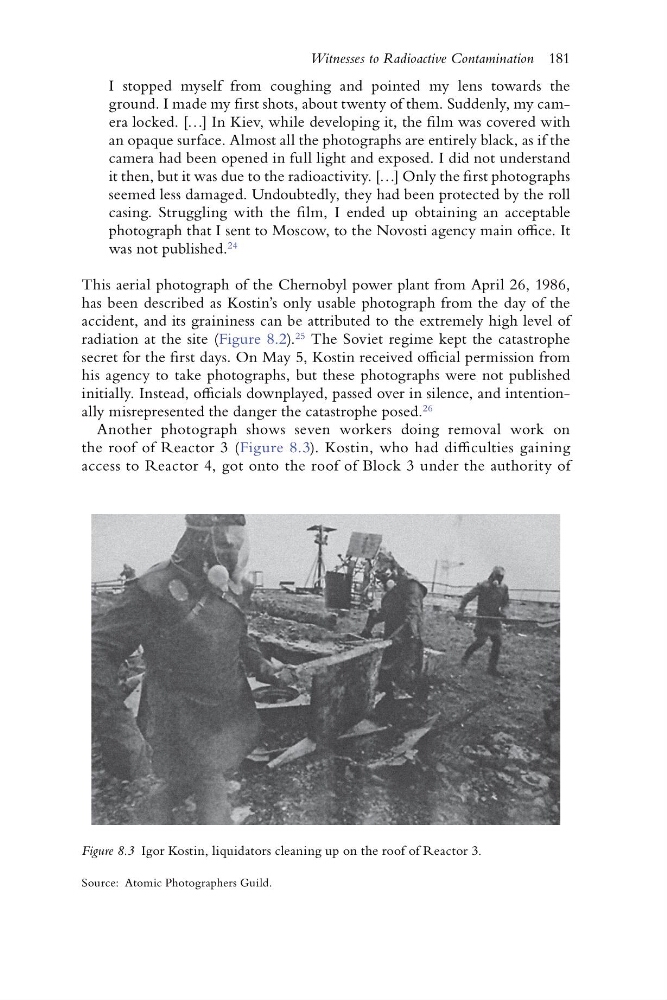
Another photograph shows seven workers doing removal work on
the roof of Reactor 3 (Figure 8.3). Kostin, who had difficulties gaining
access to Reactor 4, got onto the roof of Block 3 under the authority of
Figure 8.3 Igor Kostin, liquidators cleaning up on the roof of Reactor 3.
Source: Atomic Photographers Guild.
I stopped myself from coughing and pointed my lens towards the
ground. I made my first shots, about twenty of them. Suddenly, my camera locked. […] In Kiev, while developing it, the film was covered with
an opaque surface. Almost all the photographs are entirely black, as if the
camera had been opened in full light and exposed. I did not understand
it then, but it was due to the radioactivity. […] Only the first photographs
seemed less damaged. Undoubtedly, they had been protected by the roll
casing. Struggling with the film, I ended up obtaining an acceptable
photograph that I sent to Moscow, to the Novosti agency main office. It
was not published. 24
This aerial photograph of the Chernobyl power plant from April 26, 1986,
has been described as Kostin’s only usable photograph from the day of the
accident, and its graininess can be attributed to the extremely high level of
radiation at the site (Figure 8.2). 25 The Soviet regime kept the catastrophe
secret for the first days. On May 5, Kostin received official permission from
his agency to take photographs, but these photographs were not published
initially. Instead, officials downplayed, passed over in silence, and intentionally misrepresented the danger the catastrophe posed. 26
Another photograph shows seven workers doing removal work on
the roof of Reactor 3 (Figure 8.3). Kostin, who had difficulties gaining
access to Reactor 4, got onto the roof of Block 3 under the authority of
Figure 8.3 Igor Kostin, liquidators cleaning up on the roof of Reactor 3.
Source: Atomic Photographers Guild.