

providing power brakes, heating/cooling, lights,
catering facilities, and other auxiliaries. Whilst
pollutant emissions per train at stations are relatively low compared with those during a trip,
where several trains are running at idle and the
station is enclosed there may be an issue regarding
population exposure. There may therefore be significant potential to reduce emissions at stations
simply through enforcing maximum idle running
times [123].
When at berth, ships also need electrical power
for emergency equipment, refrigeration, cooling,
heating, lighting, loading/unloading equipment,
etc. This power is normally provided by the auxiliary engines. However, such engines result in air
pollutant emissions at the port, and these are often
close to centers of population. An alternative
approach is to obtain power from shore, a process
known as “cold ironing.” The port of Gothenburg
in Sweden was the first in the world to provide a
high-voltage onshore power supply for cargo vessels. Two local wind turbines are used to generate
the electricity, and it is claimed that the system
cuts emissions by 94–97% for ships at berth and
has led to dramatic reductions in pollutant concentrations. Systems are also available for optimizing the energy efficiency of a vessel by
advising the crew on the optimal speed for the
prevailing water conditions [138].
Road Sweeping and Washing Sweeping
(or vacuuming) and washing have been applied in
several countries as means of decreasing the silt
loading of roads, the premise being that this will
reduce PM resuspension. Purpose-built vehicles are
usually employed, and the cleaning process can
involve mechanical (broom) sweeping, vacuuming,
spraying with water, or a combination of these. Some
vehicles are specifically designed to reduce PM 10
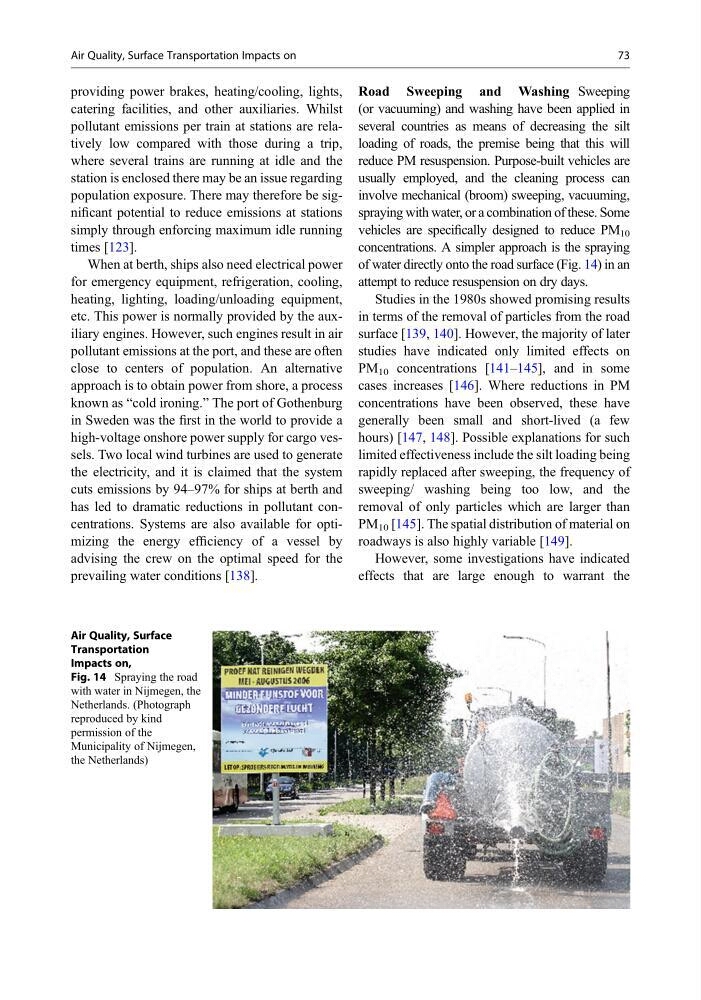
concentrations. A simpler approach is the spraying
of water directly onto the road surface (Fig. 14) in an
attempt to reduce resuspension on dry days.
Studies in the 1980s showed promising results
in terms of the removal of particles from the road
surface [139, 140]. However, the majority of later
studies have indicated only limited effects on
PM 10 concentrations [141–145], and in some
cases increases [146]. Where reductions in PM
concentrations have been observed, these have
generally been small and short-lived (a few
hours) [147, 148]. Possible explanations for such
limited effectiveness include the silt loading being
rapidly replaced after sweeping, the frequency of
sweeping/ washing being too low, and the
removal of only particles which are larger than
PM 10 [145]. The spatial distribution of material on
roadways is also highly variable [149].
However, some investigations have indicated
effects that are large enough to warrant the
Air Quality, Surface
Transportation
Impacts on,
Fig. 14 Spraying the road
with water in Nijmegen, the
Netherlands. (Photograph
reproduced by kind
permission of the
Municipality of Nijmegen,
the Netherlands)
Air Quality, Surface Transportation Impacts on
73
catering facilities, and other auxiliaries. Whilst
pollutant emissions per train at stations are relatively low compared with those during a trip,
where several trains are running at idle and the
station is enclosed there may be an issue regarding
population exposure. There may therefore be significant potential to reduce emissions at stations
simply through enforcing maximum idle running
times [123].
When at berth, ships also need electrical power
for emergency equipment, refrigeration, cooling,
heating, lighting, loading/unloading equipment,
etc. This power is normally provided by the auxiliary engines. However, such engines result in air
pollutant emissions at the port, and these are often
close to centers of population. An alternative
approach is to obtain power from shore, a process
known as “cold ironing.” The port of Gothenburg
in Sweden was the first in the world to provide a
high-voltage onshore power supply for cargo vessels. Two local wind turbines are used to generate
the electricity, and it is claimed that the system
cuts emissions by 94–97% for ships at berth and
has led to dramatic reductions in pollutant concentrations. Systems are also available for optimizing the energy efficiency of a vessel by
advising the crew on the optimal speed for the
prevailing water conditions [138].
Road Sweeping and Washing Sweeping
(or vacuuming) and washing have been applied in
several countries as means of decreasing the silt
loading of roads, the premise being that this will
reduce PM resuspension. Purpose-built vehicles are
usually employed, and the cleaning process can
involve mechanical (broom) sweeping, vacuuming,
spraying with water, or a combination of these. Some
vehicles are specifically designed to reduce PM 10
concentrations. A simpler approach is the spraying
of water directly onto the road surface (Fig. 14) in an
attempt to reduce resuspension on dry days.
Studies in the 1980s showed promising results
in terms of the removal of particles from the road
surface [139, 140]. However, the majority of later
studies have indicated only limited effects on
PM 10 concentrations [141–145], and in some
cases increases [146]. Where reductions in PM
concentrations have been observed, these have
generally been small and short-lived (a few
hours) [147, 148]. Possible explanations for such
limited effectiveness include the silt loading being
rapidly replaced after sweeping, the frequency of
sweeping/ washing being too low, and the
removal of only particles which are larger than
PM 10 [145]. The spatial distribution of material on
roadways is also highly variable [149].
However, some investigations have indicated
effects that are large enough to warrant the
Air Quality, Surface
Transportation
Impacts on,
Fig. 14 Spraying the road
with water in Nijmegen, the
Netherlands. (Photograph
reproduced by kind
permission of the
Municipality of Nijmegen,
the Netherlands)
Air Quality, Surface Transportation Impacts on
73