

and fuel cell vehicles. Vehicle technologies are
currently available that can reduce CO 2 emissions
per car by 30%, but demand-side and supply-side
barriers are delaying their deployment [126]. Cars
that emit 50% less CO 2 per kilometer than the
equivalent current models could be on the road
by 2030, subject to advances in hybrid and battery
technologies and industry overcoming cost barriers [126]. In the longer term, a 90% reduction in
emissions is possible based on battery-electric
propulsion systems [126].
In the rail sector, hybrid systems have been
shown to result in reductions in exhaust NO x and
PM of up to 90% [123]. Hybrid propulsion has
been used in shipping for many years, where the
mechanical drive for the propellers has been
replaced by electrical connections to electric
motors, which in turn drive the propellers [129].
Electricity results in zero emissions at the point
of use, giving it major local air quality benefits.
Moreover, if it is produced from renewable energy
it can have low or even effectively zero CO 2
emissions over its life cycle. The main drawbacks
with electric road vehicles include a relatively low
maximum speed, a short range, the lengthy
recharging times and the cost [126]. However,
there are continual improvements in the performance and marketability of electric vehicles.
In hydrogen vehicles the power is derived from
either combustion or electrochemical conversion
in a fuel cell. In hydrogen ICEs the combustion
process is fundamentally the same as that in petrol
ICEs. In a fuel cell the hydrogen reacts with oxygen to produce water and electricity, and the latter
is used to power the vehicle. When hydrogen is
used to generate power the only significant
emission is water vapor (though a small amount
of NO x is produced by hydrogen ICEs). If the
hydrogen is made from low-CO 2 energy sources,
very low life-cycle emissions are possible. Some
of the main obstacles to the wider use of hydrogen
for transport are the lack of an adequate infrastructure for storage/ distribution and the high cost of
implementation [15].
Eco-Driving “Eco-driving” has been widely
publicized as a means of reducing the fuel consumption and emissions of road vehicles. It is
aimed at both private motorists and fleet operators, and typically involves either a simple set of
rules to be followed or a program of training. The
advice or training varies considerably in terms of
the level of detail, but it generally features a number of common actions, including keeping the
tires at the correct pressure, reducing the vehicle
weight, avoiding sharp acceleration and heavy
braking, driving in the highest gear, and avoiding
unnecessary engine idling. Average overall reductions in fuel consumption of around 5–10% are
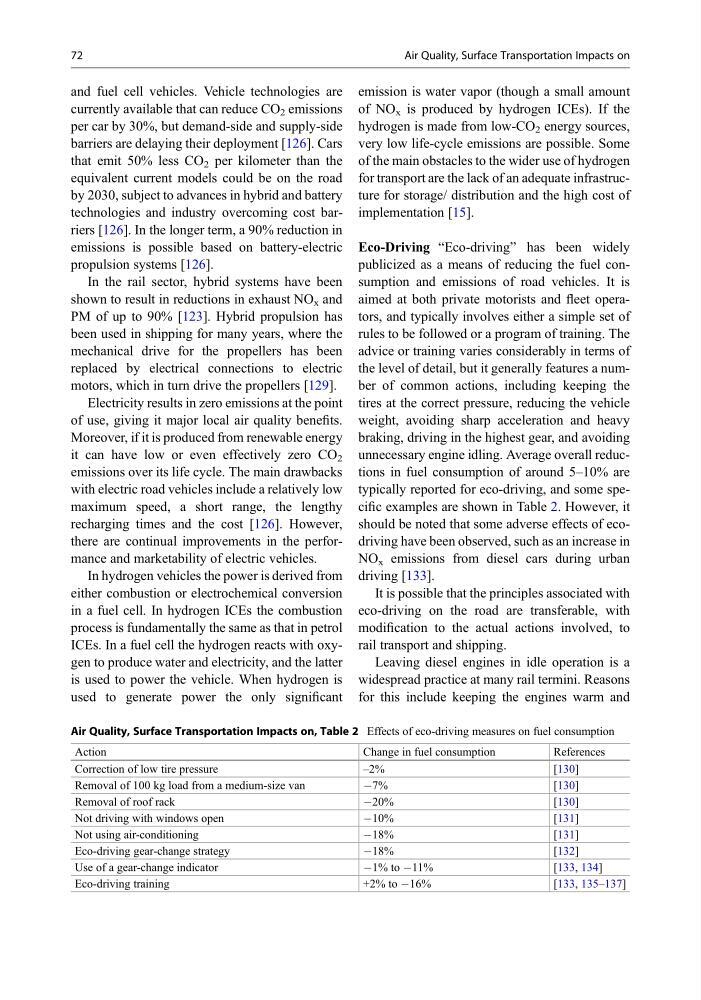
typically reported for eco-driving, and some specific examples are shown in Table 2. However, it
should be noted that some adverse effects of ecodriving have been observed, such as an increase in
NO x emissions from diesel cars during urban
driving [133].
It is possible that the principles associated with
eco-driving on the road are transferable, with
modification to the actual actions involved, to
rail transport and shipping.
Leaving diesel engines in idle operation is a
widespread practice at many rail termini. Reasons
for this include keeping the engines warm and
Air Quality, Surface Transportation Impacts on, Table 2 Effects of eco-driving measures on fuel consumption
Action
Change in fuel consumption
References
Correction of low tire pressure
–2%
[130]
Removal of 100 kg load from a medium-size van
À7%
[130]
Removal of roof rack
À20%
[130]
Not driving with windows open
À10%
[131]
Not using air-conditioning
À18%
[131]
Eco-driving gear-change strategy
À18%
[132]
Use of a gear-change indicator
À1% to À11%
[133, 134]
Eco-driving training
+2% to À16%
[133, 135–137]
72
Air Quality, Surface Transportation Impacts on
currently available that can reduce CO 2 emissions
per car by 30%, but demand-side and supply-side
barriers are delaying their deployment [126]. Cars
that emit 50% less CO 2 per kilometer than the
equivalent current models could be on the road
by 2030, subject to advances in hybrid and battery
technologies and industry overcoming cost barriers [126]. In the longer term, a 90% reduction in
emissions is possible based on battery-electric
propulsion systems [126].
In the rail sector, hybrid systems have been
shown to result in reductions in exhaust NO x and
PM of up to 90% [123]. Hybrid propulsion has
been used in shipping for many years, where the
mechanical drive for the propellers has been
replaced by electrical connections to electric
motors, which in turn drive the propellers [129].
Electricity results in zero emissions at the point
of use, giving it major local air quality benefits.
Moreover, if it is produced from renewable energy
it can have low or even effectively zero CO 2
emissions over its life cycle. The main drawbacks
with electric road vehicles include a relatively low
maximum speed, a short range, the lengthy
recharging times and the cost [126]. However,
there are continual improvements in the performance and marketability of electric vehicles.
In hydrogen vehicles the power is derived from
either combustion or electrochemical conversion
in a fuel cell. In hydrogen ICEs the combustion
process is fundamentally the same as that in petrol
ICEs. In a fuel cell the hydrogen reacts with oxygen to produce water and electricity, and the latter
is used to power the vehicle. When hydrogen is
used to generate power the only significant
emission is water vapor (though a small amount
of NO x is produced by hydrogen ICEs). If the
hydrogen is made from low-CO 2 energy sources,
very low life-cycle emissions are possible. Some
of the main obstacles to the wider use of hydrogen
for transport are the lack of an adequate infrastructure for storage/ distribution and the high cost of
implementation [15].
Eco-Driving “Eco-driving” has been widely
publicized as a means of reducing the fuel consumption and emissions of road vehicles. It is
aimed at both private motorists and fleet operators, and typically involves either a simple set of
rules to be followed or a program of training. The
advice or training varies considerably in terms of
the level of detail, but it generally features a number of common actions, including keeping the
tires at the correct pressure, reducing the vehicle
weight, avoiding sharp acceleration and heavy
braking, driving in the highest gear, and avoiding
unnecessary engine idling. Average overall reductions in fuel consumption of around 5–10% are
typically reported for eco-driving, and some specific examples are shown in Table 2. However, it
should be noted that some adverse effects of ecodriving have been observed, such as an increase in
NO x emissions from diesel cars during urban
driving [133].
It is possible that the principles associated with
eco-driving on the road are transferable, with
modification to the actual actions involved, to
rail transport and shipping.
Leaving diesel engines in idle operation is a
widespread practice at many rail termini. Reasons
for this include keeping the engines warm and
Air Quality, Surface Transportation Impacts on, Table 2 Effects of eco-driving measures on fuel consumption
Action
Change in fuel consumption
References
Correction of low tire pressure
–2%
[130]
Removal of 100 kg load from a medium-size van
À7%
[130]
Removal of roof rack
À20%
[130]
Not driving with windows open
À10%
[131]
Not using air-conditioning
À18%
[131]
Eco-driving gear-change strategy
À18%
[132]
Use of a gear-change indicator
À1% to À11%
[133, 134]
Eco-driving training
+2% to À16%
[133, 135–137]
72
Air Quality, Surface Transportation Impacts on