

Modelling methodologies can be categorized
according to two general types: empirical/statistical
models and deterministic models. Empirical models
are based largely on correlations between pollutant
concentrations and other variables, such as meteorological parameters. Although empirical models
can be used for short-term predictions, they are
most reliable for longer term averages. The assumptions that correlations represent cause and effect, and
that regression parameters remain constant into the
future, are their main weaknesses [20]. Deterministic
models predict concentrations downwind of an
emission source using mathematical formulae
which describe the physical and chemical processes
operating within the atmosphere [20]. They include
Gaussian plume models, Eulerian grid models,
Lagrangian trajectory models, and computational
fluid dynamics (CFD) models. For transport
sources, emissions are typically entered as a line
source (such as a road or railway line), or as an
area/volume source (such as a car park).
Models vary enormously in sophistication. The
simplest and most common deterministic models
are based on Gaussian dispersion theory. This
assumes that a pollutant emission develops into a
plume under the influence of the wind, and that
the concentrations in the plume have Gaussian
distributions in the horizontal and vertical directions. Two other types of model – Eulerian and
Lagrangian – take as their basis the principle of
conservation of mass of a pollutant as it spreads in
the air. In Eulerian models, the calculations are
undertaken simultaneously for all the grid points
in the model domain, whereas in the Lagrangian
approach the calculations relate to a parcel of air
which follows a defined trajectory. Several thousand trajectories are usually required to generate
statistically significant results. CFD models use
numerical methods to predict air flows. They
focus on the detailed modelling of complex structures on the local scale (e.g., street canyons), and
are not appropriate for calculating areawide
concentrations [20].
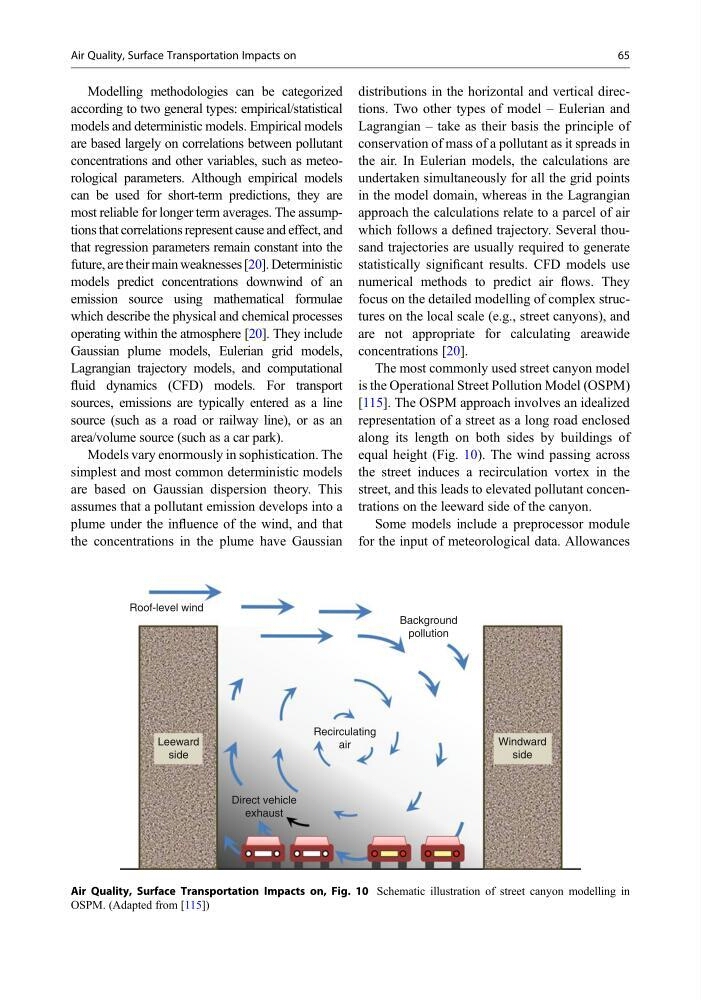
The most commonly used street canyon model
is the Operational Street Pollution Model (OSPM)
[115]. The OSPM approach involves an idealized
representation of a street as a long road enclosed
along its length on both sides by buildings of
equal height (Fig. 10). The wind passing across
the street induces a recirculation vortex in the
street, and this leads to elevated pollutant concentrations on the leeward side of the canyon.
Some models include a preprocessor module
for the input of meteorological data. Allowances
Leeward
side
Windward
side
Recirculating
air
Background
pollution
Roof-level wind
Direct vehicle
exhaust
Air Quality, Surface Transportation Impacts on, Fig. 10 Schematic illustration of street canyon modelling in
OSPM. (Adapted from [115])
Air Quality, Surface Transportation Impacts on
65
according to two general types: empirical/statistical
models and deterministic models. Empirical models
are based largely on correlations between pollutant
concentrations and other variables, such as meteorological parameters. Although empirical models
can be used for short-term predictions, they are
most reliable for longer term averages. The assumptions that correlations represent cause and effect, and
that regression parameters remain constant into the
future, are their main weaknesses [20]. Deterministic
models predict concentrations downwind of an
emission source using mathematical formulae
which describe the physical and chemical processes
operating within the atmosphere [20]. They include
Gaussian plume models, Eulerian grid models,
Lagrangian trajectory models, and computational
fluid dynamics (CFD) models. For transport
sources, emissions are typically entered as a line
source (such as a road or railway line), or as an
area/volume source (such as a car park).
Models vary enormously in sophistication. The
simplest and most common deterministic models
are based on Gaussian dispersion theory. This
assumes that a pollutant emission develops into a
plume under the influence of the wind, and that
the concentrations in the plume have Gaussian
distributions in the horizontal and vertical directions. Two other types of model – Eulerian and
Lagrangian – take as their basis the principle of
conservation of mass of a pollutant as it spreads in
the air. In Eulerian models, the calculations are
undertaken simultaneously for all the grid points
in the model domain, whereas in the Lagrangian
approach the calculations relate to a parcel of air
which follows a defined trajectory. Several thousand trajectories are usually required to generate
statistically significant results. CFD models use
numerical methods to predict air flows. They
focus on the detailed modelling of complex structures on the local scale (e.g., street canyons), and
are not appropriate for calculating areawide
concentrations [20].
The most commonly used street canyon model
is the Operational Street Pollution Model (OSPM)
[115]. The OSPM approach involves an idealized
representation of a street as a long road enclosed
along its length on both sides by buildings of
equal height (Fig. 10). The wind passing across
the street induces a recirculation vortex in the
street, and this leads to elevated pollutant concentrations on the leeward side of the canyon.
Some models include a preprocessor module
for the input of meteorological data. Allowances
Leeward
side
Windward
side
Recirculating
air
Background
pollution
Roof-level wind
Direct vehicle
exhaust
Air Quality, Surface Transportation Impacts on, Fig. 10 Schematic illustration of street canyon modelling in
OSPM. (Adapted from [115])
Air Quality, Surface Transportation Impacts on
65