

is an important source of NO x and sulfur oxides
(SO x ). Recent studies have indicated that around
15% of global NO x emissions and 5–8% of global
SO x emissions are attributable to oceangoing
ships [6, 7].
At the local level, the impacts of road transport
are exacerbated by the proximity of vehicles (and
their emissions) to the population, although the
other surface transport modes can contribute significantly to poor air quality at specific sites such
as busy railway stations, underground systems,
and large ports.
Rail transport only contributes a small proportion to total emissions from the transport sector,
but individual diesel locomotives have large
engines, and exhaust aftertreatment equipment is
not currently used on traction units. Elevated pollutant concentrations have therefore been
observed where diesel locomotives are running
with the engine at idle in enclosed stations
[9]. Several studies have addressed the exposure
of passengers to air pollution in underground rail
systems, where pollutant concentrations appear to
be considerably higher than those above ground.
For example, consistently high concentrations of
PM 10 and PM 2.5 have been reported [10–12].
Many major ports are also major cities, and so
emissions from seagoing ships in such ports can
directly affect a large population [13]. Ships at
berth are the main source of shipping emissions
in ports; the time spent at berth is typically 1 or
more days, whereas the time spent maneuvering is
typically only a few hours [14]. Moreover, almost
70% of maritime ship emissions occur within
400 km of land, and ships therefore have the
potential to contribute significantly to pollution
in coastal communities [13]. On the global scale,
PM emissions from marine shipping are thought
to be responsible for around 60,000 deaths annually, with impacts concentrated in coastal regions
on major trade routes. Most mortality effects are
seen in Asia and Europe where high populations
and high shipping-related PM concentrations
coincide [13].
The literature on transport-related air pollution is very extensive, and it is not possible to
cover every aspect in depth in this entry. The
emphasis is therefore on key areas such as historical trends in transport activity and emissions,
the processes of pollutant formation, and modelling approaches. Importantly, given the context
of this encyclopedia, a substantial part of the
entry is devoted to policies and measures which
can be implemented to reduce the impacts of
surface transport on air quality, and thus contribute to sustainability.
s
e
n
n
o
t
n
o
i
l
l
i
m
1
.
2
=
l
a
t
o
T
s
e
n
n
o
t
n
o
i
l
l
i
m
4
.
0
1
=
l
a
t
o
T
Energy
production and
distribution
20%
Energy use in
industry
14%
Road transport
41%
Non-road
transport
7%
Commercial,
institutional and
households
14%
Industrial
processes
2%
Solvent and
product use
0%
Agriculture
2%
Waste
0%
Other
0%
NOx
Energy
production and
distribution
7%
Energy use in
industry
10%
Road transport
14%
Non-road
transport
2%
Commercial,
institutional and
households
35%
Industrial
processes
17%
Solvent and
product use
1%
Agriculture
12%
Waste
2%
Other
0%
PM10
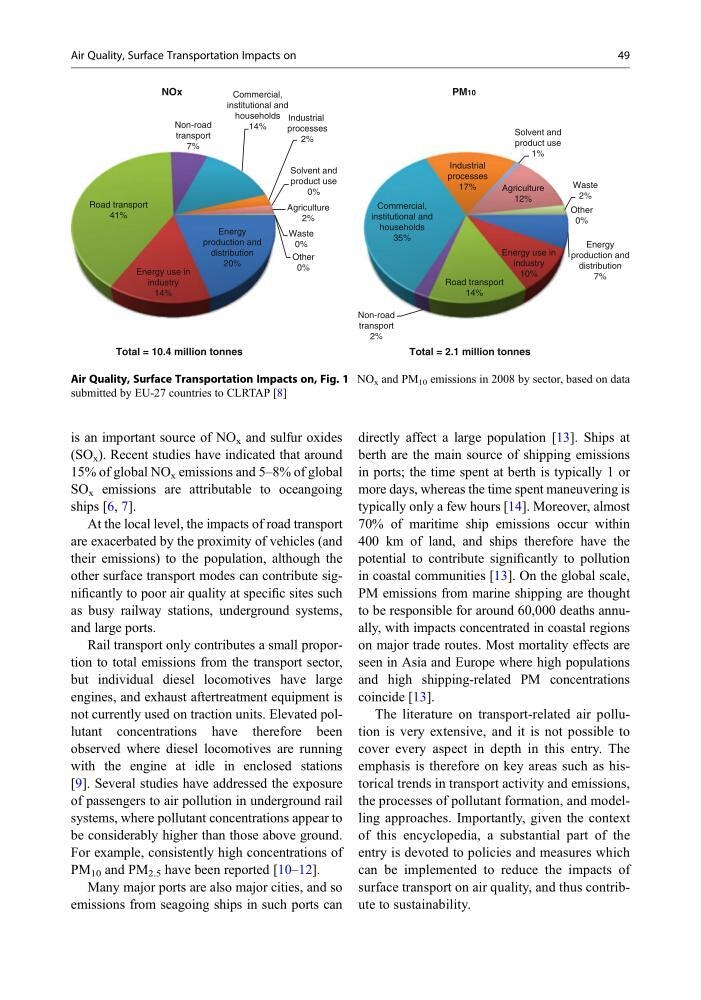
Air Quality, Surface Transportation Impacts on, Fig. 1 NO x and PM 10 emissions in 2008 by sector, based on data
submitted by EU-27 countries to CLRTAP [8]
Air Quality, Surface Transportation Impacts on
49
(SO x ). Recent studies have indicated that around
15% of global NO x emissions and 5–8% of global
SO x emissions are attributable to oceangoing
ships [6, 7].
At the local level, the impacts of road transport
are exacerbated by the proximity of vehicles (and
their emissions) to the population, although the
other surface transport modes can contribute significantly to poor air quality at specific sites such
as busy railway stations, underground systems,
and large ports.
Rail transport only contributes a small proportion to total emissions from the transport sector,
but individual diesel locomotives have large
engines, and exhaust aftertreatment equipment is
not currently used on traction units. Elevated pollutant concentrations have therefore been
observed where diesel locomotives are running
with the engine at idle in enclosed stations
[9]. Several studies have addressed the exposure
of passengers to air pollution in underground rail
systems, where pollutant concentrations appear to
be considerably higher than those above ground.
For example, consistently high concentrations of
PM 10 and PM 2.5 have been reported [10–12].
Many major ports are also major cities, and so
emissions from seagoing ships in such ports can
directly affect a large population [13]. Ships at
berth are the main source of shipping emissions
in ports; the time spent at berth is typically 1 or
more days, whereas the time spent maneuvering is
typically only a few hours [14]. Moreover, almost
70% of maritime ship emissions occur within
400 km of land, and ships therefore have the
potential to contribute significantly to pollution
in coastal communities [13]. On the global scale,
PM emissions from marine shipping are thought
to be responsible for around 60,000 deaths annually, with impacts concentrated in coastal regions
on major trade routes. Most mortality effects are
seen in Asia and Europe where high populations
and high shipping-related PM concentrations
coincide [13].
The literature on transport-related air pollution is very extensive, and it is not possible to
cover every aspect in depth in this entry. The
emphasis is therefore on key areas such as historical trends in transport activity and emissions,
the processes of pollutant formation, and modelling approaches. Importantly, given the context
of this encyclopedia, a substantial part of the
entry is devoted to policies and measures which
can be implemented to reduce the impacts of
surface transport on air quality, and thus contribute to sustainability.
s
e
n
n
o
t
n
o
i
l
l
i
m
1
.
2
=
l
a
t
o
T
s
e
n
n
o
t
n
o
i
l
l
i
m
4
.
0
1
=
l
a
t
o
T
Energy
production and
distribution
20%
Energy use in
industry
14%
Road transport
41%
Non-road
transport
7%
Commercial,
institutional and
households
14%
Industrial
processes
2%
Solvent and
product use
0%
Agriculture
2%
Waste
0%
Other
0%
NOx
Energy
production and
distribution
7%
Energy use in
industry
10%
Road transport
14%
Non-road
transport
2%
Commercial,
institutional and
households
35%
Industrial
processes
17%
Solvent and
product use
1%
Agriculture
12%
Waste
2%
Other
0%
PM10
Air Quality, Surface Transportation Impacts on, Fig. 1 NO x and PM 10 emissions in 2008 by sector, based on data
submitted by EU-27 countries to CLRTAP [8]
Air Quality, Surface Transportation Impacts on
49